
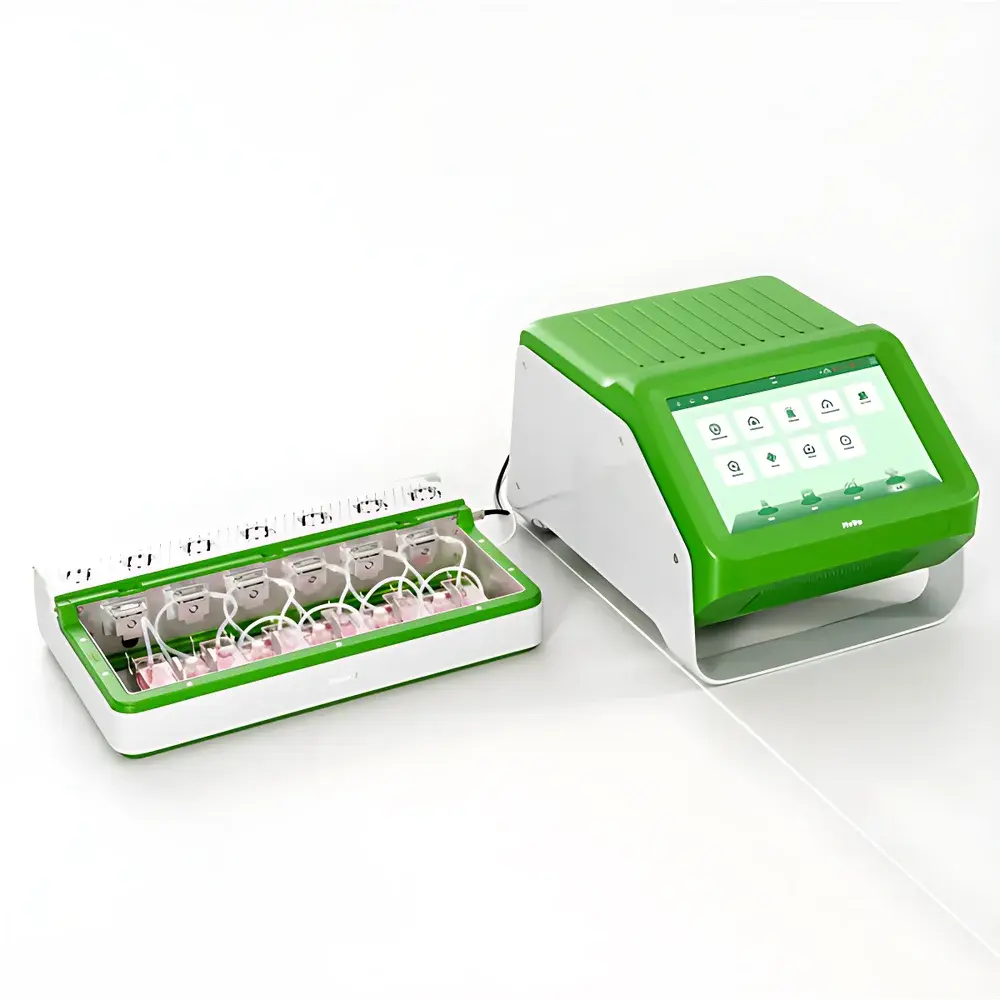
Hvita Hvita 3D Automated Perfusion Culture System for Live Cells
| Brand | Hvita |
|---|---|
| Origin | Shanghai, China |
| Manufacturer Type | Authorized Distributor |
| Product Origin | Domestic (China) |
| Model | Hvita |
| Pricing | Available Upon Request |
Overview
The Hvita Hvita 3D Automated Perfusion Culture System is an integrated, closed-loop bioreactor platform engineered for long-term, physiologically relevant 3D culture of live human cells and organoids. Unlike conventional static or orbital shake-based systems, the Hvita system implements continuous, low-shear laminar perfusion directly within a sealed, temperature- and gas-controlled incubation chamber. This architecture replicates key aspects of in vivo microenvironmental dynamics—including nutrient replenishment, waste removal, and interstitial fluid flow—enabling enhanced cellular viability, polarization, and functional maturation over extended durations (≥14 days). The system operates on a modular principle: the core incubation chamber houses interchangeable U-bottom transwell-type organoid perfusion chips, while embedded peristaltic pumps, precision flow sensors, and real-time pressure monitoring ensure reproducible flow rates (0.1–50 µL/min, user-configurable) and protocol fidelity. Designed for compatibility with standard CO₂ incubators and inverted microscopy workstations, the Hvita platform supports label-free, time-lapse imaging without compromising sterility or perfusion integrity.
Key Features
- Integrated on-chamber perfusion: Eliminates external tubing loops and reduces contamination risk by embedding fluidic pathways directly into the incubation module.
- U-bottom transwell perfusion chips: Engineered with porous membranes (0.4 µm or 3.0 µm pore size options) and optimized geometry to support apical-basolateral polarity, extracellular matrix embedding, and uniform organoid aggregation.
- Automated media exchange & harvesting: Single-step protocol execution for seeding, medium refreshment, and endpoint collection—reducing operator variability and enabling walk-away operation for multi-day assays.
- Real-time perfusion telemetry: Onboard logging of flow rate, cumulative volume, pressure differentials, and system status; data exported in CSV/JSON format with timestamped metadata.
- Microscopy-ready design: Optically clear polycarbonate chamber body and chip substrates compatible with phase contrast, fluorescence, and confocal imaging up to 63× objective magnification.
- Modular scalability: Supports parallel operation of up to four independent perfusion units under unified software control, facilitating dose-response or multi-line comparative studies.
Sample Compatibility & Compliance
The Hvita system accommodates primary human cells, iPSC-derived progenitors, and patient-derived tumor organoids across epithelial (colonic, hepatic, pancreatic), neural, and renal lineages. All wetted components comply with USP Class VI biological safety standards and are certified non-cytotoxic per ISO 10993-5. The perfusion chips are supplied sterile, gamma-irradiated, and RNase/DNase-free. The system architecture supports GLP-aligned workflows: audit-trail-enabled software (optional FDA 21 CFR Part 11 compliance package available), electronic batch records, and SOP-driven protocol locking. It meets essential requirements for ISO 13485-certified labs conducting preclinical organoid banking, biomarker discovery, and translational pharmacodynamics research.
Software & Data Management
The Hvita Control Suite (v3.2+) provides intuitive graphical workflow configuration, real-time dashboard visualization, and automated report generation. Users define perfusion schedules (e.g., pulsatile vs. continuous, gradient ramps), set alarm thresholds (e.g., occlusion detection at >15 kPa), and assign sample IDs linked to LIMS-compatible identifiers. All operational data—including timestamps, flow deviations (>±5% tolerance), and manual intervention logs—are stored locally with SHA-256 hash verification. Export modules support integration with ELN platforms (e.g., LabArchives, Benchling) via RESTful API. Raw imaging metadata (DICOM header extensions) can be synchronized with perfusion event markers for correlative analysis.
Applications
- Organoid biobanking: Standardized expansion of cryopreserved organoids with >90% post-thaw recovery and <15% coefficient of variation in size distribution (n=48, measured via automated brightfield segmentation).
- Tumor organoid drug sensitivity testing: Enables ≥6-arm parallel screening per chip under identical perfusion conditions, improving statistical power and reducing inter-assay CV from 28% (plate-based) to ≤11% (Hvita-based).
- Regenerative medicine modeling: Sustains structural integrity and lineage-specific marker expression (e.g., SOX9, LGR5, ALB) in intestinal and liver organoids beyond Day 12—significantly exceeding monolayer or Matrigel-dome limits.
- Host–microbe interaction studies: Integrated gas-permeable membranes allow controlled anaerobic/aerobic co-culture with commensal bacteria while maintaining luminal flow gradients.
- Toxicity phenotyping: Permits chronic exposure (7–21 days) to low-dose xenobiotics with dynamic readouts including TEER, secreted cytokine profiling, and metabolic flux (Seahorse-compatible assay plates).
FAQ
What sterilization method is used for the perfusion chips?
All chips undergo validated gamma irradiation (25–35 kGy) and are supplied in double-barrier packaging compliant with ISO 11137.
Can the system operate inside a standard CO₂ incubator?
Yes—the chamber is designed for placement inside humidified 5% CO₂ incubators (ambient temperature range: 35–37°C); internal heaters maintain precise setpoints independently.
Is third-party software integration supported?
Yes—API documentation and Python SDK are provided for custom automation, including integration with high-content screening pipelines and robotic liquid handlers.
How is cross-contamination prevented between runs?
Each chip is single-use; the fluidic path contains no shared valves or manifolds—peristaltic pump tubing is replaced per experiment, and chamber surfaces are autoclavable.
What regulatory documentation is available for clinical-grade applications?
CE-IVDR self-declaration is in progress; full technical file, risk management report (ISO 14971), and validation protocols (IQ/OQ/PQ) are available under NDA.





