
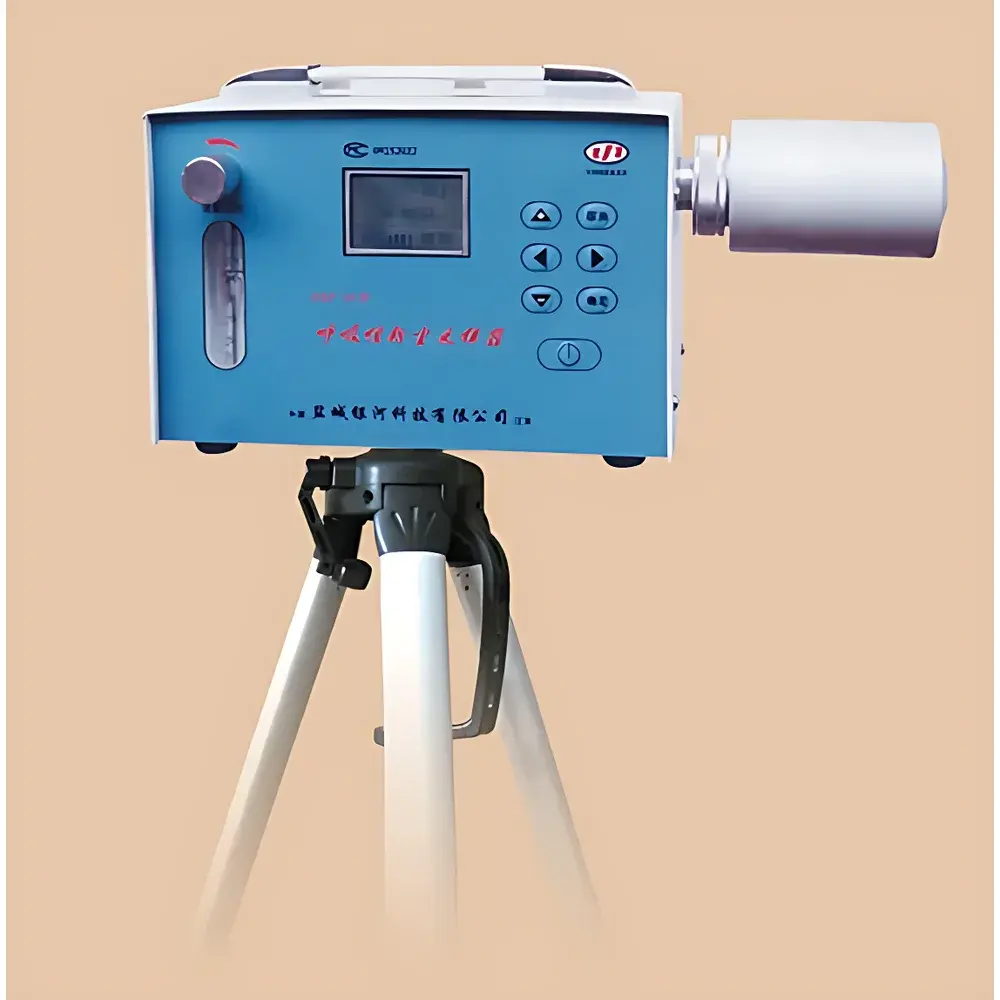
HXF-35 Respirable Dust Sampler
| Origin | Jiangsu, China |
|---|---|
| Manufacturer Type | Authorized Distributor |
| Model | HXF-35 |
| Pricing | Available Upon Request |
| Operating Voltage | DC 10 V (8× Ni-Cd/Ni-MH rechargeable batteries) / AC 220 V ±10 %, 50 Hz |
| Flow Range | 5–25 L/min |
| Maximum Vacuum Pressure | >3000 Pa |
| Flow Accuracy | ±2.5 % FS |
| Flow Stability | ≤5 % |
| Timer Accuracy | ≤±0.1 % |
| Operating Noise | <80 dB(A) |
| Ambient Temperature Range | −5 to 40 °C |
| Relative Humidity | ≤95 % RH |
| Charging Current | 500 mA |
| Continuous Operation Time | >180 min |
| Dimensions (L×W×H) | 205 × 135 × 115 mm |
| Weight | 2.5 kg |
| Sampling Targets | Respirable dust and total suspended particulates (TSP) |
| Impactor Cut-off Diameter | 2.2 µm (50 % collection efficiency per BMRC/BMPC curve at 20 L/min) |
Overview
The HXF-35 Respirable Dust Sampler is a portable, battery-operated personal sampling instrument engineered for quantitative collection of airborne particulate matter in occupational and environmental settings. It operates on the principle of size-selective inertial separation using a cyclonic or impactor-based respirable dust sampling head—configured to meet the British Medical Research Council (BMRC) or British Occupational Hygiene Society (BOHS) “BMPC” particle size-selective curve when operated at a calibrated flow rate of 20 L/min. At this flow rate, the sampling head achieves a 50 % aerodynamic cut-point at 2.2 µm, with ≥90 % collection efficiency for particles >7.07 µm and ≤10 % efficiency for particles <1.0 µm—ensuring compliance with ISO 7708:1995 (Air quality — Particle size fraction definitions for health-related sampling) and OSHA Method ID-131. The device supports dual-mode sampling: total dust (TSP) via standard 37-mm or 25-mm filter cassettes, and respirable dust via a certified impactor head with 25-mm glass impaction substrate pre-coated with silicone oil.
Key Features
- Programmable digital timer with user-defined sampling duration (00:01 to 99:59 h:min), mid-sampling pause/resume function, and automatic end-of-sampling audible/visual alert
- Real-time LCD display showing elapsed time, remaining battery voltage, state-of-charge indicator, and charging progress during AC recharging
- Dual-power operation: seamless transition between internal 8-cell Ni-Cd/Ni-MH battery pack (10 V DC, >180 min runtime at 20 L/min) and AC mains input (220 V ±10 %, 50 Hz)
- High-stability diaphragm pump delivering consistent flow across the full 5–25 L/min range, with built-in flow calibration verification capability
- Compact ergonomic design (205 × 135 × 115 mm; 2.5 kg) optimized for belt-mounted personal sampling and field-deployable area monitoring
- Low-noise operation (<80 dB(A)) suitable for use in confined industrial workspaces without acoustic interference
Sample Compatibility & Compliance
The HXF-35 is compatible with standard 25-mm and 37-mm PVC, mixed cellulose ester (MCE), or polyvinyl chloride (PVC) membrane filters for gravimetric analysis per ISO 8518:2021 and NIOSH Method 0600. When equipped with the optional BMPC-compliant impactor head (with 25-mm colorless glass impaction plate), it satisfies the performance criteria outlined in EN 481:1993 (Occupational health — Size fraction definitions for airborne particles) and aligns with ACGIH TLV® technical documentation for respirable dust sampling protocols. All flow calibration data are traceable to national metrology standards, and the instrument’s ±2.5 % FS flow accuracy and ≤5 % stability over time support adherence to GLP requirements for workplace exposure monitoring records.
Software & Data Management
While the HXF-35 operates as a standalone hardware platform without embedded wireless connectivity or proprietary software, its timer module logs start/stop timestamps and cumulative run time—enabling manual correlation with laboratory gravimetric results. Users may integrate collected field data into validated LIMS or EHS platforms via standardized CSV export from external calibration logs. For audit readiness, the device supports full traceability under ISO/IEC 17025:2017 (calibration certificate retention) and meets documentation requirements for OSHA 29 CFR 1910.1200 (Hazard Communication Standard) exposure assessment reporting. Optional external flow calibrators (e.g., primary piston meters per ISO 6145-1) are recommended for quarterly verification per AIHA RP-1 guidelines.
Applications
- Workplace exposure assessment in mining, construction, foundry operations, cement manufacturing, and woodworking facilities
- Respirable crystalline silica (RCS) monitoring per OSHA Silica Standard (29 CFR 1926.1153) and EU Directive 2017/2398
- Field validation of local exhaust ventilation (LEV) system performance through comparative area vs. personal sampling
- Academic research and student training in industrial hygiene, environmental science, and occupational safety curricula
- Baseline ambient dust characterization in community air quality studies near industrial perimeters
FAQ
What is the required flow rate for respirable dust sampling with the HXF-35?
The instrument must be operated at precisely 20 L/min when using the BMPC-compliant impactor head to ensure correct particle size cut-point alignment.
Can the HXF-35 be used for total dust sampling only?
Yes—by replacing the impactor head with a standard 37-mm closed-face cassette holder, the unit functions as a high-flow total dust sampler compliant with ISO 7708 and NIOSH 0500.
Is the battery pack user-replaceable and serviceable?
The 8-cell Ni-Cd/Ni-MH battery assembly is field-serviceable with standard soldering tools; replacement packs are available through authorized distributors with CE-marked safety certification.
Does the HXF-35 include NIST-traceable calibration documentation?
Each unit ships with a factory calibration report referencing national flow standards; users are responsible for periodic recalibration per ISO/IEC 17025-accredited laboratories every 6–12 months.
How is compliance with BMPC curve verification confirmed?
Verification requires independent testing using monodisperse aerosol challenge (e.g., PSL spheres) at 20 L/min, conducted per ASTM D6620-20 and reported in the instrument’s technical validation dossier.
Related Products







