
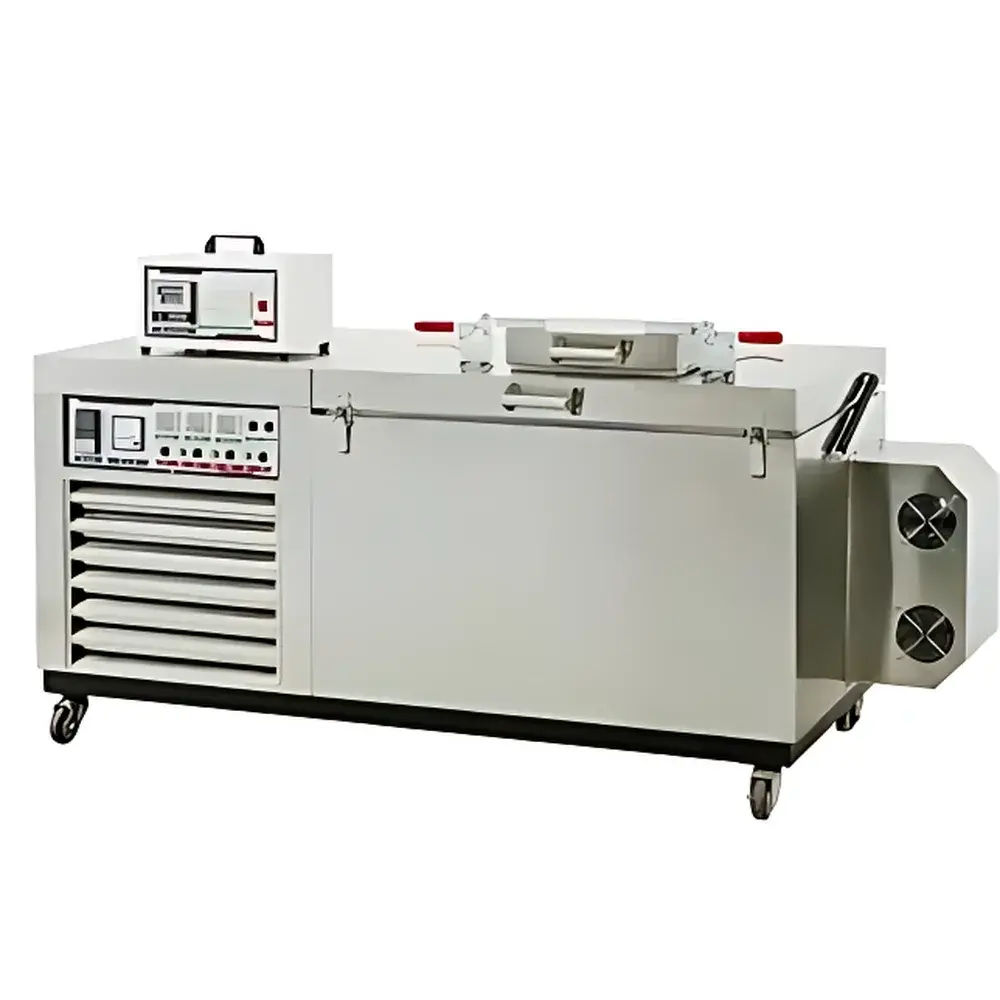
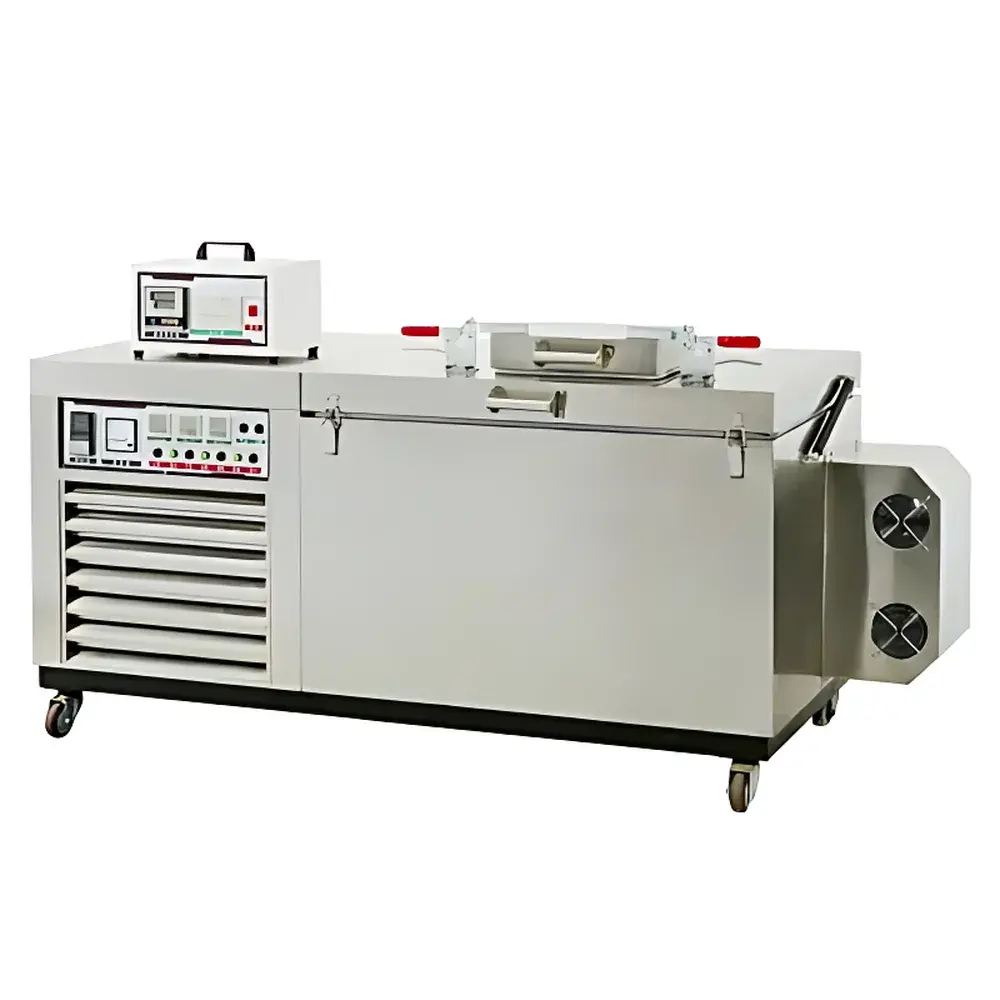
HY-769Q Shoe Thermal Insulation Tester
| Origin | Tianjin, China |
|---|---|
| Manufacturer Type | Authorized Distributor |
| Origin Classification | Domestic (China) |
| Model | HY-769Q |
| Pricing | Upon Request |
| Temperature Range | Ambient to –30 °C (optional –50 °C) |
| Chamber Configuration | Horizontal insulated cold chamber with integrated refrigeration system |
| Chamber Material | Interior and exterior SUS 304 brushed stainless steel |
| Test Fixture | Standard-compliant shoe thermal insulation fixture per GB/T 21284–2007 |
| Included Accessories | Cold chamber unit, shoe-specific thermal insulation fixture, digital temperature data logger with calibrated Pt100 sensors, NIST-traceable calibration certificate (ISO/IEC 17025 accredited lab) |
Overview
The HY-769Q Shoe Thermal Insulation Tester is an engineered laboratory instrument designed to quantify the thermal resistance (Rct) of finished footwear under controlled low-temperature conditions. It operates on the principle of steady-state heat transfer measurement, where a standardized heated foot form—simulating human foot thermoregulation—is inserted into the test shoe and placed inside a precisely regulated cold chamber. The system measures the temperature gradient across the shoe structure and the power required to maintain a constant surface temperature on the foot form, enabling calculation of thermal insulation according to the guarded-hot-plate analog methodology defined in ISO 20877:2001 and GB/T 21284–2007. This approach provides objective, repeatable, and internationally comparable data for evaluating cold-weather performance of winter boots, safety footwear, mountaineering shoes, and occupational cold-protective gear.
Key Features
- Horizontally oriented, double-walled cold chamber with vacuum-insulated sidewalls and high-efficiency vapor-compression refrigeration, ensuring stable temperature control from ambient down to –30 °C (–50 °C optional upon specification)
- Brushed 304 stainless steel interior and exterior surfaces—corrosion-resistant, non-porous, and compliant with ISO 17025 environmental requirements for metrological traceability
- Dedicated shoe thermal insulation fixture conforming dimensionally and thermally to Clause 6 of GB/T 21284–2007, including anatomically shaped aluminum foot form with embedded Pt100 Class A sensors and uniform heating distribution
- Integrated digital temperature data logger with ≥4-channel input, 0.1 °C resolution, ±0.2 °C accuracy (at 23 °C), and real-time logging at user-defined intervals (1–60 s)
- Pre-installed firmware supporting automatic Rct calculation per ISO 20877 Annex B, with configurable test duration (minimum 60 min), stabilization criteria, and pass/fail thresholds
Sample Compatibility & Compliance
The HY-769Q accommodates adult and youth-sized footwear (EU 34–48, US 4–13) without modification. Its fixture design allows secure mounting of lace-up, zippered, or elastic-sided shoes while maintaining consistent contact pressure and thermal boundary conditions. The system meets essential regulatory and standardization requirements for textile and PPE testing laboratories, including full alignment with GB/T 21284–2007 (Determination of thermal insulation of footwear), ISO 20877:2001 (Footwear — Test method for thermal insulation), and GB/T 20991–2007 (Protective footwear — Requirements and test methods). All delivered units include an ISO/IEC 17025-accredited calibration certificate issued by a CNAS-recognized metrology laboratory, covering temperature uniformity mapping of the chamber and sensor linearity verification across the operational range.
Software & Data Management
The HY-769Q operates via embedded firmware with USB export capability for raw time-series temperature and power data (CSV format). While no proprietary PC software is bundled, the exported datasets are fully compatible with common analytical platforms—including MATLAB, Python (NumPy/Pandas), and Microsoft Excel—for post-test computation of Rct, thermal conductivity (λ), and comparative statistical analysis (e.g., ANOVA across material batches). Audit trails are maintained internally for each test run, recording operator ID (via manual entry), start/end timestamps, chamber setpoint, mean measured temperatures, and final calculated Rct value. For laboratories operating under GLP or ISO 17025 quality systems, the instrument supports integration into LIMS environments via RS-232 or Modbus RTU protocols (hardware interface module optional).
Applications
- Quality assurance of insulated work boots for oil & gas, arctic logistics, and cold-storage facilities
- R&D validation of novel insulating materials (e.g., aerogel composites, phase-change linings, hollow-fiber synthetics) in footwear prototypes
- Third-party certification testing for CE-marked protective footwear (EN ISO 20345:2022 Annex A.6 references thermal insulation assessment)
- Comparative benchmarking against industry reference standards (e.g., ASTM F2250–19a is not directly applicable but used contextually for thermal barrier evaluation)
- Supporting technical documentation for FDA-regulated medical footwear used in cryogenic clinical environments
FAQ
What standards does the HY-769Q directly support?
It is configured and validated for GB/T 21284–2007, ISO 20877:2001, and GB/T 20991–2007. Additional protocol adaptation for ASTM or EN standards may be performed via custom fixture validation.
Is the temperature chamber pre-calibrated before shipment?
Yes—each unit ships with a full ISO/IEC 17025-accredited calibration report, including chamber uniformity mapping at –10 °C, –20 °C, and –30 °C, as well as sensor verification at three points across the range.
Can the system test children’s footwear?
Yes—the fixture accommodates EU sizes 34–48; smaller foot forms (for sizes <34) are available as optional accessories subject to prior validation against GB/T 21284 Annex C.
Does the instrument comply with FDA 21 CFR Part 11 requirements?
The base configuration does not include electronic signature or audit trail encryption; however, it can be integrated into a Part 11–compliant environment when deployed with validated LIMS middleware and documented procedural controls.
What maintenance is required for long-term accuracy?
Annual recalibration of temperature sensors and chamber uniformity verification is recommended; refrigerant charge integrity checks should be performed biannually by certified HVAC-R technicians.



