
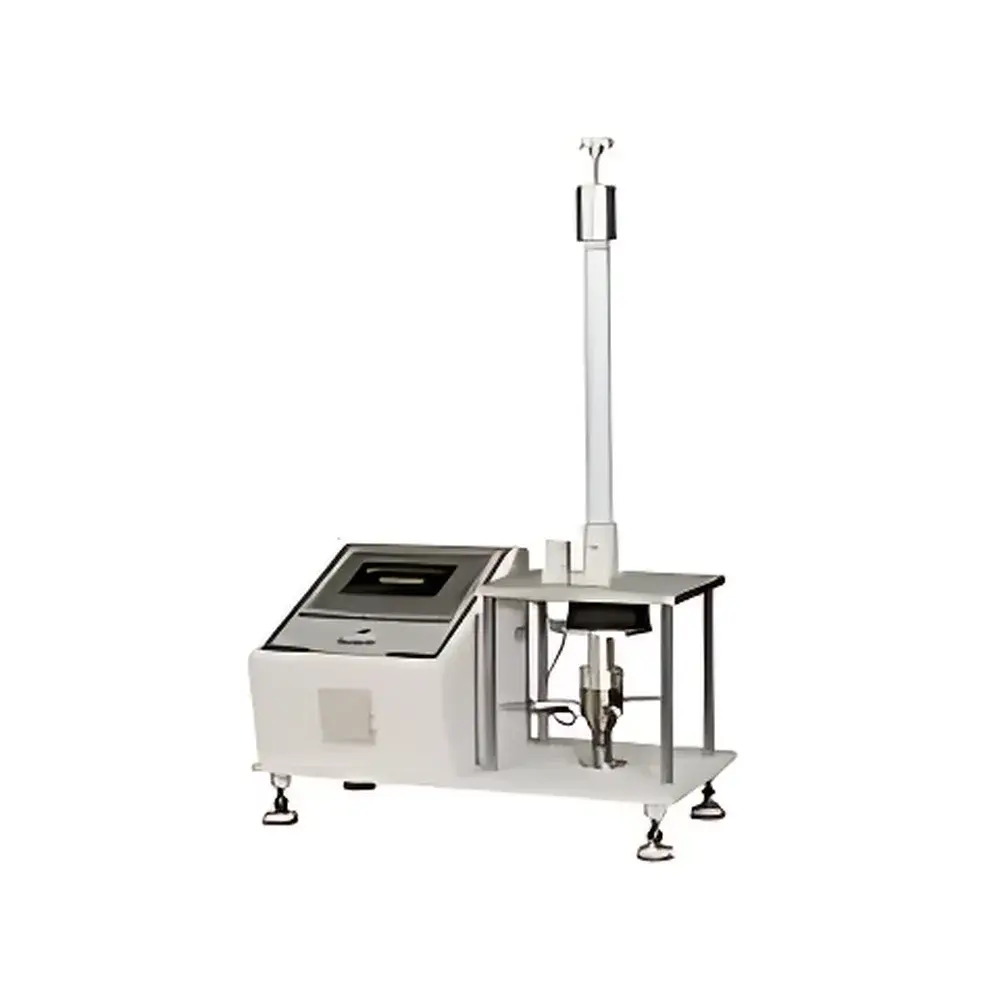
HY-7721C Sponge & Foam Ball Rebound Resilience Tester
| Origin | Tianjin, China |
|---|---|
| Manufacturer Type | Authorized Distributor |
| Origin Category | Domestic (PRC) |
| Model | HY-7721C |
| Price | USD 1,760 (FOB Tianjin) |
| Standard Compliance | GB/T 6670–2008, ASTM D3574, ISO 8307 |
| Drop Height (Method A) | 500 ± 0.5 mm |
| Drop Height (Method B) | 460 ± 0.5 mm |
| Ball Mass (Method A) | 16.8 ± 1.5 g |
| Ball Mass (Method B) | 16.3 g |
| Ball Diameter | 16.0 ± 0.5 mm |
| Sample Dimensions | 100 × 100 × 50 mm (L × W × H) |
| Rebound Accuracy | < ±1.5% |
| Measurement Output | Average rebound height, average rebound percentage, statistical summary per test set |
| Control System | Industrial PLC + 7-inch TFT touch HMI (Chinese UI) |
| Data Output | Integrated thermal micro-printer (desktop type) |
| Sensor | High-speed optical distance sensor (non-contact, 1 kHz sampling) |
Overview
The HY-7721C Sponge & Foam Ball Rebound Resilience Tester is a precision-engineered instrument designed for the quantitative evaluation of elastic recovery behavior in flexible polyurethane (PU) foams and other resilient cellular materials. It operates on the principle of gravitational free-fall impact followed by non-contact optical measurement of rebound height — a standardized mechanical energy restitution method widely adopted in foam quality assurance and formulation development. The device implements Method A and Method B as defined in GB/T 6670–2008, ASTM D3574 (Test Method C), and ISO 8307, ensuring traceable, inter-laboratory comparable results. Its core function is to determine rebound resilience (%) — calculated as (maximum rebound height / nominal drop height) × 100 — under strictly controlled impact conditions. This metric directly correlates with internal cell structure integrity, polymer network elasticity, and viscoelastic damping characteristics. The system’s rigid frame, calibrated release mechanism, and high-resolution optical sensing architecture collectively minimize mechanical hysteresis and positional uncertainty, enabling repeatable measurements within ±1.5% accuracy across consecutive trials.
Key Features
- Dual-standard compliance: Fully aligned with GB/T 6670–2008 (China), ASTM D3574–22 Section C (U.S.), and ISO 8307:2018 (International), supporting global regulatory submissions and supplier qualification protocols.
- Precision drop control: Electromechanical release mechanism with < ±0.5 mm vertical positioning tolerance; adjustable height column with vernier scale and locking clamp ensures stable setup for both Method A (500 mm) and Method B (460 mm).
- Non-contact optical sensing: High-speed photogate array (1 kHz sampling rate) captures first-peak rebound displacement without surface contact or inertia-induced perturbation — eliminating measurement bias from sensor mass loading.
- Integrated industrial control: PLC-based logic controller synchronizes release timing, sensor acquisition, and data logging; 7-inch resistive touchscreen HMI provides real-time status feedback, parameter configuration, and Chinese-language operation interface.
- Onboard statistical processing: Automatic computation of mean rebound height, mean rebound percentage, standard deviation, and coefficient of variation across up to 10 sequential impacts per sample — compliant with GLP documentation requirements.
- Traceable output: Built-in thermal micro-printer generates time-stamped reports including test ID, operator name, sample ID, environmental temperature/humidity (optional external probe input), raw height values, and final resilience % — suitable for audit-ready QA records.
Sample Compatibility & Compliance
The HY-7721C is validated for use with flexible open-cell polyurethane foams, viscoelastic memory foams, latex foams, and cross-linked elastomeric sponge materials meeting dimensional specifications of 100 mm × 100 mm × 50 mm (L × W × H). Specimens must be conditioned at 23 ± 2 °C and 50 ± 5% RH for ≥16 hours prior to testing per ISO 293 and ASTM D618. The instrument supports both Method A (16.8 g steel ball, 500 mm drop) and Method B (16.3 g ball, 460 mm drop), allowing comparative analysis across material grades and production batches. All mechanical components conform to ISO 9001:2015 manufacturing controls; calibration certificates for ball mass, drop height, and sensor linearity are provided with each unit. The system satisfies functional requirements for ISO/IEC 17025 accredited laboratories performing resilience testing under clause 5.4.2 (Equipment Verification) and supports 21 CFR Part 11-compliant data archiving when paired with validated LIMS integration.
Software & Data Management
While the HY-7721C operates via embedded firmware without PC-dependent software, its control architecture supports RS-232 serial export of ASCII-formatted test logs (CSV-compatible) for downstream analysis in Excel, MATLAB, or laboratory information management systems (LIMS). Each printed report includes unique test timestamp, operator ID field, sample identification code, ambient condition annotations (if external hygrothermograph is connected), individual rebound heights, arithmetic mean, and %RSD. Firmware versioning and calibration history are stored internally and accessible via service menu. For GMP environments, optional USB data export module enables encrypted binary log transfer to secure network drives, fulfilling FDA-required audit trails for electronic records per 21 CFR Part 11 Subpart B.
Applications
- Quality control of automotive seating foams during incoming inspection and in-process validation.
- R&D screening of PU foam formulations — evaluating catalyst systems, polyol/isocyanate ratios, and blowing agent effects on resilience.
- Comparative benchmarking of bio-based foams versus petrochemical analogues under identical test conditions.
- Supplier qualification testing per OEM technical specifications (e.g., Ford WSS-M99P1260-A2, GMW15634).
- Failure analysis of low-resilience batches linked to cure inhibition, moisture contamination, or cell collapse.
- Supporting ISO 9001 internal audits through documented measurement system analysis (MSA) including repeatability (EV) and reproducibility (AV) studies.
FAQ
What standards does the HY-7721C comply with?
It fully implements GB/T 6670–2008, ASTM D3574–22 (Method C), and ISO 8307:2018 for foam resilience testing.
Can the instrument store test data internally?
No — it lacks onboard memory but outputs real-time data to the integrated thermal printer and supports ASCII serial export for external storage.
Is calibration certification included?
Yes — NIST-traceable calibration certificates for steel ball mass, drop height gauge, and optical sensor linearity are shipped with each unit.
What environmental conditions are required during testing?
Per ISO 293 and ASTM D618, specimens must be conditioned at 23 ± 2 °C and 50 ± 5% RH for minimum 16 hours; testing should occur within same environment.
Does the system support automated pass/fail judgment against specification limits?
Not natively — pass/fail thresholds must be applied externally during data review; however, mean ± SD output facilitates SPC charting in third-party software.



