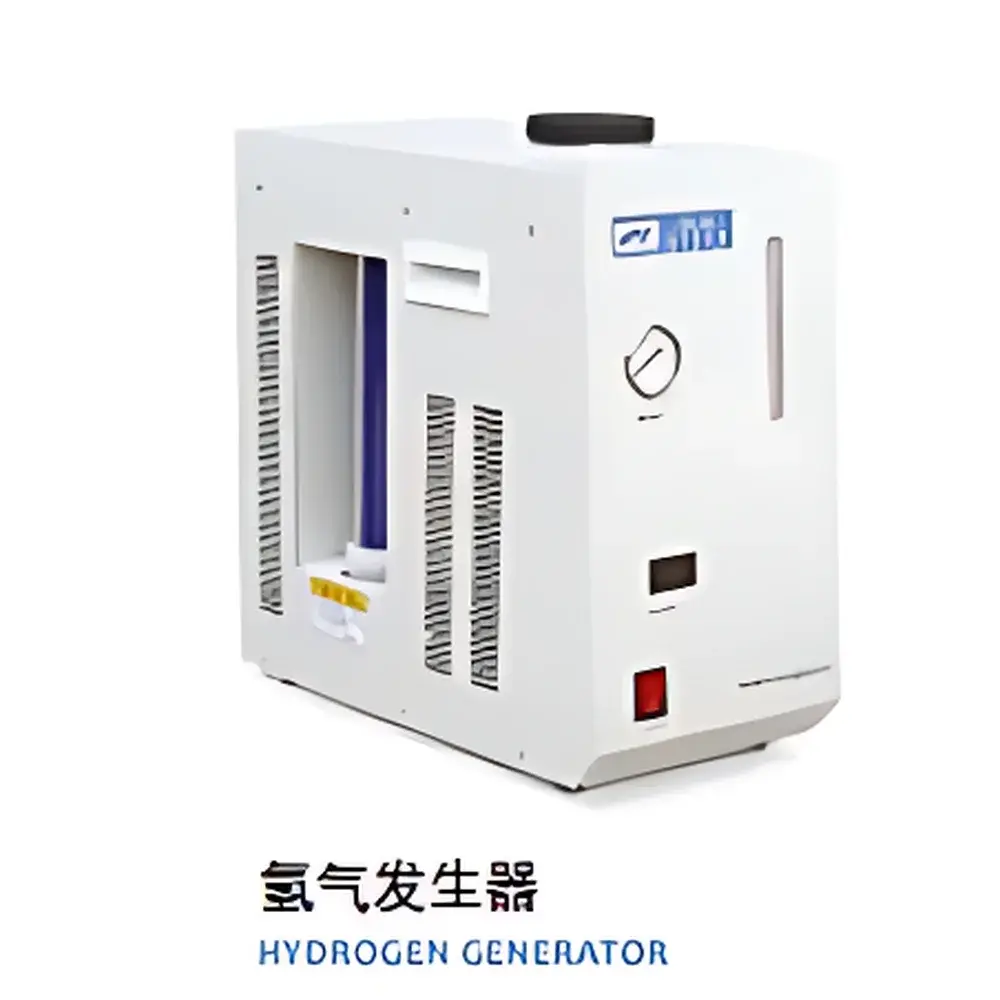
Hydrogen Generator by Zhongkehuifen
| Brand | Zhongkehuifen |
|---|---|
| Origin | Beijing, China |
| Manufacturer Type | Authorized Distributor |
| Country of Origin | China |
| Model | H2-300 |
| Output Purity | 99.99% (v/v, O₂-equivalent) |
| Flow Rate | 0–300 mL/min |
| Input Voltage | AC 220 V, 50 Hz |
| Operating Temperature | 10–40 °C |
| Relative Humidity | <85% RH |
| Max Power Consumption | 210 W |
Overview
The Zhongkehuifen H2-300 Hydrogen Generator is a membrane-based alkaline electrolysis system engineered for reliable, on-demand hydrogen supply in laboratory gas chromatography (GC), fuel cell testing, and catalytic research applications. It employs a proprietary solid polymer electrolyte (SPE)-enhanced alkaline electrolytic cell architecture, operating at low thermal load (<45 °C) to ensure extended service life and stable gas output. Unlike cylinder-based alternatives, the H2-300 eliminates high-pressure storage risks and logistical constraints—delivering ultra-pure hydrogen directly from deionized or distilled water feedstock via electrochemical decomposition (2H₂O → 2H₂ + O₂). The integrated oxygen venting pathway ensures continuous separation of gaseous byproducts, maintaining consistent purity without external scrubbing or purification stages.
Key Features
- Stable Pressure & Flow Control: Equipped with a precision pressure-regulated output stage and digital mass-flow feedback loop, enabling consistent delivery across the full 0–300 mL/min range with ≤±2% flow deviation under varying backpressure conditions.
- Intelligent Water Management: Auto-sensing reservoir level detection triggers visual alert prior to refill; compatible exclusively with ASTM D1193 Type II or higher purity water to prevent electrode fouling and maintain long-term electrolyte integrity.
- No-Backflow Protection: Patented non-return liquid trap design prevents condensate migration into downstream instrumentation—critical for safeguarding sensitive GC detectors (e.g., FID, TCD) and avoiding column contamination.
- Low-Temperature Electrolysis: Optimized cell geometry and thermal dissipation pathways maintain electrolyzer temperature below 42 °C during continuous operation, significantly reducing degradation of nickel-based electrodes and diaphragm materials.
- Integrated Safety Architecture: Dual-stage overpressure cutoff, real-time current monitoring, and automatic shutdown upon abnormal voltage fluctuation or dry-run condition comply with IEC 61010-1 safety requirements for laboratory power equipment.
Sample Compatibility & Compliance
The H2-300 is validated for use with all major GC platforms requiring carrier or fuel gas (Agilent, Thermo Fisher, Shimadzu, PerkinElmer), including FID, NPD, and PFPD detectors. Its 99.99% hydrogen purity meets ASTM D7217–22 specifications for GC-grade hydrogen and satisfies USP and EP 2.5.27 requirements for residual oxygen limits (<10 ppm v/v). The unit’s electrical design conforms to CE marking directives (2014/30/EU EMC and 2014/35/EU LVD), while its operational documentation supports GLP-compliant audit trails when paired with optional RS-232 data logging.
Software & Data Management
While the H2-300 operates as a standalone instrument, it includes an RS-232 serial interface for integration into centralized lab infrastructure. Optional firmware upgrade enables time-stamped event logging (startup/shutdown, pressure anomalies, water level warnings) compatible with LabArchives ELN and Agilent OpenLab CDS. All operational parameters—including cumulative runtime, total gas volume delivered, and last maintenance timestamp—are accessible via front-panel LED display or remote query command set. Audit-ready records support FDA 21 CFR Part 11 compliance when deployed with validated third-party electronic signature modules.
Applications
- Carrier gas source for capillary GC and GC-MS systems requiring high-purity, low-moisture hydrogen
- Fuel gas supply for flame ionization detectors (FID) with enhanced signal-to-noise ratio versus helium alternatives
- Controlled-reducing atmosphere generation in catalysis screening reactors and material synthesis gloveboxes
- Calibration gas standard preparation in environmental air monitoring labs (e.g., VOC analysis per EPA Method TO-15)
- On-site hydrogen feed for PEM fuel cell characterization under variable load profiles
FAQ
What water quality is required for optimal performance?
Deionized or distilled water meeting ASTM D1193 Type II specifications (resistivity ≥1 MΩ·cm, TOC <50 ppb) is mandatory. Tap or softened water will cause rapid scaling and irreversible cell damage.
Can the generator be operated intermittently without affecting longevity?
Yes—the system features auto-idle mode that reduces electrolysis current during standby, minimizing electrode wear and extending service intervals beyond 5,000 hours under typical lab usage patterns.
Is external drying or filtration necessary before connecting to GC instruments?
No. The built-in palladium-doped membrane dryer and particulate filter deliver dew point ≤−60 °C and particle retention ≥0.1 µm, satisfying ISO 8573-1 Class 2:2:2 requirements for compressed gases.
How often does the electrolyte require replacement?
The KOH-free alkaline electrolyte is sealed and maintenance-free for the rated service life; no periodic replenishment or concentration adjustment is needed.
Does the unit meet regulatory requirements for unattended overnight operation?
Yes—certified to IEC 60335-1 and equipped with redundant thermal fusing, making it suitable for continuous 24/7 deployment in ISO/IEC 17025-accredited laboratories.