
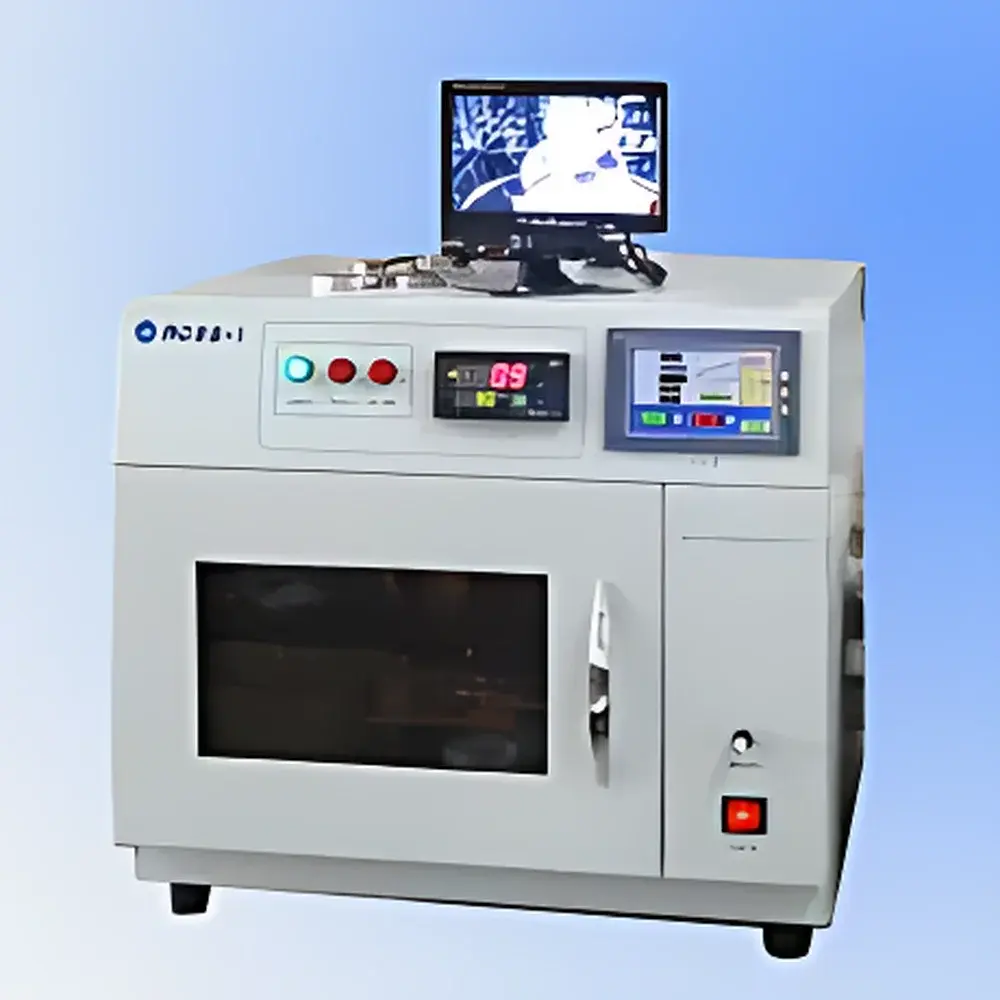
Hyoyan MC8S-1 Microwave-Ultrasound Hybrid Synthesis Reactor
| Brand | Hyoyan |
|---|---|
| Origin | Jiangsu, China |
| Model | MC8S-1 |
| Microwave Power | 0–1000 W (continuous, linearly adjustable) |
| Microwave Frequency | 2450 MHz ±50 MHz |
| Ultrasonic Power | 50 W |
| Ultrasonic Frequency | 40 kHz |
| Temperature Range | 0–300 °C (±1 °C accuracy) |
| Reaction Volume | 10–500 mL |
| Cavity Material | Stainless steel |
| Safety Compliance | Microwave leakage < national safety limit (GB 10436 / IEC 61000-3-2) |
| Interface | Full-color TFT LCD touchscreen, RS-485 optional (Modbus RTU), video output (composite analog) |
Overview
The Hyoyan MC8S-1 Microwave-Ultrasound Hybrid Synthesis Reactor is an engineered platform for controlled, multi-energy-driven chemical processing in research and analytical laboratories. It integrates two complementary non-thermal activation mechanisms—microwave dielectric heating and low-frequency ultrasonic cavitation—within a single, shielded stainless-steel cavity. Microwave energy (2450 MHz) induces rapid, volumetric molecular rotation and dipole alignment, enabling efficient bulk heating with minimal thermal gradients. Simultaneously, the bottom-mounted 40 kHz ultrasonic transducer generates acoustic cavitation, producing localized hotspots (>5000 K), high shear forces, and microstreaming that enhance mass transfer, disrupt interfacial boundaries, and accelerate reaction kinetics. This synergistic coupling supports heterogeneous catalysis, solvent-free extraction, oxidative degradation, nanoparticle synthesis, and solid–liquid phase reactions where conventional heating or sonication alone yields suboptimal reproducibility or incomplete conversion.
Key Features
- Independent or simultaneous operation of microwave and ultrasound modules—enabling method development across single-energy and hybrid regimes
- Continuous, linear microwave power control (0–1000 W) via fuzzy logic algorithm, ensuring dynamic stabilization of cavity field density during temperature-sensitive reactions
- Integrated 40 kHz ultrasonic system (50 W nominal output) mounted at the cavity base—optimized for mechanical stability, low operational noise (<65 dB(A)), and high acoustic coupling efficiency into reaction vessels
- Industrial-grade embedded microcomputer with full-color capacitive touchscreen interface (7-inch TFT LCD), supporting multilingual UI localization (English firmware available upon request)
- Real-time contact-based temperature monitoring using calibrated Pt100 sensor (0–300 °C, ±1 °C accuracy), with closed-loop feedback to modulate microwave output
- Top-access opening equipped with waveguide choke structure—fully compliant with IEC 61000-4-3 immunity requirements and permitting safe installation of reflux condensers, gas inlets, water-cooled jackets, or overhead mechanical stirrers
- Dual-safety architecture: interlocked door switch, magnetron overtemperature cutoff, and pressure-responsive cavity venting (when used with optional digestion vessels)
Sample Compatibility & Compliance
The MC8S-1 accommodates standard borosilicate glassware (e.g., round-bottom flasks, reflux assemblies, sealed digestion tubes) within its 10–500 mL working volume range. Its open-top design supports ASTM E2967-compliant reflux, Soxhlet-style continuous extraction, and USP photostability-compatible configurations when integrated with optional UV modules (MC8S-3 variant). The reactor meets electromagnetic compatibility (EMC) requirements per GB/T 18268.1–2010 (equivalent to IEC 61326-1) and radiation safety limits per GB 10436–2008 (aligned with ICNIRP 1998 guidelines). All electrical interfaces—including optional RS-485 Modbus RTU port—are isolated and rated for industrial laboratory environments (IP20 enclosure rating).
Software & Data Management
The onboard control firmware enables storage of up to 100 user-defined protocols, each comprising multi-stage time–power–temperature profiles, alarm thresholds, and real-time data logging (sampled at 1 Hz). Reaction progress can be monitored visually via the integrated TFT display or externally captured using the composite video output (NTSC/PAL). Optional PC-based acquisition software (sold separately) provides CSV export, GLP-compliant audit trails, electronic signature support, and 21 CFR Part 11-ready configuration—suitable for regulated QC/QA workflows in pharmaceutical, food, and environmental testing labs. Data integrity is preserved through non-volatile memory retention and timestamped event logging (start/stop, fault triggers, parameter overrides).
Applications
- Accelerated solvent extraction (ASE) of plant metabolites, lipids, and polyphenols under reduced thermal load
- Catalytic oxidation of organic pollutants (e.g., phenol, methylene blue) in aqueous matrices
- Green synthesis of metal oxide nanoparticles (e.g., ZnO, TiO₂) with controlled crystallinity and size distribution
- Acid- or alkali-mediated digestion of biological tissues and environmental solids prior to ICP-MS analysis
- Multi-step organic transformations requiring sequential heating, stirring, and reflux—such as Fischer esterification or Claisen condensation
- Method development for ISO 13877 (microwave-assisted extraction of organochlorine pesticides from soil)
FAQ
Is the MC8S-1 compatible with standard laboratory glassware?
Yes—the top-opening cavity accepts common 24/40 and 29/32 ground-glass joints; optional adapters are available for custom vessel integration.
Can temperature be measured inside sealed vessels?
Only with optional fiber-optic probes or IR-transparent windows; the standard Pt100 sensor measures external vessel wall temperature.
Does the instrument support remote monitoring via Ethernet or Wi-Fi?
No native Ethernet/Wi-Fi interface is included; however, RS-485-to-Ethernet gateways may be deployed externally for SCADA-level integration.
What safety certifications does the MC8S-1 hold?
It complies with Chinese national standards GB 10436 (microwave leakage), GB/T 18268.1 (EMC), and GB 4793.1 (electrical safety); CE marking requires end-user conformity assessment per EU Directive 2014/30/EU.
Is validation documentation (IQ/OQ/PQ) provided?
Factory-issued calibration certificates and traceable sensor verification reports are supplied; full qualification packages require site-specific execution by qualified personnel.



