
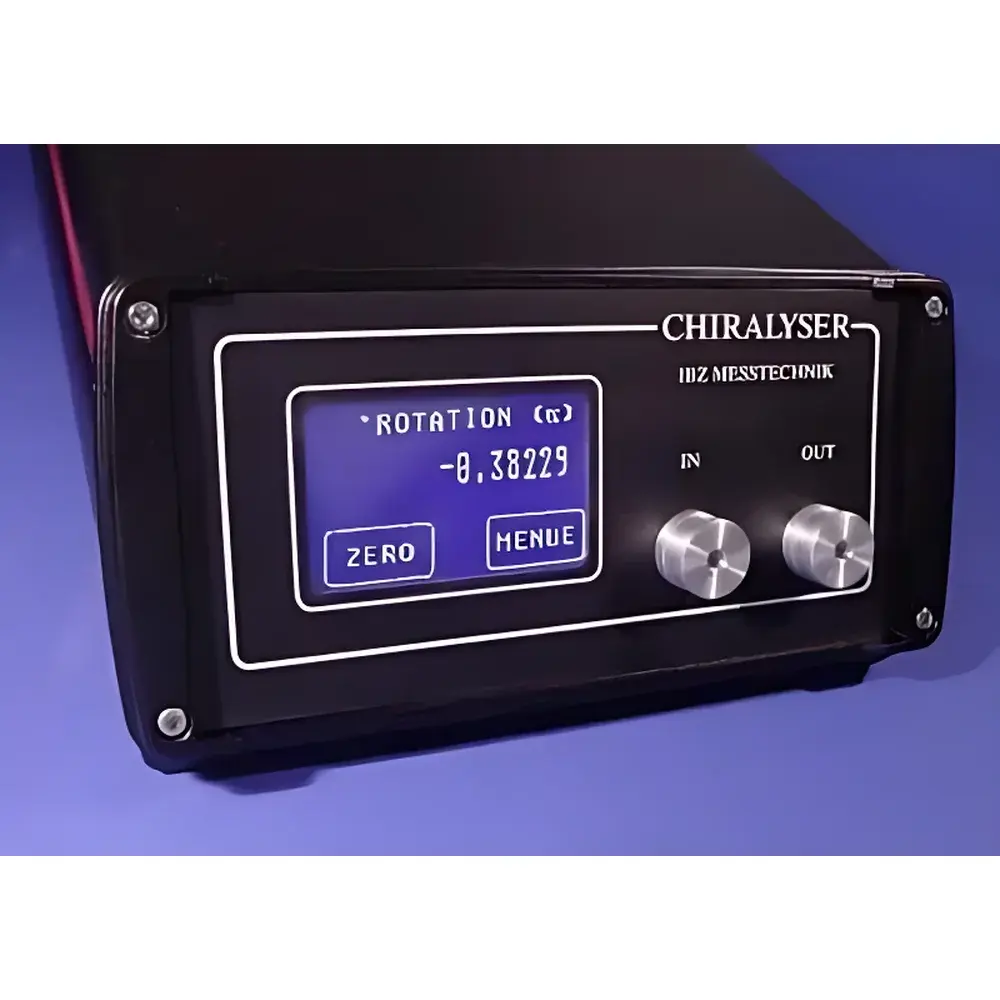
IBZ CHIRALYSER Faraday-Compensated Polarimetric Detector for HPLC
| Brand | IBZ |
|---|---|
| Origin | Germany |
| Model | CHIRALYSER |
| Wavelength | 428 nm |
| Detection Principle | Faraday Modulation |
| Light Source | High-Stability LED |
| Noise | 20 μdeg |
| Drift | 10 μdeg |
| LOD | 0.5 mg/L [α = 90°, direct injection] |
| Max Flow Rate | 3 mL/min (semi-preparative compatible) |
| Output Signal | Analog (±10 V) |
Overview
The IBZ CHIRALYSER is a high-precision, Faraday-compensated polarimetric detector engineered for real-time, quantitative detection of optically active compounds in liquid chromatography systems. Unlike conventional UV or refractive index detectors, the CHIRALYSER directly measures the specific rotation (α) of chiral analytes—providing absolute stereochemical information without derivatization or chiral stationary phases. Its core measurement principle relies on Faraday modulation: a magneto-optic crystal (typically terbium-doped glass) rotates the plane of polarized light in proportion to the magnetic field applied, while the sample-induced optical rotation is precisely nulled via feedback-controlled compensation. This closed-loop architecture eliminates baseline drift and enables sub-microdegree angular resolution. Designed for integration into both analytical and semi-preparative HPLC workflows, the detector supports flow rates up to 3 mL/min and delivers robust performance under GMP-relevant conditions—making it suitable for method development, enantiomeric excess (ee) determination, and chiral purity assessment in pharmaceutical, agrochemical, and fine chemical R&D.
Key Features
- Fundamental Faraday compensation architecture ensures intrinsic zero-drift operation and high long-term stability (drift ≤ 10 μdeg over 8 h)
- High-brightness, narrow-bandwidth LED light source centered at 428 nm—optimized to balance Cotton effect minimization and signal intensity per the Drude equation
- Multi-path flow cell design enhances optical path length without increasing dead volume, improving sensitivity while maintaining chromatographic integrity
- Analog ±10 V output compatible with standard data acquisition systems; optional digital interface modules available for seamless integration with Agilent ChemStation, Waters Empower, or Thermo Chromeleon
- Integrated touchscreen interface for standalone operation; full remote control via Ethernet or USB using IBZ’s proprietary ControlSuite software
- Compliant with ICH Q5C (stability testing of biotechnological products) and USP (optical rotation), supporting audit-trail-enabled data capture under 21 CFR Part 11 when paired with validated software
Sample Compatibility & Compliance
The CHIRALYSER is compatible with common HPLC mobile phases—including aqueous buffers, alcohols, acetonitrile, and low-concentration organic modifiers—provided they exhibit minimal UV absorption and birefringence at 428 nm. It accommodates standard 1/16″ stainless steel or PEEK capillary connections and integrates directly with most commercial HPLC systems (e.g., Shimadzu Nexera, Agilent 1260, Waters Alliance). The detector meets ISO/IEC 17025 general requirements for competence of testing and calibration laboratories and is routinely employed in GLP-compliant environments for chiral assay validation per FDA Guidance for Industry: Bioanalytical Method Validation. Its optical design avoids laser-induced birefringence artifacts and mercury-xenon lamp aging effects—ensuring consistent performance across >20,000 injections without recalibration.
Software & Data Management
IBZ ControlSuite provides instrument control, real-time polarization angle visualization, peak integration, and ee calculation (based on reference standards or calibration curves). Raw analog signals are digitized at 100 Hz with 16-bit resolution and timestamped to microsecond precision. All method parameters, raw traces, processed results, and user actions are logged in encrypted SQLite databases compliant with ALCOA+ principles (Attributable, Legible, Contemporaneous, Original, Accurate, Complete, Consistent, Enduring, Available). Export options include CSV, ASCII, and .cdf (NetCDF) formats for third-party statistical analysis (e.g., MATLAB, Python pandas). When deployed in regulated environments, optional 21 CFR Part 11 add-ons provide electronic signatures, role-based access control, and immutable audit trails.
Applications
- Enantiomeric excess (ee) quantification in asymmetric synthesis reaction monitoring
- Chiral purity testing of APIs per ICH Q6A specifications
- Stability-indicating assays for chiral degradation products
- Method transfer between analytical and semi-preparative scales (validated up to 3 mL/min)
- Direct coupling with chiral SFC systems using CO₂/methanol mobile phases
- Support of QbD (Quality by Design) initiatives through continuous, label-free stereochemical profiling
FAQ
Does the CHIRALYSER require chiral columns to function?
No—it detects optical rotation directly and is fully orthogonal to separation chemistry; it can be used with achiral columns to monitor enantiomer interconversion or racemization kinetics.
What is the minimum detectable concentration for a typical chiral compound?
At α = 90°, the limit of detection is 0.5 mg/L under direct injection conditions; actual sensitivity depends on molecular rotation magnitude and path length—consult IBZ’s application note AN-CHI-04 for compound-specific calibration protocols.
Is analog-to-digital conversion mandatory for data acquisition?
Yes—if your HPLC data system accepts only digital inputs (e.g., Agilent’s G7117A), a certified analog input module or external DAQ device meeting IEC 61000-4-3 immunity standards must be installed.
Can the CHIRALYSER be validated for GMP use?
Yes—IBZ supplies IQ/OQ documentation templates, traceable calibration certificates (NIST-traceable quartz rotatory standards), and risk-based URS support for computerized system validation per Annex 11 and GAMP 5.
How often does the LED light source require replacement?
The 428 nm LED is rated for ≥50,000 hours (≈5.7 years at 24/7 operation); output stability is monitored continuously and reported in the system log—no routine recalibration is needed during service life.
Related Products





