
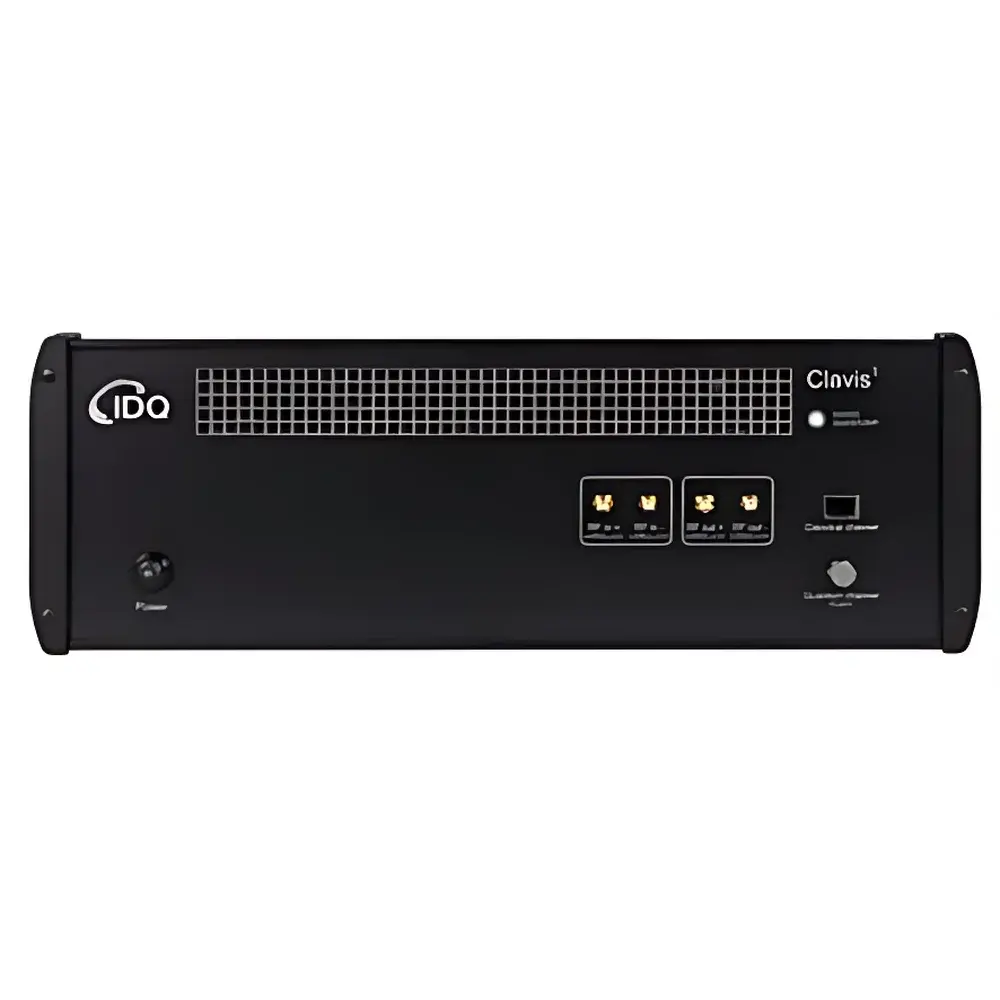
ID Quantique Clavis3 Coherent-One-Way Quantum Key Distribution System
| Origin | Switzerland |
|---|---|
| Supplier Type | Authorized Distributor |
| Origin Category | Imported |
| Model | Clavis3 QKD |
| Price Range | USD 270,000 – 540,000 (FOB Geneva) |
| Measurement Mode | AC-coupled single-photon detection |
Overview
The ID Quantique Clavis3 is a research-grade, fiber-based Quantum Key Distribution (QKD) system engineered for experimental validation and protocol development in quantum-safe cryptography. It implements the patented Coherent-One-Way (COW) protocol—a prepare-and-measure QKD scheme grounded in quantum mechanical principles of wave-particle duality and measurement disturbance. Unlike classical key exchange mechanisms vulnerable to Shor’s algorithm on future fault-tolerant quantum computers, COW-QKD guarantees information-theoretic security by detecting eavesdropping through statistical anomalies in photon arrival timing and interference visibility. The system operates at telecom wavelengths (1550 nm ITU grid), enabling seamless integration into existing DWDM infrastructure without requiring dedicated dark fiber. Its architecture separates the transmitter (Clavis3-A, “Alice”) and receiver (Clavis3-B, “Bob”) units, with hardware-level synchronization via FPGA-generated TTL triggers—ensuring precise temporal alignment critical for low quantum bit error rate (QBER) and high secure key rate.
Key Features
- Coherent-One-Way (COW) protocol implementation compliant with ETSI GS QKD 004 and ISO/IEC 23837-1 draft standards for QKD system characterization
- 1.25 GHz pulsed laser source with active wavelength stabilization to ±0.1 pm around 1550.12 nm (ITU channel 35)
- Dual-detector architecture: Bit detector (Dbit) for key generation and monitoring detector (Dmon) for real-time eavesdropping assessment via interferometric visibility analysis
- FPGA-based hardware key sifting and error correction engine—minimizing latency and enabling >10 kbps raw key rate over 100 km standard SMF-28 fiber
- Modular design supporting external superconducting nanowire single-photon detectors (SNSPDs) or InGaAs avalanche photodiodes (APDs) with user-configurable gating and quenching
- Full parameter accessibility via LabVIEW-compatible API and command-line interface—enabling custom protocol variants, decoy-state optimization, and side-channel vulnerability testing
Sample Compatibility & Compliance
The Clavis3 platform is designed for laboratory and pre-deployment evaluation environments using standard G.652.D single-mode optical fiber. It supports both manual and automated operation modes, with built-in diagnostics for fiber birefringence compensation and polarization drift tracking. All firmware and control logic comply with NIST SP 800-185 recommendations for cryptographic module assurance. System logs—including photon detection timestamps, basis reconciliation outcomes, and privacy amplification parameters—are timestamped with UTC-synchronized hardware clocks and stored in tamper-evident binary formats suitable for GLP audit trails. While not certified under FIPS 140-3 or Common Criteria EAL4+, the Clavis3 meets functional requirements defined in ETSI EN 303 978 for QKD subsystem interoperability and is referenced in multiple peer-reviewed studies published in Physical Review Applied, Optics Express, and IEEE Journal of Quantum Electronics.
Software & Data Management
The Clavis3 Control Suite provides a unified GUI for real-time monitoring of QBER, sifted key length, and photon detection efficiency. It includes integrated post-processing modules for error correction (Cascade algorithm), privacy amplification (Toeplitz matrix hashing), and final key extraction per RFC 8784. Raw data exports are supported in HDF5 format with metadata conforming to the QKD Data Interchange Format (QDIF) v1.2 specification. For industrial integration, RESTful APIs enable orchestration within larger security infrastructures—e.g., interfacing with Centauris Layer-2 encryptors (up to 100 Gb/s throughput) or CN8000 network encryptors. Audit logs retain full traceability of all parameter changes, key generation events, and synchronization status—meeting baseline requirements for FDA 21 CFR Part 11 electronic record integrity when deployed in regulated R&D settings.
Applications
- Academic research on QKD protocol robustness against Trojan-horse, blinding, and time-shift attacks
- Testing of quantum repeater interfaces and trusted-node network topologies
- Evaluation of coexistence between QKD channels and classical DWDM traffic in live telecom networks
- Training platforms for quantum information science curricula—demonstrating quantum no-cloning theorem, wavefunction collapse, and entanglement-free security proofs
- Pre-standardization validation of new physical-layer countermeasures for side-channel leakage mitigation
FAQ
What is the maximum secure distance achievable with the Clavis3 system?
Under standard G.652.D fiber with typical splice losses (0.05 dB/km) and ambient temperature stability, the Clavis3 achieves ≤11% QBER up to 105 km—enabling positive secret key rates after privacy amplification. Performance beyond 120 km requires active polarization feedback or low-noise SNSPD integration.
Does the system support decoy-state protocols?
Yes—the Clavis3-A transmitter supports three-intensity decoy-state modulation (signal, decoy, vacuum) via programmable electro-optic attenuators, configurable through the SDK for asymptotic or finite-key security analysis.
Can the Clavis3 be operated in a fully automated, unattended mode?
It supports scheduled key generation runs with automatic re-synchronization, QBER-triggered recalibration, and email/SNMP alerts upon threshold violations—though human oversight remains recommended for cryptographic validation per NIST IR 8105.





