
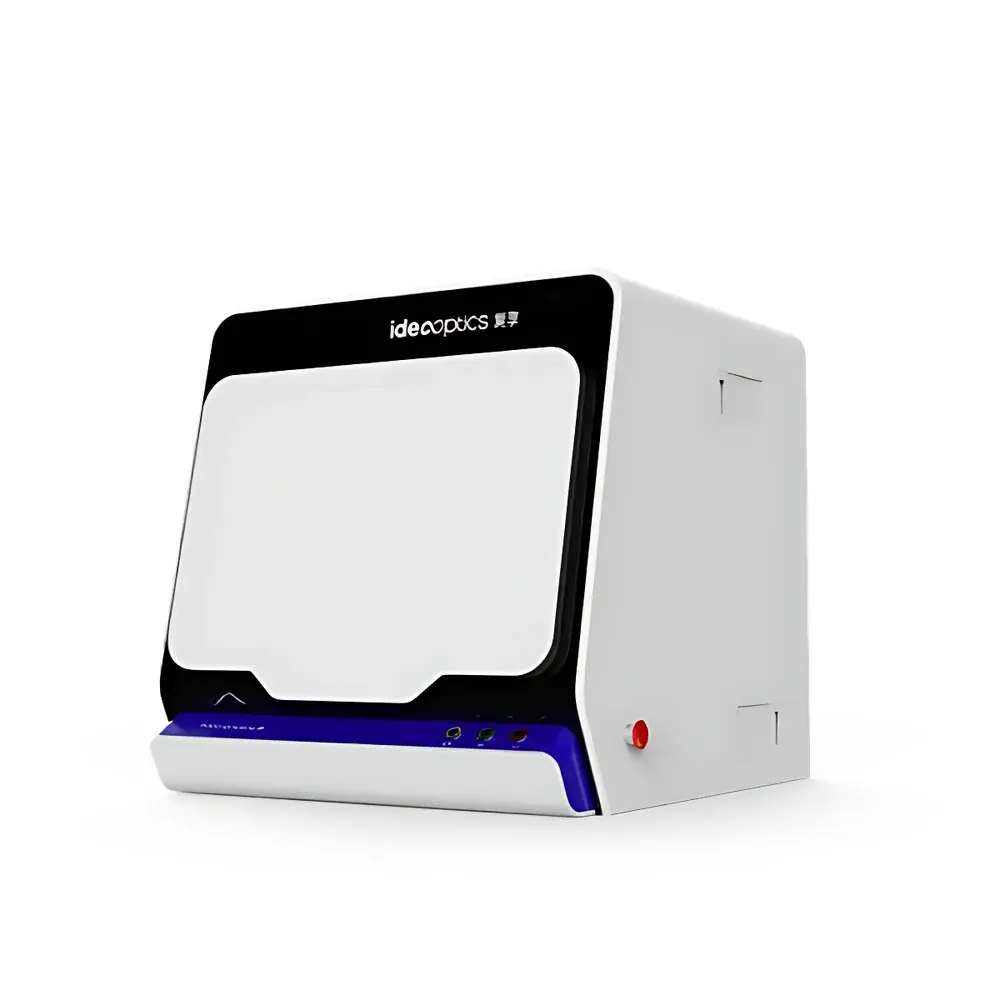
IdeaOptics MetronLens Metasurface Optical Characterization System
| Brand | IdeaOptics |
|---|---|
| Model | MetronLens |
| Origin | Shanghai, China |
| Manufacturer Type | Direct Manufacturer |
| Regional Category | Domestic (China) |
| Pricing | Upon Request |
Overview
The IdeaOptics MetronLens Metasurface Optical Characterization System is a purpose-built platform engineered for the quantitative, multi-parameter metrology of planar photonic devices—including metasurfaces, metasurface-based lenses (metalenses), microlens arrays (MLAs), and diffractive optical elements (DOEs). Unlike conventional optical test benches, MetronLens integrates three complementary measurement modalities within a single, co-registered optical architecture: microscopic near-field intensity mapping, off-axis digital holographic interferometry for quantitative phase retrieval, and far-field angular distribution analysis. This tri-modal acquisition enables simultaneous, spatially correlated characterization of the full complex optical field—amplitude, phase, and radiation pattern—directly at the device plane and in its emission hemisphere. The system operates on the principle of heterodyne off-axis interferometry, where a stabilized reference beam interferes with the object wavefront modulated by the metasurface under test; phase maps are reconstructed pixel-wise from the carrier-fringed interferograms via Fourier-domain filtering and phase unwrapping algorithms. This approach ensures high temporal stability, immunity to environmental vibration, and intrinsic compatibility with dynamic or time-resolved measurements.
Key Features
- Millisecond-scale quantitative phase imaging: Leverages patented micro-lens array-based detection methodology combined with off-axis heterodyne interferometry to achieve real-time phase map acquisition at frame rates up to 100 Hz; phase resolution better than 50 mrad (RMS) over full field of view.
- Sub-micron spatial resolution: Employs a high-NA (NA > 0.75) microscope objective coupled with a scientific-grade CMOS sensor (≥ 4.2 MP), delivering diffraction-limited lateral resolution of ≤ 0.6 µm across a 1.2 mm × 0.9 mm field of view.
- Precision Z-axis scanning: Integrated three-axis fully closed-loop motorized stage with 22 mm travel range along Z; bidirectional repeatability ±0.5 µm and absolute positioning accuracy ±1 µm (traceable to NIST-traceable calibration standards).
- Multi-wavelength illumination architecture: Onboard laser module supports simultaneous or sequential operation of three continuous-wave lasers at 457 nm, 532 nm, and 660 nm; fiber-coupled ports enable external laser integration (e.g., tunable diode lasers, UV/IR sources) without optical realignment.
- Unified coordinate registration: All modalities—near-field intensity, phase, and far-field—are intrinsically registered to a common coordinate system via mechanical and software alignment protocols, eliminating registration error during cross-modal data fusion.
Sample Compatibility & Compliance
MetronLens accommodates standard 4-inch and 6-inch wafers, as well as discrete chips (up to 25 × 25 mm²) mounted on kinematic stages. Sample holders support vacuum chucking or mechanical clamping. The system complies with ISO 10110-5 (surface form tolerances), ISO 14999-2 (interferometric testing of micro-optics), and ASTM E2847 (standard guide for optical testing of diffractive elements). Data acquisition and processing workflows adhere to GLP principles, with audit-trail-enabled software supporting 21 CFR Part 11-compliant electronic signatures when deployed in regulated environments.
Software & Data Management
The MetronLens Control Suite is a modular, Python-driven application built on Qt and NumPy/SciPy libraries. It provides synchronized hardware control, real-time interferogram visualization, automated phase unwrapping, point-spread function (PSF) extraction, Strehl ratio calculation, and MTF derivation. Raw interferograms, wrapped/unwrapped phase maps, intensity stacks, and far-field polar plots are stored in HDF5 format with embedded metadata (wavelength, NA, exposure, stage position, calibration timestamps). Export options include CSV, TIFF (16-bit), and industry-standard .zmx (Zemax) surface file generation for design validation loops. Version-controlled software updates and user-defined macro scripting are supported.
Applications
- Verification of electromagnetic simulation outputs (e.g., FDTD, RCWA) against experimental phase and amplitude profiles.
- Process development feedback for nanoimprint lithography (NIL), electron-beam lithography (EBL), and deep-UV photolithography of metasurfaces.
- Quality assurance of wafer-level metalens production—assessing uniformity, stitching errors, and edge effects across die.
- Characterization of polarization-sensitive metasurfaces using optional rotating half-wave plate and polarizer modules.
- Far-field beam shaping analysis of DOE-based beam splitters, vortex generators, and structured light projectors.
FAQ
What types of metasurface designs can MetronLens characterize?
MetronLens supports scalar and vectorial metasurfaces operating in transmission or reflection mode, including Pancharatnam–Berry (PB) phase, geometric-phase, and resonant-phase configurations.
Is the system compatible with cryogenic or vacuum environments?
The base platform is ambient-air optimized; however, custom vacuum-compatible stages and sealed optical paths are available as OEM options.
Can MetronLens measure absolute optical path difference (OPD) across large-area metasurfaces?
Yes—via multi-position stitching and global phase referencing using a calibrated reference flat, enabling OPD mapping over areas exceeding 10 × 10 mm² with sub-10 nm height uncertainty.
Does the software support batch processing of wafer maps?
Yes—the Control Suite includes a WaferMap module that automates grid-based acquisition, defect flagging based on phase RMS thresholds, and statistical reporting per die.
Are calibration certificates provided with the system?
Each shipment includes NIST-traceable calibration reports for stage positioning, wavelength accuracy, and detector linearity, valid for 12 months from delivery.




