
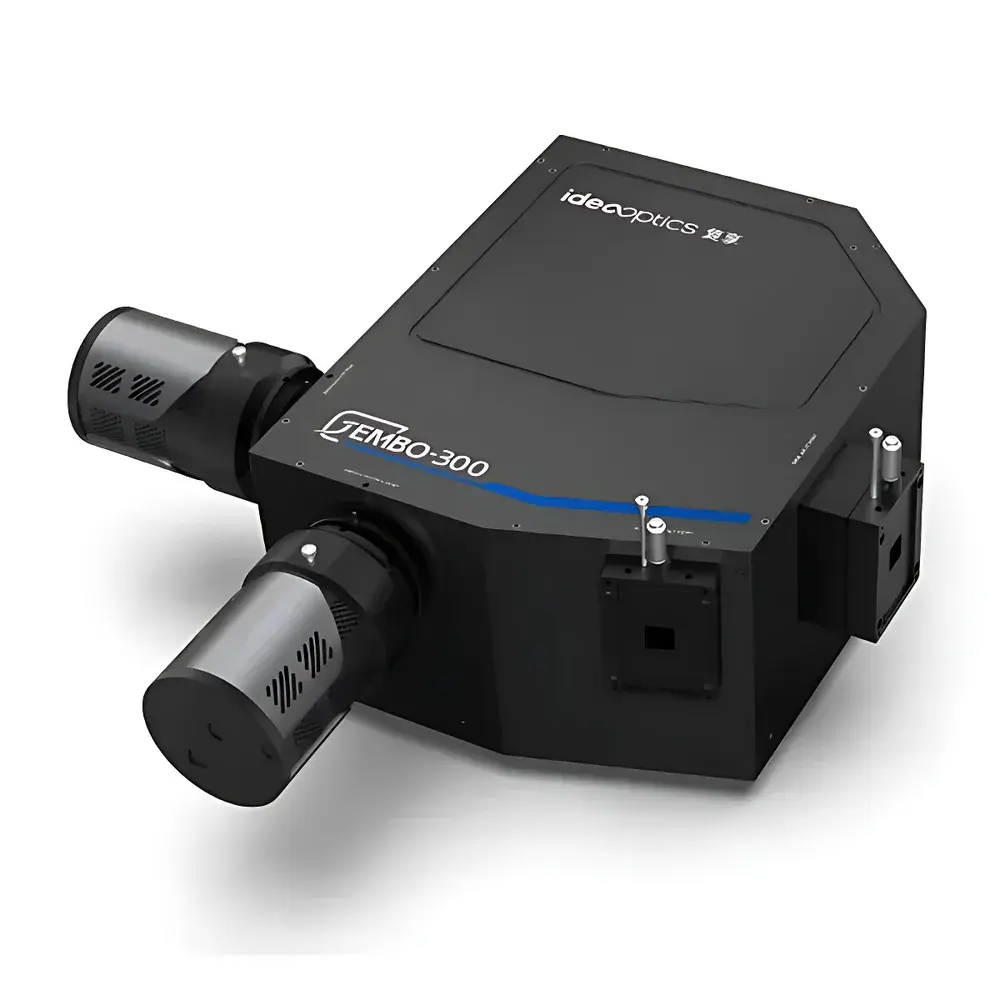
IdeaOptics TEMBO-300 High-Resolution Imaging Spectrometer
| Brand | IdeaOptics |
|---|---|
| Origin | Shanghai, China |
| Manufacturer Type | Original Equipment Manufacturer (OEM) |
| Country of Origin | China |
| Model | TEMBO-300 |
| Pricing | Available Upon Request |
Overview
The IdeaOptics TEMBO-300 High-Resolution Imaging Spectrometer is an advanced Czerny–Turner imaging spectrometer engineered for precision spectroscopic applications requiring sub-nanometer spectral resolution, high optical throughput, and exceptional wavelength fidelity. Based on astigmatism-corrected optical design with in-axis grating rotation, the TEMBO-300 achieves a typical spectral resolution of 0.1 nm across the UV–Vis–NIR range (e.g., 200–1100 nm), with resolution enhancement algorithms enabling up to 40% improvement in both resolving power and peak intensity without compromising signal-to-noise ratio. Its dual-input/dual-output architecture supports simultaneous excitation and detection path routing—critical for time-resolved and multi-channel spectroscopy—including Raman, transient absorption, and plasma diagnostics. The system operates on fundamental principles of dispersion-based spectral imaging, where spatially resolved spectral data are captured on a 2D detector array, preserving both spectral and spatial information in a single acquisition.
Key Features
- Astigmatism-corrected optical design delivering uniform imaging quality across the entire focal plane, ensuring high spatial and spectral fidelity
- In-axis grating rotation mechanism maintaining optimal diffraction efficiency across all grating angles—maximizing light throughput and spectral consistency
- Typical spectral resolution of 0.1 nm (with resolution enhancement mode extending effective resolution to ≤0.05 nm under optimized conditions)
- Wavelength accuracy of ±0.2 nm and repeatability of ±0.02 nm, supported by automated one-click wavelength calibration using internal or external reference sources (e.g., Hg/Ar lamp)
- Dual-input/dual-output port configuration enabling flexible optical path integration—for example, separate excitation and collection arms in confocal Raman setups or pump–probe geometries
- Modular tower-wheel interface supporting automatic recognition of interchangeable gratings, slits, and filter turrets for rapid experimental reconfiguration
- Native compatibility with scientific CMOS and back-illuminated CCD detectors (including TE-cooled variants), with support for trigger synchronization and ROI readout
Sample Compatibility & Compliance
The TEMBO-300 is designed for use with free-space optical beams and fiber-coupled inputs (SMA905 or FC/PC interfaces). It accommodates standard 25.4 mm or 50.8 mm input beam diameters and integrates seamlessly into vacuum-compatible or ambient laboratory environments. While not certified as a medical device or process analytical technology (PAT) instrument per se, its wavelength traceability aligns with ISO/IEC 17025 requirements when calibrated against NIST-traceable emission standards. The system supports GLP-compliant data acquisition workflows when paired with compliant software (e.g., compliant timestamping, audit trail logging, and electronic signature readiness). No inherent radiation hazard; optical safety compliance follows IEC 60825-1 for Class 1 operation when used with appropriate laser sources.
Software & Data Management
The TEMBO-300 is controlled via IdeaOptics’ SpectraStudio software suite—a Windows-based platform offering real-time spectrum visualization, multi-channel acquisition, kinetic series capture, and spectral fitting tools (including Gaussian/Lorentzian deconvolution and baseline correction). All raw and processed data are saved in HDF5 format, ensuring metadata-rich, self-describing files compatible with Python (h5py), MATLAB, and LabVIEW environments. Software features include hardware-triggered acquisition with microsecond-level timing resolution, dark-current subtraction, pixel binning, and region-of-interest (ROI) extraction. Audit trail functionality records user actions, parameter changes, and calibration events—supporting FDA 21 CFR Part 11 compliance when deployed with validated IT infrastructure and access controls.
Applications
- Raman spectroscopy: Resolves narrow Raman linewidths (<1 cm⁻¹) with high signal fidelity; dual-port architecture enables rejection of Rayleigh scatter while preserving Stokes/anti-Stokes signal integrity
- Transient absorption spectroscopy: Supports kHz-rate spectral acquisition with low read noise and minimal frame latency—enabling reconstruction of ultrafast carrier dynamics in semiconductors and photocatalysts
- Plasma diagnostics: Captures fine-structure emission lines (e.g., He I triplet at 587.6 nm, Ar II multiplets) with sufficient resolution to extract electron temperature and density via line-ratio analysis
- Photoluminescence mapping: Enables hyperspectral imaging of quantum dot arrays, perovskite thin films, and 2D materials with <10 µm spatial registration and sub-nm spectral registration
- Reaction monitoring: Facilitates in-situ tracking of spectral shifts during catalytic or polymerization processes, with long-term wavelength stability ensuring quantitative comparability across days or weeks
FAQ
What spectral range is supported by the TEMBO-300?
The base configuration covers 200–1100 nm; exact coverage depends on selected grating groove density, detector quantum efficiency, and optional bandpass filters.
Can the TEMBO-300 be integrated with third-party lasers or detectors?
Yes—it accepts standard free-space and fiber-optic inputs, and provides TTL/CMOS trigger I/O for synchronization with external lasers, delay generators, or detectors.
Is remote operation supported?
Yes, SpectraStudio includes TCP/IP and DLL-based APIs for integration into custom LabVIEW, Python, or MATLAB control environments.
How often does wavelength calibration need to be performed?
Under stable thermal conditions, recalibration is recommended every 8–12 hours for metrology-grade work; the one-click function completes full calibration in under 30 seconds using onboard or external references.
Does the system support vacuum or purged operation?
The optical bench is sealed and optionally available with vacuum flange ports (CF35/CF63); purge gas inlets (N₂ or dry air) can be added to minimize atmospheric water vapor absorption in NIR regions.





