
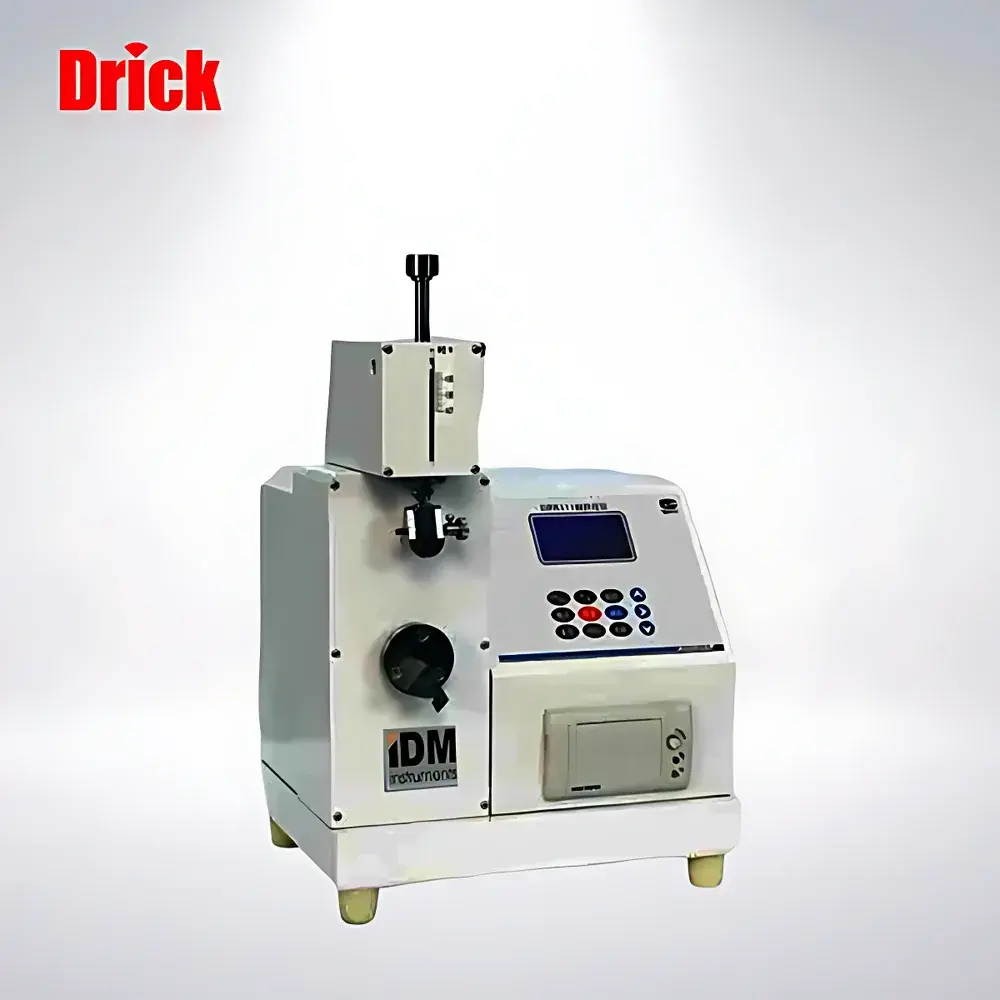
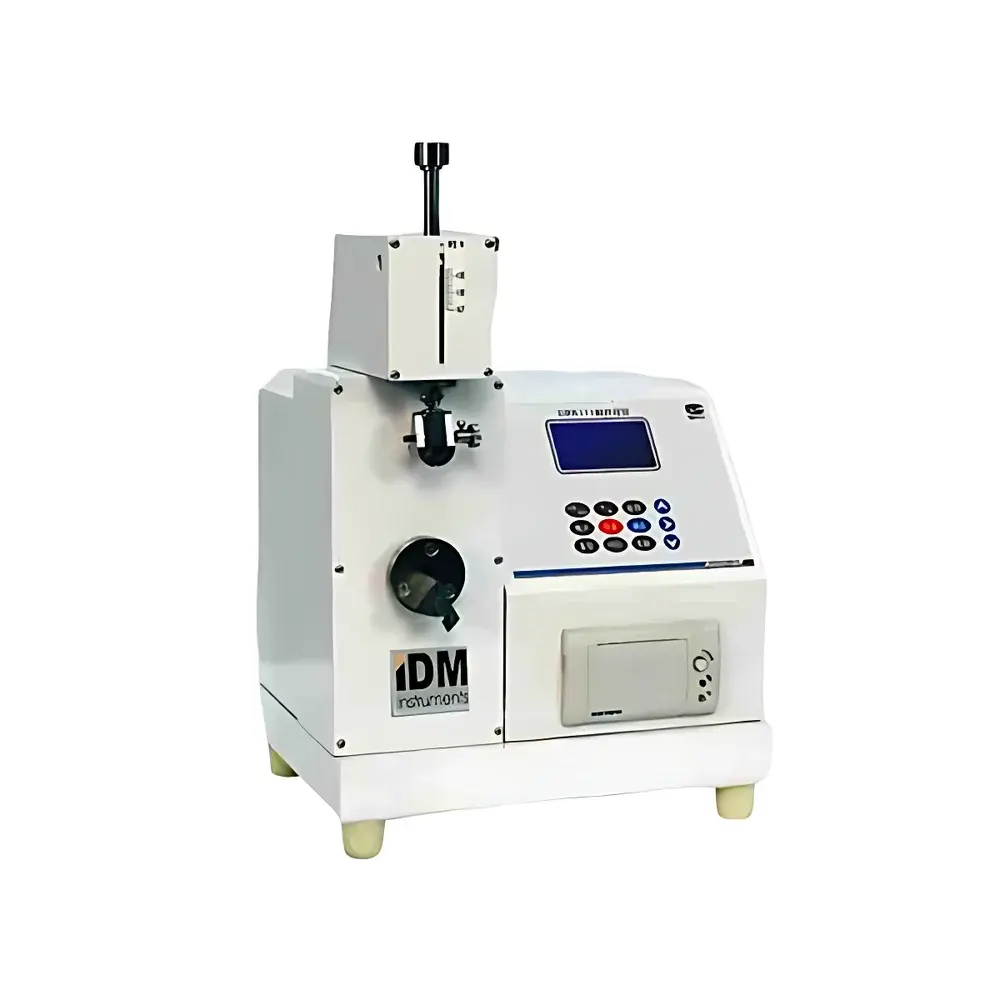
IDM B0013 MIT Fold Endurance Tester
| Brand | IDM |
|---|---|
| Origin | Shandong, China |
| Model | B0013 |
| Folding Angle | 135°±2° |
| Folding Rate | (175±10) cycles/min |
| Tension Range | 4.9–14.7 N |
| Counting Range | 1–99999 folds |
| Fold Head Width | 19±1 mm |
| Fold Slot Radius | R0.38±0.02 mm |
| Tension Variation Due to Eccentricity | ≤0.343 N |
| Fold Gap Options | 0.25 / 0.50 / 0.75 / 1.00 mm |
| Specimen Dimensions | 140 mm × 15 mm (L×W), Thickness: 0.01–1.00 mm |
| Power Supply | AC 220 V ±10%, 50 Hz |
| Operating Environment | 0–40 °C, ≤85% RH |
| Dimensions (L×W×H) | 90 × 305 × 440 mm |
| Net Weight | 21 kg |
| Compliance | ISO 5626, TAPPI T511, JIS P 8115, ASTM D 2176 |
Overview
The IDM B0013 MIT Fold Endurance Tester is an electromechanical instrument engineered for quantitative assessment of fold fatigue resistance in flexible sheet materials. Based on the MIT (Massachusetts Institute of Technology) principle, it subjects standardized specimens to repeated double-folding under controlled tension and geometric constraints—specifically a fixed 135° folding angle and programmable cyclic frequency—to simulate real-world mechanical degradation during handling, storage, or end-use. Unlike tensile or tear testing, fold endurance quantifies cumulative damage from bending-induced microcracking, fiber delamination, and surface embrittlement—critical failure modes in paper-based substrates, leather composites, metallized foils, and thin polymer films. Its design adheres strictly to internationally harmonized test methodologies, ensuring data traceability across global quality control laboratories and R&D facilities.
Key Features
- High-precision optical counting system with automatic cycle termination upon specimen rupture—capable of resolving up to 99,999 folds with ±1-cycle accuracy.
- Adjustable tension mechanism (4.9–14.7 N) calibrated via certified dead-weight verification; tension drift due to rotational eccentricity limited to ≤0.343 N per cycle.
- Interchangeable fold heads with four standardized gap widths (0.25, 0.50, 0.75, and 1.00 mm) to accommodate varying substrate stiffness and thickness profiles.
- Stainless-steel structural frame and low-backlash gear train minimize operational noise (<55 dB(A)) and ensure long-term dimensional stability under continuous duty.
- Fixed fold geometry: 19±1 mm head width, R0.38±0.02 mm corner radius, and 135°±2° folding angle—maintained within tolerance throughout service life per ISO 5626 Annex A calibration requirements.
- Standardized specimen holder accepts 140 mm × 15 mm strips; compatible with thicknesses from 0.01 mm (e.g., cigarette paper) to 1.00 mm (e.g., thick board or laminated leather).
Sample Compatibility & Compliance
The B0013 supports routine evaluation of diverse planar materials including but not limited to: uncoated and coated printing papers, banknote substrates, archival map papers, corrugated board liners, vegetable-tanned leathers, synthetic upholstery hides, aluminum foil laminates, and PET-based flexible packaging films. All test protocols align with mandatory regulatory and industry benchmarks—including ISO 5626 (paper and board), TAPPI T511 (fold endurance of paper), JIS P 8115 (Japanese industrial standard for folding strength), and ASTM D 2176 (folding endurance of paper using MIT tester). Instrument validation documentation includes factory calibration certificates referencing NIST-traceable force and angular metrology standards. The system is suitable for GLP-compliant environments when operated with defined SOPs and periodic performance verification.
Software & Data Management
While the B0013 operates as a stand-alone electromechanical tester without embedded firmware or touchscreen interface, its analog output signal (TTL pulse per fold) is compatible with external data acquisition systems (e.g., LabVIEW, MATLAB, or custom SCADA platforms) for time-stamped logging, statistical process control (SPC) charting, and automated report generation. Optional RS-232 or USB-to-serial adapters enable integration into LIMS environments supporting ASTM E1384 or ISO/IEC 17025 audit trails. Raw fold counts, test date/time stamps, operator ID, and parameter settings (tension, fold gap, specimen ID) can be exported in CSV format for retrospective analysis and cross-laboratory correlation studies.
Applications
- Quality assurance of premium-grade currency papers and security documents where fold durability directly correlates with circulation lifespan.
- Accelerated aging studies—monitoring fold endurance decline after controlled exposure to elevated temperature/humidity (e.g., 40 °C/90% RH per ISO 4889) to model shelf-life degradation.
- Comparative benchmarking of leather tanning processes—evaluating how chrome vs. vegetable tanning affects flex-crack resistance in footwear and upholstery applications.
- Process optimization in paper mills—correlating refining degree, filler content, and sizing agents with fold count outcomes to refine pulp formulations.
- Regulatory submission support for FDA 21 CFR Part 11–compliant packaging validation dossiers requiring documented mechanical robustness data.
FAQ
What materials are appropriate for testing on the B0013?
Paper, paperboard, leather (natural and synthetic), thin metallic foils, cellulose acetate films, and other flexible sheet materials with thickness between 0.01 mm and 1.00 mm.
Does the instrument meet ISO 5626 calibration requirements?
Yes—the fold angle, tension delivery, and counting resolution are verified against ISO 5626 Annex A specifications prior to shipment, and calibration templates are provided for user-performed periodic checks.
Can non-standard specimen dimensions be accommodated?
Standard specimens are 140 mm × 15 mm; custom fixtures for alternate lengths or widths are available upon request and subject to mechanical feasibility review.
Is maintenance required between tests?
No scheduled maintenance is needed between individual tests; however, weekly inspection of fold head alignment, tension spring integrity, and optical sensor cleanliness is recommended per the operation manual.
How is test repeatability ensured across operators?
By enforcing strict adherence to specimen conditioning (ISO 187), clamping torque consistency (via torque wrench), and use of certified reference materials (CRM) for inter-operator bias assessment.





