
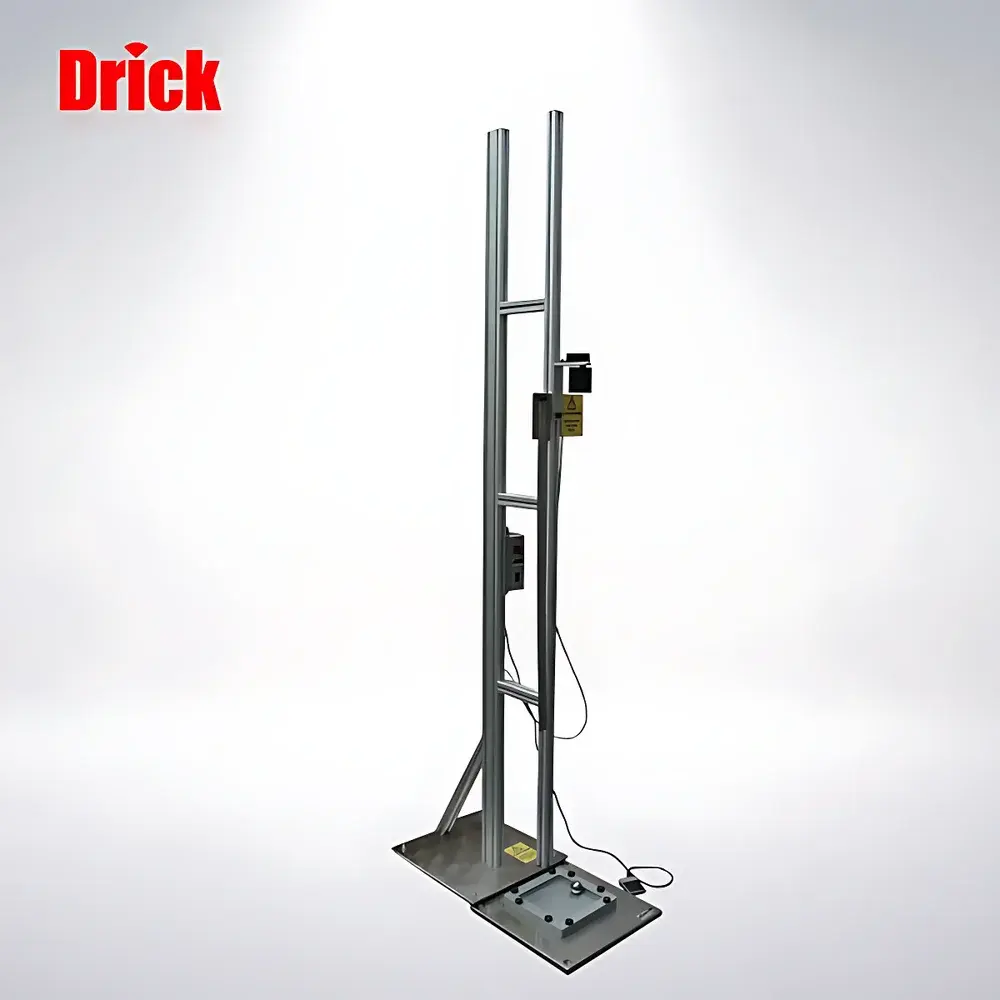
IDM I0004 Large Ball Impact Tester for Laminated Panels
| Brand | IDM |
|---|---|
| Origin | Shandong, China |
| Manufacturer Type | Authorized Distributor |
| Country of Origin | China |
| Model | I0004 |
| Drop Height Range | Adjustable up to 2,500 mm |
| Impact Mass | 324 g ± 5.0 g (Steel Sphere, Ø 42.8 mm ± 0.2 mm) |
| Test Area Clamp | 270 mm × 270 mm |
| Base Plate Dimensions | 450 mm × 475 mm (Solid Steel) |
| Frame Footprint | 450 mm × 450 mm (Steel Enclosure) |
| Power Supply | 220/240 VAC @ 50 Hz or 110 VAC @ 60 Hz |
| Overall Dimensions (H×W×D) | 2500 mm × 450 mm × 900 mm |
| Weight | 75 kg |
| Compliance | ISO 4586-2, EN 438-2:2005 |
| Optional Module | AS/NZS 4266.27 Compliant Test Unit |
Overview
The IDM I0004 Large Ball Impact Tester is a precision-engineered mechanical property tester designed specifically for evaluating the impact resistance of rigid laminated panels—particularly high-pressure decorative laminates (HPL), compact laminates, and engineered surfacing materials. It operates on the principle of controlled gravitational impact: a standardized steel sphere is released from a calibrated height onto a horizontally clamped test specimen, and the maximum drop height at which no visible damage (e.g., cracking, delamination, or indentation exceeding the sphere diameter) occurs after five consecutive impacts is recorded as the material’s large-ball impact resistance. This method provides a repeatable, quantitative metric for surface integrity under localized dynamic loading—critical for quality assurance in architectural panel manufacturing, furniture production, and interior fit-out applications.
Key Features
- Robust structural architecture: Heavy-duty steel base plate (450 mm × 475 mm) and rigid aluminum frame ensure dimensional stability during repeated impact cycles and eliminate vibration-induced measurement drift.
- Precision-guided drop mechanism: Electromagnetic release system with foot-switch activation enables hands-free, operator-independent triggering—minimizing human reaction variability and supporting GLP-compliant testing protocols.
- Adjustable vertical travel: Linear height scale calibrated from 0 to 2500 mm allows fine-tuned increment control (10 mm resolution standard) for precise determination of threshold impact energy.
- Dedicated specimen clamping zone: 270 mm × 270 mm active test area with uniform clamping force distribution prevents edge deformation and ensures consistent load transfer across the sample surface.
- Standardized impactor: Certified steel sphere (Ø 42.8 mm ± 0.2 mm, mass 324 g ± 5.0 g) manufactured to ISO 4586-2 dimensional tolerances, traceable to national metrology standards.
- Universal power compatibility: Dual-voltage input (110 VAC / 220–240 VAC) with 50/60 Hz auto-sensing—enabling seamless deployment in North American, European, and APAC laboratory environments without hardware modification.
Sample Compatibility & Compliance
The I0004 accommodates flat, rigid laminated specimens up to 25 mm thick and minimum dimensions of 300 mm × 300 mm. It is validated for use with thermoset resin-based HPL (e.g., phenolic- or melamine-formaldehyde bonded), ceramic-reinforced composites, and metal-clad laminates. The instrument fully supports test execution per ISO 4586-2:2016 (“Decorative laminates — High-pressure decorative laminates — Part 2: Determination of resistance to impact”) and EN 438-2:2005 (“High-pressure decorative laminates — Part 2: Determination of resistance to impact”). An optional AS/NZS 4266.27-compliant test module is available for certification workflows in Australia and New Zealand, including enhanced documentation templates aligned with NATA requirements. All mechanical components are CE-marked; electrical subsystems comply with IEC 61000-6-3 (EMC) and IEC 61000-6-2 (immunity).
Software & Data Management
While the base I0004 operates as a manual, analog-height-readout system, it integrates seamlessly with optional digital data acquisition modules. These include a USB-connected height encoder with ±0.5 mm repeatability and PC software that logs impact sequence, drop height, pass/fail status per impact, and timestamp metadata. Export formats include CSV and PDF reports compliant with ISO/IEC 17025 documentation requirements. Audit trail functionality supports 21 CFR Part 11 readiness when paired with validated electronic signature packages—suitable for GMP-regulated laminate suppliers serving medical or aerospace sectors.
Applications
- Quality control of decorative laminates prior to shipment in OEM panel supply chains.
- Comparative evaluation of resin formulation changes (e.g., crosslink density, filler content) on surface toughness.
- Validation of post-lamination curing parameters in continuous press lines.
- Third-party certification testing for CE marking, NSF/ANSI 373 sustainability claims, and GREENGUARD Indoor Air Quality certification.
- R&D investigations into substrate–laminate interfacial adhesion under dynamic loading conditions.
FAQ
What standards does the I0004 directly support out-of-the-box?
ISO 4586-2 and EN 438-2:2005 test procedures are fully implemented via mechanical design, impactor geometry, and clamping specifications—no firmware or calibration adjustments required.
Can the instrument be used for non-laminated substrates such as solid wood or MDF?
Yes—provided specimens meet minimum rigidity and thickness requirements (≥18 mm, deflection <0.5 mm under 100 N pre-load); however, interpretation must reference substrate-specific annexes in ISO 4586-2 Clause 8.
Is height calibration traceable to national standards?
The integrated linear scale is supplied with a factory calibration certificate (NIST-traceable reference gauge block), and recalibration services are available through IDM-accredited service centers annually or after 5,000 impact cycles.
Does the system include safety interlocks?
Yes—a dual-channel optical beam sensor interrupts electromagnetic release if the operator’s hand or tool breaches the impact zone during setup, meeting ISO 13857 safety distance requirements.
What maintenance is required for long-term repeatability?
Monthly inspection of sphere surface finish (visual + profilometer check for pitting > Ra 0.8 µm), quarterly torque verification of clamping bolts (12 N·m ± 5%), and annual verification of vertical guide rail parallelism (≤0.1 mm deviation over full stroke).






