
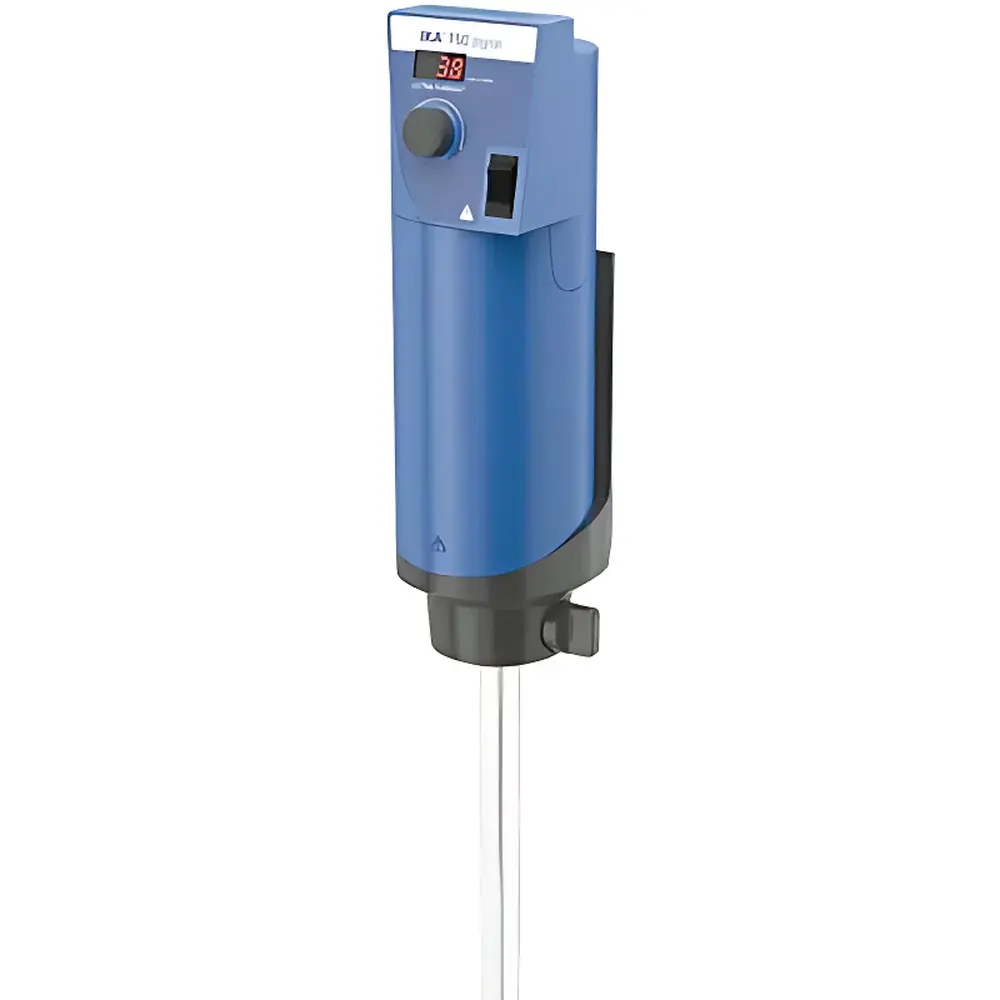
IKA T 50 digital ULTRA-TURRAX® High-Performance Digital Dispersion Homogenizer
| Brand | IKA |
|---|---|
| Origin | Germany |
| Manufacturer | IKA-Werke GmbH & Co. KG |
| Type | Probe-type Rotating Rotor-Stator Homogenizer |
| Model | T 50 digital |
| Dimensions (W×D×H) | 115 × 355 × 139 mm |
| Processing Volume Range | 0.25–30 L (H₂O) |
| Motor Input Power | 1100 W |
| Motor Output Power | 700 W |
| Speed Range | 600–10,000 rpm |
| Speed Accuracy | ±1 % |
| Speed Display | LED Digital |
| Speed Control | Continuous (Stepless) Electronic Regulation |
| Max. Viscosity | 5000 mPa·s |
| Noise Level (without dispersing tool) | 72 dB(A) |
| Shaft Diameter | 16 mm |
| Shaft Length | 220 mm |
| IP Rating | IP20 |
| Operating Temperature | 5–40 °C |
| Relative Humidity Limit | ≤80 % RH |
| Voltage | 220–240 V AC |
| Frequency | 50/60 Hz |
| Continuous Duty Cycle | 100 % |
| Weight | 5.76 kg |
Overview
The IKA T 50 digital ULTRA-TURRAX® is a high-torque, microprocessor-controlled dispersion homogenizer engineered for precision batch processing in research laboratories, quality control environments, and pilot-scale development workflows. It operates on the rotor-stator principle—where high-speed rotation of a precisely engineered stainless-steel rotor within a concentric stator generates intense shear, cavitation, and hydraulic forces—to achieve efficient particle size reduction, emulsification, suspension stabilization, and cell disruption. Designed and manufactured in Staufen, Germany, the T 50 digital integrates robust mechanical architecture with real-time electronic speed regulation, enabling consistent energy input regardless of sample viscosity changes—a critical requirement for method transfer, regulatory compliance, and inter-laboratory reproducibility.
Key Features
- Digitally controlled, stepless speed regulation from 600 to 10,000 rpm with ±1 % accuracy—ensuring precise protocol execution and traceable parameter logging
- High-output 700 W motor delivering stable torque across the full speed range; optimized for both low-volume micro-dispersion (down to 0.25 L) and larger-scale homogenization (up to 30 L H₂O-equivalent)
- LED digital display providing immediate visual feedback of actual rotational speed—eliminating reliance on analog dials or external tachometers
- Integrated electronic overload protection and error-code diagnostics (e.g., stall detection, thermal warning) to prevent motor damage and support predictive maintenance
- Stainless-steel dispersing tools—including S-shaped, conical, and saw-toothed geometries—designed for rapid cleaning, autoclavability, and application-specific shear profile optimization
- Smooth soft-start function minimizing splashing and vortex formation during initiation; especially critical for volatile, viscous, or foaming samples
- IP20-rated housing compliant with DIN EN 60529; suitable for standard laboratory ambient conditions (5–40 °C, ≤80 % RH)
Sample Compatibility & Compliance
The T 50 digital accommodates a broad spectrum of sample matrices—including aqueous suspensions, polymer solutions, biological lysates, pharmaceutical suspensions, food emulsions, and ceramic slurries—within its 0.25–30 L operational envelope. Its ability to maintain constant rotational speed under variable load ensures adherence to standardized test methods requiring fixed shear history, such as ISO 7888 (water quality—turbidity measurement preparation), ASTM D4084 (emulsion stability evaluation), or USP (light scattering for subvisible particle analysis). The device supports GLP-compliant documentation when integrated into validated workflows, and its electronic speed control architecture facilitates alignment with FDA 21 CFR Part 11 requirements when paired with audit-trail-enabled laboratory software.
Software & Data Management
While the T 50 digital operates as a standalone instrument with embedded firmware, its digital speed interface enables seamless integration with third-party data acquisition systems via analog output (0–10 V) or optional RS232 communication module (sold separately). This allows synchronization with time-stamped environmental sensors (e.g., temperature, pH), recording of real-time speed profiles for SOP validation, and export of operational metadata—including runtime, peak torque events, and fault codes—for inclusion in electronic lab notebooks (ELN) or LIMS databases. All firmware updates are distributed directly by IKA-Werke and documented per IEC 62304 medical device software lifecycle standards.
Applications
- Preparation of homogeneous nanoparticle dispersions for drug delivery formulation development
- Routine homogenization of tissue samples prior to nucleic acid or protein extraction (e.g., in accordance with ISO 15189-accredited molecular pathology protocols)
- Stabilization of oil-in-water and water-in-oil emulsions in cosmetic and food R&D
- Deagglomeration of pigment suspensions in ink and coating formulations
- Dispersion of carbon nanotubes or graphene in polymer matrices for composite material characterization
- Batch-wise cell lysis under controlled shear conditions for bioprocess optimization studies
FAQ
Is the T 50 digital compatible with non-IKA dispersing tools?
No. Only genuine IKA ULTRA-TURRAX® dispersing tools are certified for use with this instrument. Substitution may compromise safety, performance, and warranty coverage.
Can the unit operate continuously at maximum speed?
Yes—rated for 100 % duty cycle under nominal load conditions. However, prolonged operation above 8,000 rpm with high-viscosity media (>3,000 mPa·s) requires active cooling and periodic thermal monitoring.
What does the displayed error code “E1” indicate?
“E1” signifies rotor lock or excessive mechanical resistance—typically caused by oversized particles, dry-running, or incorrect tool mounting. Power must be cycled after resolving the obstruction.
Does the device meet electromagnetic compatibility (EMC) requirements for laboratory environments?
Yes—it complies with EN 61326-1:2013 for laboratory equipment, including immunity to electrostatic discharge (IEC 61000-4-2) and radiated RF fields (IEC 61000-4-3).
Is calibration required before first use?
No factory calibration is needed—the speed control system is pre-calibrated and traceable to national standards. Users may perform routine verification using an external optical tachometer per internal SOP.



