
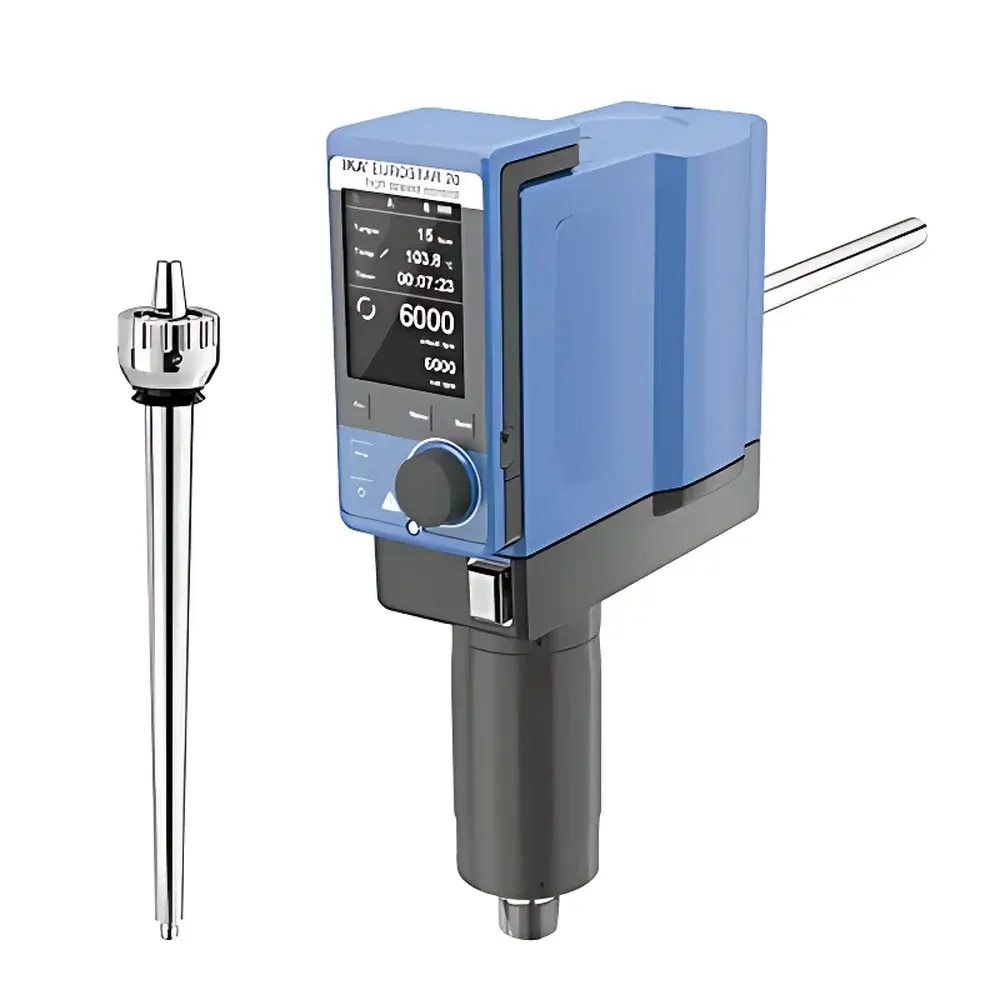
IKA EUROSTAR 20 High-Speed Digital Laboratory Stirrer
| Brand | IKA |
|---|---|
| Origin | Germany |
| Model | EUROSTAR 20 high speed control |
| Maximum Stirring Volume | 20 L (H₂O) |
| Speed Range | 0/150–6000 rpm |
| Temperature Measurement Range | −10 °C to +350 °C |
| Motor Type | Brushless DC |
| Max. Torque | 20 N·cm |
| Power Input | 176 W |
| Power Output | 125 W |
| Display | Digital TFT |
| Interfaces | RS-232, USB |
| IP Rating | IP40 |
| Dimensions | 86 × 325 × 230 mm |
| Weight | 4.7 kg |
| Ambient Operating Conditions | 5–40 °C, ≤80% RH |
Overview
The IKA EUROSTAR 20 High-Speed Digital Laboratory Stirrer is an engineered solution for precision-controlled mixing, dispersion, and homogenization in research, quality control, and production laboratories. Built on brushless DC motor technology, it eliminates carbon wear, ensures long-term speed stability, and delivers consistent torque output across its full operational range. Unlike conventional stirrers relying on mechanical commutation, the EUROSTAR 20 employs microprocessor-based closed-loop speed regulation—enabling real-time correction of rotational deviations and maintaining setpoint accuracy within ±1 rpm (at n > 300 rpm) or ±3 rpm (at n < 300 rpm). Its design integrates direct-drive architecture with a rigid cast-aluminum housing coated in thermoplastic polymer, providing structural integrity, thermal dissipation efficiency, and resistance to common lab solvents. The unit supports continuous operation at 100% duty cycle under rated load conditions, making it suitable for extended batch processing, reaction monitoring, and viscosity-sensitive protocols where reproducibility and thermal management are critical.
Key Features
- Brushless DC motor delivering 125 W mechanical output power and peak torque of 20 N·cm—optimized for high-viscosity media up to 10,000 mPa·s
- Digitally controlled speed range from 0/150 to 6000 rpm with infinitely variable adjustment and programmable ramp profiles
- Integrated torque trend display for real-time monitoring of rheological changes during stirring—enabling detection of gelation, phase separation, or polymer crosslinking events
- Multilingual TFT display with intuitive navigation, error-code diagnostics, and simultaneous visualization of speed, torque, time, and temperature
- RS-232 and USB interfaces compliant with standard serial communication protocols—supporting remote parameter control, data logging, and firmware updates via PC-based software
- PT1000-compatible external temperature sensor input (DIN IEC 751 Class A), enabling accurate in-situ temperature monitoring with ±0.5 K precision
- Programmable timer function (1–6000 min), interval operation mode, and safety-circuit locking for GLP-compliant workflows
- Ergonomic slim casing (86 × 325 × 230 mm), low-noise operation (<55 dB(A)), and IP40-rated enclosure suitable for general laboratory environments
Sample Compatibility & Compliance
The EUROSTAR 20 accommodates standard laboratory vessels—including glass beakers, jacketed reactors, and stainless-steel containers—up to 20 L volume (water-equivalent). Its push-through agitator shaft (280 mm length, 220 mm max immersion depth) accepts interchangeable impellers (e.g., paddle, propeller, anchor) via a standardized quick-lock coupling. The system complies with DIN EN 60529 (IP40 ingress protection), IEC 61000-6-3 (EMC emissions), and IEC 61000-6-2 (immunity). While not intrinsically safe or explosion-proof, its non-sparking motor architecture and thermal cutoff circuitry meet general electrical safety requirements for non-hazardous zones per IEC 61010-1. For regulated environments, audit-trail-capable data export via USB/RS-232 supports alignment with FDA 21 CFR Part 11 principles when paired with validated third-party acquisition software.
Software & Data Management
The stirrer’s embedded firmware enables bidirectional communication with host systems through ASCII-based command sets over RS-232 or virtual COM port emulation via USB. Users may configure and execute multi-step protocols—including speed ramps, hold phases, torque thresholds, and temperature-triggered actions—using IKA’s LabWorldSoft platform or custom-developed scripts. All operational parameters (timestamped speed, torque, temperature, elapsed time) are logged internally and exportable as CSV files. Firmware updates preserve calibration constants and retain user-defined presets. The system supports timestamped error logging and diagnostic codes (e.g., E01 = overload, E04 = sensor fault), facilitating root-cause analysis during process validation or equipment qualification (IQ/OQ).
Applications
This stirrer serves diverse applications requiring precise kinetic control: dissolution testing per USP , emulsion stabilization studies, catalyst suspension in heterogeneous catalysis, polymerization initiation under inert atmosphere, buffer preparation for bioprocessing, and temperature-dependent solubility mapping. Its torque trend capability is particularly valuable in QC labs performing viscosity consistency checks on pharmaceutical suspensions or food-grade thickeners. In academic settings, it supports teaching modules on fluid dynamics, Newtonian/non-Newtonian behavior, and shear-rate dependency—especially when coupled with calibrated viscometers or rheometers for correlative analysis.
FAQ
Can the EUROSTAR 20 operate continuously at maximum speed and torque?
Yes—it is rated for 100% duty cycle at all speeds within specification; however, sustained operation above 4000 rpm with high-viscosity loads (>5000 mPa·s) requires adequate vessel cooling and periodic torque verification.
Is the PT1000 temperature sensor included with the device?
No—the PT1000 probe is optional and must be ordered separately; the unit provides the interface and signal conditioning but not the physical sensor.
Does the stirrer support analog output for PLC integration?
No—it lacks dedicated 0–10 V or 4–20 mA analog outputs; integration with industrial control systems requires digital-to-analog conversion via external interface hardware.
What is the maximum permissible ambient humidity for continuous operation?
Relative humidity must not exceed 80% at 25 °C, non-condensing, per IEC 61010-1 environmental classification.
Can the wireless controller be used in shielded or RF-noisy environments?
The optional wireless controller operates at 868 MHz (EU) with a typical line-of-sight range of 150 m; performance may degrade near metal enclosures, microwave ovens, or active Wi-Fi 5 GHz bands.



