
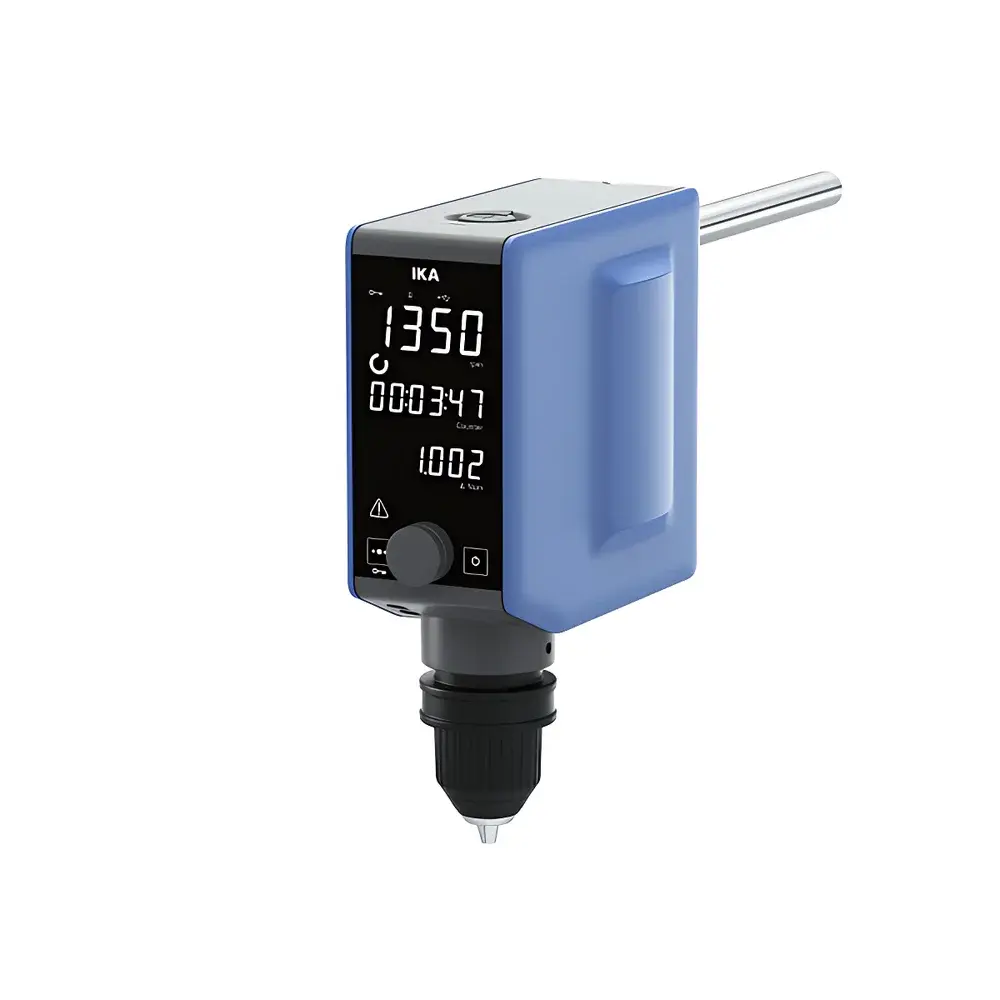
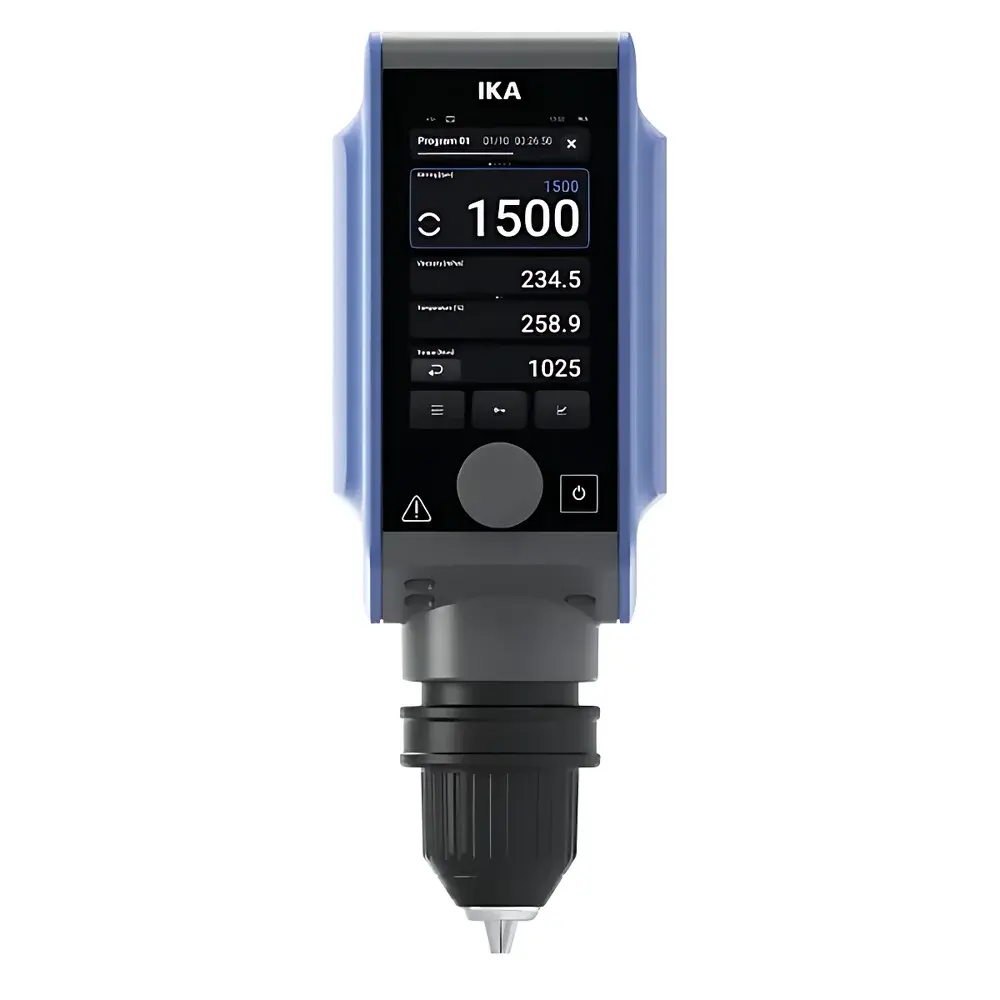
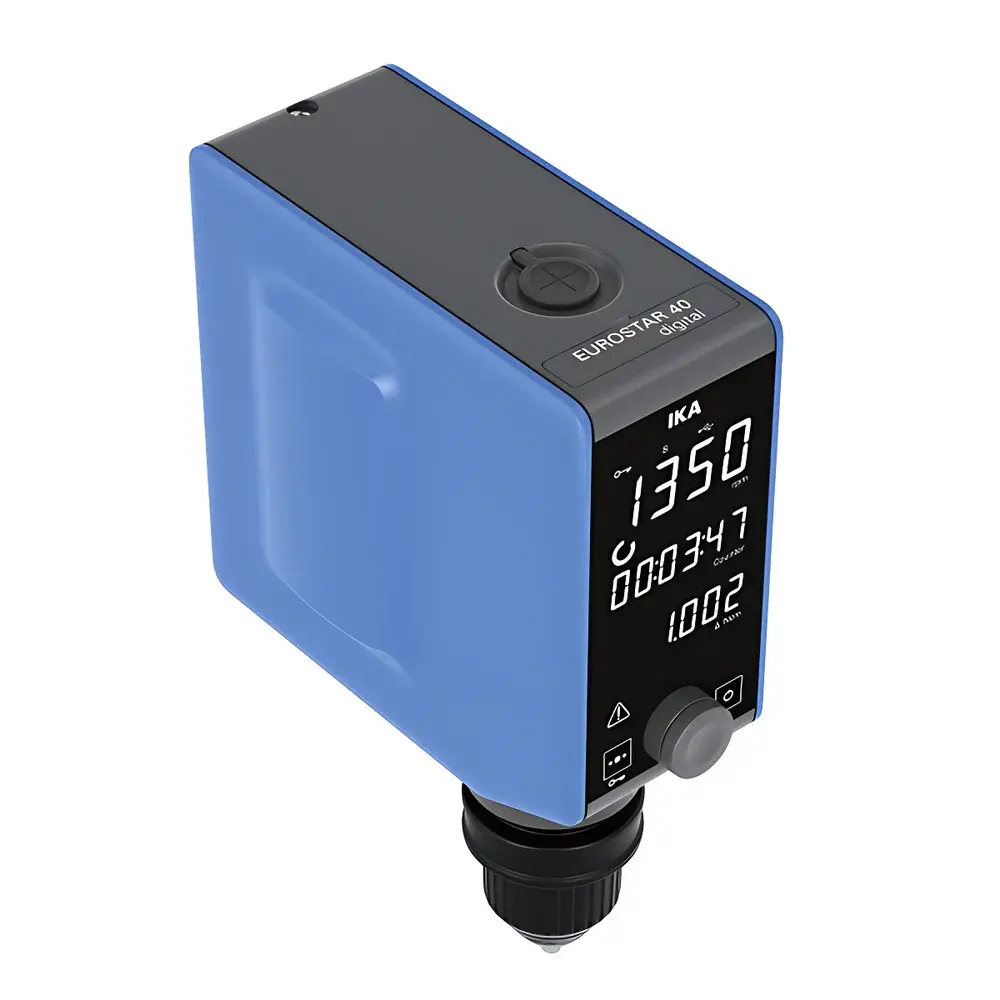
IKA EUROSTAR 40 digital Overhead Stirrer
| Brand | IKA |
|---|---|
| Origin | Germany |
| Manufacturer | IKA Werke GmbH & Co. KG |
| Model | EUROSTAR 40 digital |
| Maximum Mixing Volume | 25 L (H₂O) |
| Speed Range | 0/30–2000 rpm |
| Torque Range | 60 N·cm (at ≤200 rpm), 40–60 N·cm (linearly adjustable from 200–2000 rpm) |
| Temperature Operating Range | 5–40 °C |
| Max. Viscosity | 30,000 mPa·s |
| Protection Rating | IP54 |
| Compliance | ISO Class 7/8 Cleanroom Certified |
| Interfaces | USB-C, RS232 |
| Motor Type | Brushless DC |
| Display | LCD with real-time torque trend |
| Safety Features | Auto-stop on stall, torque limit, sudden torque drop detection, key lock |
| Enclosure Material | Anodized aluminum housing with thermoplastic polymer coating |
| Dimensions (W×H×D) | 89 × 237 × 191 mm |
| Weight | 3.8 kg |
Overview
The IKA EUROSTAR 40 digital is a high-precision overhead stirrer engineered for reproducible, scalable mixing in regulated and research-intensive laboratory environments. Utilizing brushless DC motor technology, it delivers consistent rotational motion across its full speed range (30–2000 rpm) while maintaining stable setpoint adherence—even under dynamically changing viscosity conditions. Its core operational principle relies on closed-loop electronic speed control combined with real-time torque sensing, enabling direct inference of rheological behavior during mixing. Unlike conventional stirrers that only regulate speed, the EUROSTAR 40 digital continuously monitors mechanical load at the drive shaft and displays torque trends with ±6 N·cm accuracy—providing objective process feedback essential for method development, scale-up validation, and quality-critical batch documentation. Designed to meet stringent spatial constraints, its compact footprint (23% smaller than predecessor models) ensures seamless integration into fume hoods, biosafety cabinets, and ISO 7/8 cleanroom workstations without compromising structural rigidity or thermal stability.
Key Features
- Brushless DC motor: Eliminates carbon dust generation, extends service life, and ensures quiet operation (<52 dB(A) at no-load)
- Real-time torque trend display: Visualizes viscosity evolution during mixing—critical for detecting gelation, phase separation, or polymer swelling events
- Intelligent safety architecture: Automatic shutdown triggered by motor stall, user-defined torque limits, or abrupt torque reduction (e.g., vessel rupture or impeller disengagement)
- Tool-free quick-release chuck: One-hand operation for rapid impeller exchange; accommodates shaft diameters from 0.5 to 10 mm (including hollow-shaft compatibility for temperature probe insertion)
- Full electronic speed control: Adjustable in 1-rpm increments; speed accuracy ±1 rpm (≥300 rpm), ±3 rpm (<300 rpm)
- Dual communication interfaces: Native USB-C and RS232 ports support bidirectional data transfer and remote parameter control
- IP54-rated enclosure: Resistant to water splashes and airborne particulates—validated for use in humidified labs and controlled environments
- Integrated timer/counter: Programmable duration from 1 to 6000 minutes with automatic stop and event logging
Sample Compatibility & Compliance
The EUROSTAR 40 digital supports mixing of low-to-high-viscosity Newtonian and non-Newtonian fluids—including aqueous suspensions, polymer solutions, emulsions, and cell culture media—up to 25 L (water-equivalent volume) and 30,000 mPa·s. Its sealed motor housing and anodized aluminum construction comply with ISO 14644-1 Class 7 and Class 8 cleanroom requirements, making it suitable for pharmaceutical formulation, bioprocess development, medical device manufacturing, and semiconductor-grade chemical handling. The device conforms to IEC 61000-6-3 (EMC emission standards), IEC 61000-6-2 (immunity), and carries CE marking per Directive 2014/30/EU (EMC) and 2014/35/EU (LVD). Optional audit-trail-enabled firmware updates align with FDA 21 CFR Part 11 expectations when used with labworldsoft® software in GxP-regulated workflows.
Software & Data Management
Native integration with IKA’s labworldsoft® laboratory software enables centralized configuration, real-time monitoring, and automated documentation of stirring parameters—including speed, torque, elapsed time, and system status flags. All data are timestamped and stored in CSV or PDF formats compliant with GLP/GMP record retention policies. USB-C connectivity allows direct export to networked storage or LIMS systems, while RS232 facilitates legacy instrument fleet synchronization. The software supports multi-user access control, electronic signatures, and change history tracking—ensuring traceability across method validation, equipment qualification (IQ/OQ), and routine operation logs.
Applications
- Pharmaceutical: Dissolution testing, buffer preparation, API suspension homogenization, and lyophilization cycle support
- Biotechnology: Mammalian and microbial culture media blending, transfection reagent dispersion, and cryoprotectant mixing
- Materials Science: Nanoparticle dispersion in solvents, composite resin degassing, and ceramic slurry conditioning
- Food & Beverage R&D: Emulsion stabilization trials, viscosity profiling of dairy analogs, and sensory sample preparation
- Academic Research: Teaching rheology fundamentals, reaction kinetics studies under controlled shear, and polymer processing simulation
FAQ
What is the maximum continuous duty cycle for the EUROSTAR 40 digital?
It is rated for 100% continuous operation under ambient conditions of 5–40 °C and ≤80% relative humidity.
Can the torque trend function be exported for analysis?
Yes—when connected via USB-C or RS232 to labworldsoft®, torque vs. time profiles are logged at user-configurable intervals and exportable as CSV or graphical reports.
Is the unit compatible with explosion-proof environments?
No—it is not ATEX or IECEx certified; however, its brushless motor design minimizes spark risk compared to brushed alternatives.
Does the device support external temperature feedback for coupled heating/cooling systems?
Not natively—the EUROSTAR 40 digital does not include PID temperature control; it operates independently of thermal modules but can be synchronized externally via TTL or analog signals using third-party controllers.
How is calibration verified for torque measurement?
Torque sensor calibration is performed at factory level against traceable NIST-equivalent standards; field verification requires optional IKA-certified calibration kits and is recommended annually in GxP settings.



