
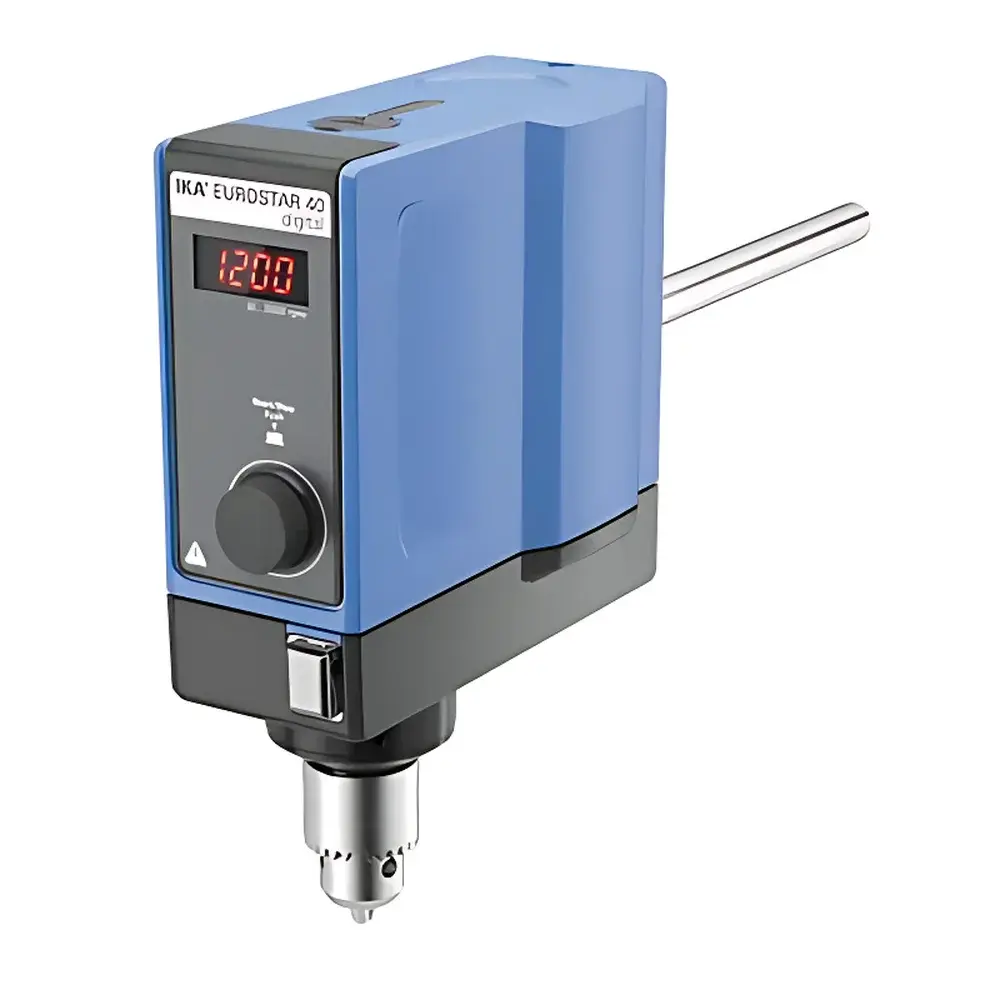
IKA EUROSTAR 40 digital Overhead Stirrer
| Brand | IKA |
|---|---|
| Origin | Germany |
| Model | EUROSTAR 40 digital |
| Maximum Stirring Volume | 25 L (H₂O) |
| Speed Range | 0/30–2000 rpm |
| Motor Type | Brushless DC Motor |
| Input Power | 118 W |
| Output Power | 87 W |
| Max Torque | 40 N·cm |
| Speed Accuracy | ±1 rpm (n > 300 rpm) |
| Speed Display | LED 7-segment |
| Clamp Range | 0.5–10 mm |
| Hollow Shaft Diameter | 11 mm |
| Housing Material | Cast aluminum with thermoplastic polymer coating |
| Dimensions (W×H×D) | 86 × 248 × 208 mm |
| Weight | 4.4 kg |
| Protection Class | IP 40 |
| Operating Ambient | 5–40 °C, ≤80% RH |
| Voltage | 230 V / 100–115 V, 50/60 Hz |
Overview
The IKA EUROSTAR 40 digital is a precision-engineered overhead stirrer designed for demanding laboratory mixing applications requiring high torque stability, reproducible speed control, and long-term operational reliability. Based on brushless DC motor technology, it eliminates carbon brush wear and delivers consistent rotational performance across its full speed range of 0/30–2000 rpm. Unlike conventional AC-driven stirrers, the EUROSTAR 40 digital employs microprocessor-based closed-loop speed regulation: real-time feedback from the motor shaft continuously compares actual vs. setpoint rpm, automatically compensating for load variations—including viscosity changes during polymer dissolution, suspension homogenization, or emulsion formation. This ensures constant shear input critical for kinetic studies, reaction scalability, and QC batch consistency. Its robust cast aluminum housing with thermoplastic polymer coating provides mechanical rigidity and chemical resistance suitable for routine use in general chemistry, pharmaceutical development, and materials synthesis labs.
Key Features
- Brushless DC motor architecture enabling maintenance-free operation, low electromagnetic interference, and extended service life
- Closed-loop speed control system with ±1 rpm accuracy above 300 rpm and ±1% below—validated per DIN EN 60529 for repeatability under variable load conditions
- Maximum torque output of 40 N·cm at low speeds, supporting viscous media up to 30,000 mPa·s (e.g., CMC solutions, silicone oils, or uncured resins)
- Hollow shaft design (11 mm internal diameter) allows simultaneous insertion of temperature probes, pH electrodes, or sampling needles without interrupting agitation
- Integrated safety circuitry that detects motor stall or thermal overload and initiates immediate shutdown—compliant with IEC 61000-6-2 immunity requirements
- Ergonomic universal clamp (0.5–10 mm jaw range) and 220 mm extendable support arm (16 mm diameter) ensure secure mounting on standard lab frames and compatibility with diverse vessel geometries
- Continuous 100% duty cycle rating validated for unattended overnight operation under nominal load conditions
Sample Compatibility & Compliance
The EUROSTAR 40 digital accommodates vessels from 50 mL beakers to 25 L jacketed reactors when paired with appropriate impellers (e.g., pitched-blade, anchor, or helical ribbons). Its torque profile supports Newtonian and non-Newtonian fluids—including shear-thinning hydrogels and thixotropic pastes—without speed droop. The unit meets CE marking requirements under the EU Machinery Directive 2006/42/EC and Electromagnetic Compatibility Directive 2014/30/EU. While not certified for hazardous area use (ATEX/IECEx), its IP 40 ingress protection level safeguards against solid particulates during standard benchtop operation. For GLP/GMP environments, the absence of analog outputs or digital interfaces precludes direct audit trail generation; however, manual log entries of setpoints and runtime remain fully traceable per FDA 21 CFR Part 11 Annex 11 principles when documented alongside experimental protocols.
Software & Data Management
This model operates as a standalone instrument without embedded firmware connectivity. It features no RS232, USB, or Ethernet ports, nor does it support external software integration or remote parameter adjustment. All operational parameters—including speed setpoint, direction toggle, and run status—are controlled via front-panel membrane buttons and displayed on a high-contrast 7-segment LED screen. Data recording must be performed manually or synchronized externally using third-party data loggers interfaced with auxiliary sensors (e.g., PT100 probes inserted through the hollow shaft). For laboratories implementing electronic lab notebooks (ELNs), metadata such as stirrer ID, calibration date, and speed verification logs should be archived alongside raw experimental records to satisfy ISO/IEC 17025 clause 7.7 on equipment traceability.
Applications
- Batch preparation of buffer solutions, cell culture media, and reagent stocks where uniform solute dispersion prevents localized pH or osmolarity gradients
- Kinetic studies involving heterogeneous catalysis, where constant agitation intensity ensures reproducible mass transfer coefficients (kLa)
- Viscosity-dependent processes such as latex coagulation, nanoparticle dispersion, and solvent-borne paint formulation
- Scale-up trials bridging R&D flask experiments to pilot-scale reactors—leveraging torque and speed linearity for geometric similarity modeling
- Long-duration stability testing of suspensions and colloids under controlled thermal conditions (when used with external water baths or heating mantles)
FAQ
Does the EUROSTAR 40 digital support programmable ramping or multi-step protocols?
No. It provides only manual speed adjustment and fixed-speed operation; no built-in timer, ramp function, or sequence programming is available.
Can it be mounted on a fume hood or vertical rail system?
Yes—its 16 mm diameter extension arm and universal clamp allow rigid attachment to standard lab support rods, fume hood brackets, or modular rail systems.
Is calibration required before first use?
While factory-calibrated, users should verify speed accuracy using an external tachometer prior to critical applications, especially after prolonged storage or mechanical shock.
What impeller types are recommended for high-viscosity applications?
Anchor or helical ribbon impellers with close-clearance geometry (≤5 mm gap to vessel wall) maximize torque transmission and minimize dead zones in fluids exceeding 10,000 mPa·s.
How often should maintenance be performed?
No scheduled maintenance is required due to the brushless motor design; however, periodic inspection of clamp integrity, shaft runout, and housing fasteners is advised every 6 months under daily use.
Related Products



