
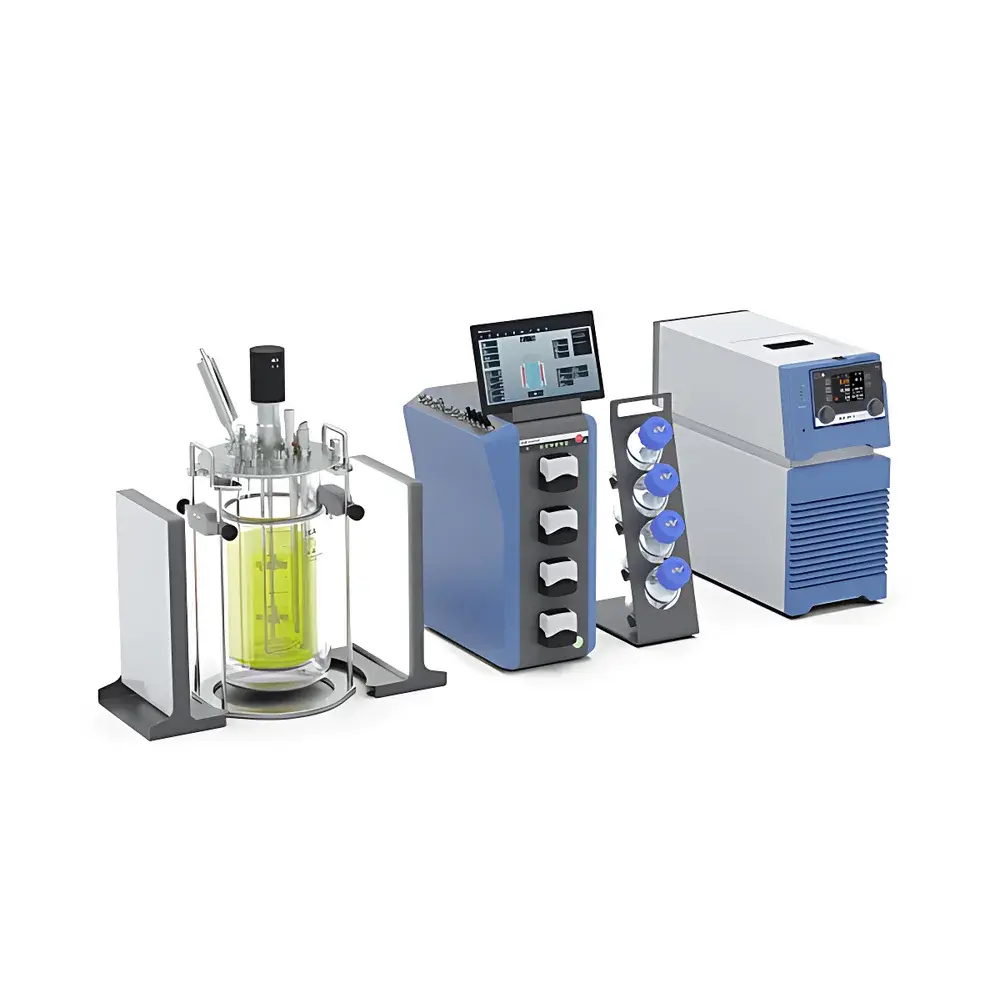
IKA HABITAT Photo Cell CCT Light-Controlled Bioreactor
| Brand | IKA |
|---|---|
| Origin | Germany |
| Manufacturer Type | Manufacturer |
| Origin Category | Imported |
| Model | HABITAT Photo Cell CCT |
| Instrument Classification | Photobioreactor / Lab-Scale Controlled Bioreactor |
| Vessel Material | Borosilicate Glass (DIN ISO 3585) |
| Dimensions (W×D×H) | 224 × 624 × 405 mm |
| Weight | 14 kg |
| Power Supply | 100–240 V, 50/60 Hz |
| Max. Input Power | 1100 W |
| IP Rating | IP20 |
| Environmental Operating Conditions | 5–40 °C, ≤80% RH (at 31 °C), linearly decreasing to 50% RH at 40 °C |
Overview
The IKA HABITAT Photo Cell CCT is a modular, light-integrated laboratory-scale bioreactor system engineered for precision photobiological cultivation—particularly algae, cyanobacteria, and photosynthetic microorganisms requiring controlled spectral irradiance, gas composition, and physiological parameters. Unlike conventional stirred-tank reactors, the HABITAT Photo Cell CCT integrates a calibrated LED illumination panel directly into its control architecture, enabling programmable light intensity (0–100% full spectrum white or customizable wavelength profiles), photoperiod simulation (e.g., circadian cycles), and real-time photon flux monitoring. Its core measurement and control architecture follows standard bioprocess engineering principles: dissolved oxygen (DO) is regulated via cascade control with O₂/N₂/air/CO₂ mass flow controllers; pH is maintained through acid/base dosing; temperature is stabilized using either a vessel-adapted heating blanket (for single-wall vessels) or external thermostatic circulation (for double-jacketed vessels); and mixing employs IKA’s proprietary Chaotic Mixing algorithm—a deterministic, non-periodic agitation strategy derived from chaotic dynamical systems theory—to achieve superior homogeneity, reduced shear stress, and enhanced mass transfer without mechanical complexity.
Key Features
- Integrated 10.4-inch tablet PC with touch interface, running IKA BioControl software v5.x—supporting FDA 21 CFR Part 11-compliant audit trail, electronic signatures, and role-based access control
- Four independently controllable Watson-Marlow 114DV peristaltic pumps (acid, base, antifoam, feed), each reversible, with flow range 1–270 mL/min and tube ID compatibility 0.5–4.8 mm
- Four-channel mass flow control (MFC) for N₂, O₂, air, and CO₂—full-scale range 0–2000 sccm per channel, accuracy ±2% FS, pressure input 200–3000 mbar
- Comprehensive sensor suite: pH (0–14, ±0.02 pH), DO (0–200% saturation, ±0.3% sat), temperature (PT1000, 5–60 °C operation, ±0.2 °C control accuracy), level, foam, turbidity, conductivity, and optional CO₂ (in-line IR sensor)
- Chaotic Mixing mode: dynamically modulated impeller speed profile (1–2200 rpm) generating non-repeating velocity fields to eliminate dead zones while minimizing cell damage
- Modular vessel support: compatible with single-wall and double-jacketed borosilicate glass vessels (0.5–10 L working volume), autoclavable lid mount with integrated sensor and drive attachment points
- Robust data management: 32 GB internal storage, Ethernet/RS232/USB/WiFi connectivity, real-time remote monitoring via web browser or mobile client
Sample Compatibility & Compliance
The HABITAT Photo Cell CCT supports aerobic, anaerobic, and photoautotrophic cultivations across microbial, algal, and mammalian suspension systems. Its glass vessel construction ensures chemical inertness and optical clarity for in-situ light transmission and visual process observation. The system complies with ISO 13485 design controls for medical device-related bioprocess development and meets essential requirements of the EU Machinery Directive 2006/42/EC. For regulated environments, the optional 21 CFR Part 11 software package provides electronic record integrity, user authentication, change tracking, and secure calibration logging—fully traceable for GLP, GMP, and ISO/IEC 17025 audits. All sensor calibrations (pH, DO, temperature) follow documented SOPs with automated timestamped entries and deviation alerts.
Software & Data Management
BioControl software delivers a unified interface for configuration, operation, visualization, and reporting. Process parameters are displayed on synchronized time-series graphs with zoom, overlay, and export (CSV/PDF). Calibration workflows guide users step-by-step with validation prompts and automatic metadata capture (operator ID, date/time, buffer lot, electrode serial number). Batch records include complete event logs (start/stop, alarm triggers, manual interventions), raw sensor outputs, and controller setpoint histories. Data export supports LIMS integration via OPC UA or RESTful API. Audit trails are immutable and encrypted, meeting ALCOA+ (Attributable, Legible, Contemporaneous, Original, Accurate, Complete, Consistent, Enduring, Available) data integrity standards.
Applications
- Phototrophic cultivation of Chlorella vulgaris, Nannochloropsis gaditana, and Synechocystis sp. PCC 6803 under controlled PAR (Photosynthetically Active Radiation) conditions
- Metabolic engineering studies requiring dynamic light/dark cycling to modulate carbon partitioning or pigment synthesis
- Biopharmaceutical upstream process development for photosynthetic chassis expressing recombinant proteins
- Wastewater treatment microbiology: optimization of algal-bacterial consortia for nutrient removal and biomass recovery
- Carbon capture research: quantification of CO₂ fixation kinetics under variable irradiance and gas composition
- Educational bioprocessing labs: hands-on training in fed-batch, perfusion, and chemostat operation with full parameter transparency
FAQ
Is the LED illumination panel spectrally tunable?
No—the standard HABITAT Photo Cell CCT includes a broadband white LED panel (400–700 nm) with adjustable intensity only. Spectral customization requires third-party LED modules interfaced via analog/digital I/O ports.
Can the system operate in perfusion mode with continuous harvest?
Yes—via coordinated control of feed pumps, harvest pump (configured as fifth peristaltic channel), level sensor feedback, and turbidity monitoring to maintain viable cell density.
What vessel configurations are validated for autoclaving?
All glass vessels, lids, and sensor housings are rated for repeated steam sterilization at 121 °C, 2 bar for 20 minutes. Silicone tubing and LED panel must be removed prior to autoclaving.
Does the Chaotic Mixing algorithm require special impellers?
No—it operates with standard IKA impellers (6-blade Rushton, 3-blade hydrofoil, or flat-blade disc), though optimal performance is achieved with dual-impeller arrangements on the same shaft.
Is remote access supported without local network infrastructure?
Yes—via optional 4G/LTE router integration or direct WiFi hotspot mode; all remote sessions enforce TLS 1.2+ encryption and session timeout policies.



