
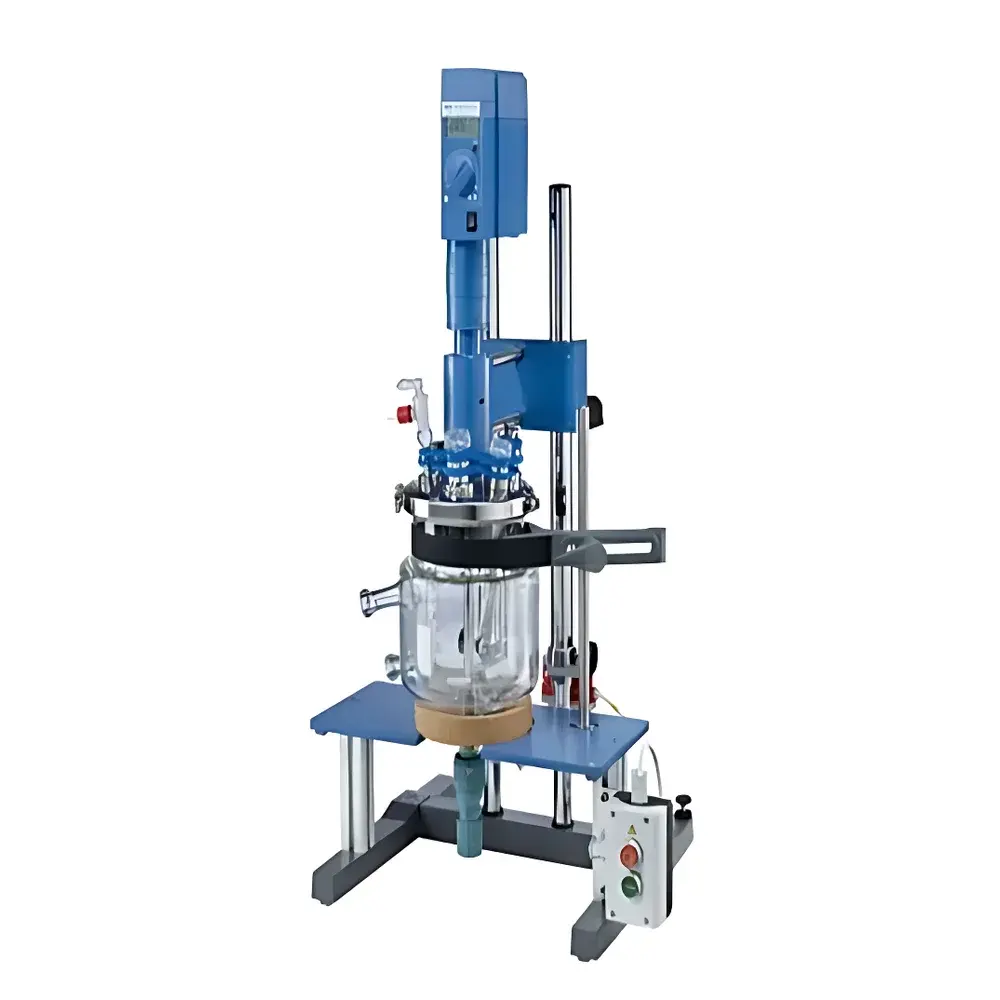
IKA LR-2.ST Modular Laboratory Reactor System with Jacketed Vessel LR 2000.2
| Brand | IKA |
|---|---|
| Origin | Germany |
| Model | LR-2.ST |
| Vessel Type | Jacketed Glass Reactor (LR 2000.2) |
| Minimum Working Volume | 500 mL |
| Maximum Working Volume | 2000 mL |
| Temperature Range | Ambient to 230 °C |
| Vacuum Capability | Down to 25 mbar |
| Max. Viscosity Handling | 150,000 mPa·s |
| Speed Range | 8–290 rpm |
| Vertical Travel of Lifting Stand | 390 mm |
| Material of Wetted Parts | Borosilicate Glass 3.3, FFPM, PTFE, Stainless Steel 1.4571 |
| Port Configuration | 3× NS 29/32 + 2× NS 14/23 |
| Dimensions (W×H×D) | 460 × 1240 × 430 mm |
| Weight | 25 kg |
| Ambient Operating Conditions | 5–40 °C, ≤80% RH |
| Ingress Protection | IP 42 |
| Interface | RS 232, Analog Output |
| Power Supply | 230 V, 50/60 Hz |
| Rated Input Power | 130 W |
Overview
The IKA LR-2.ST Modular Laboratory Reactor System is an engineered platform for precise, reproducible chemical synthesis and process development under controlled thermal, mechanical, and atmospheric conditions. Based on Couette-type shear mechanics and integrated temperature regulation via jacketed vessel design, the system enables real-time monitoring and control of reaction kinetics, mixing efficiency, and phase behavior across a wide range of viscosities and thermal profiles. Designed for scalability from lab-scale optimization to pilot-stage simulation, the LR-2.ST supports both open-atmosphere and vacuum-enabled operations (down to 25 mbar), making it suitable for solvent removal, distillation, hydrogenation, polymerization, and heterogeneous catalysis workflows. Its modular architecture allows seamless integration of ancillary modules—including temperature control units, condensers, dosing systems, and gas inlets—without compromising structural integrity or operational safety.
Key Features
- Modular reactor platform with configurable ports (3× NS 29/32 and 2× NS 14/23) for simultaneous installation of temperature probes, overhead stirrers, ULTRA-TURRAX® dispersers, reflux condensers, and feed lines.
- Jacketed borosilicate glass vessel (LR 2000.2) rated for continuous operation from ambient temperature up to 230 °C, compatible with external heating/cooling circulators.
- EUROSTAR control motor (P7 model) delivering high-torque performance with microprocessor-regulated speed stability—even under variable load conditions—and built-in relative torque display for indirect viscosity trend analysis.
- FFPM (perfluoroelastomer) sealing components providing exceptional resistance to aggressive solvents, thermal cycling, and vacuum-induced compression set.
- Integrated safety interlock switch preventing operation when lid is improperly seated; compliant with DIN EN 60529 IP 42 environmental protection rating.
- Vertical lifting stand with 390 mm travel range and fine-height adjustment for precise alignment of drive shaft and impeller geometry.
- Dual communication interfaces: RS 232 for instrument control and data logging, plus analog output (0–10 V) for external process monitoring systems.
Sample Compatibility & Compliance
The LR-2.ST accommodates diverse sample types—including corrosive organometallics, high-boiling-point solvents, viscous polymer melts, and moisture-sensitive reagents—thanks to its chemically inert wetted path (borosilicate glass 3.3, FFPM, PTFE, and acid-resistant stainless steel 1.4571). The system meets fundamental requirements for Good Manufacturing Practice (GMP) and Good Laboratory Practice (GLP) environments, supporting audit-ready documentation through traceable parameter logging. While not inherently 21 CFR Part 11-compliant, its RS 232 interface enables integration with validated LIMS or ELN platforms that enforce electronic signature and change-control protocols. All electrical components conform to IEC 61000-6-3 (EMC) and IEC 61000-6-2 (immunity) standards.
Software & Data Management
The LR-2.ST operates as a standalone hardware platform but is fully compatible with IKA’s Labworldsoft® software suite (optional), enabling remote parameter configuration, real-time graphing of speed/torque/temperature trends, and export of time-stamped CSV datasets. Data acquisition supports synchronization with external sensors (e.g., pH, conductivity, FTIR flow cells) via analog input channels. Audit trails—including user login events, setpoint modifications, and emergency stop triggers—are recordable when interfaced with compliant laboratory informatics infrastructure. Firmware updates are delivered via USB or serial connection and include version-controlled release notes aligned with ISO 9001 change management practices.
Applications
- Optimization of batch reaction parameters (temperature ramping, addition rate, agitation intensity) for API synthesis and fine chemical manufacturing.
- Viscosity profiling during polymer chain growth or crosslinking reactions using torque-derived rheological indicators.
- Vacuum-assisted solvent exchange and low-temperature crystallization under inert atmosphere.
- Multi-phase emulsification and nanoparticle dispersion using combined anchor + ULTRA-TURRAX® configurations.
- Thermal stability testing of catalysts and battery electrolyte formulations under controlled heating/cooling cycles.
- Scale-down modeling of industrial stirred-tank reactors (STRs) for kinetic modeling and CFD validation.
FAQ
Can the LR-2.ST be operated under inert gas purge?
Yes—the reactor lid includes dedicated gas inlet/outlet ports compatible with standard Schlenk line connections; optional gas-tight seals and pressure-rated accessories are available.
Is the anchor impeller LR 2000.11 suitable for highly viscous media?
Yes—it features a scraped-surface geometry with flow-through orifices, designed specifically for non-Newtonian fluids up to 150,000 mPa·s at reduced rotational speeds.
Does the system support automated temperature ramping?
Temperature ramping requires an external circulator with programmable profile capability; the LR-2.ST itself provides passive jacket connectivity but no integrated heating/cooling element.
What maintenance intervals are recommended for the FFPM seals?
Under normal use (≤200 °C, non-oxidizing environment), FFPM seals exhibit service life exceeding 12 months; visual inspection before each vacuum cycle is advised.
Is calibration documentation provided with the unit?
Factory calibration certificates for speed accuracy (±1 rpm) and torque linearity (±3% FS) are included; temperature sensor calibration is performed separately by the end-user’s metrology provider.
Related Products



