
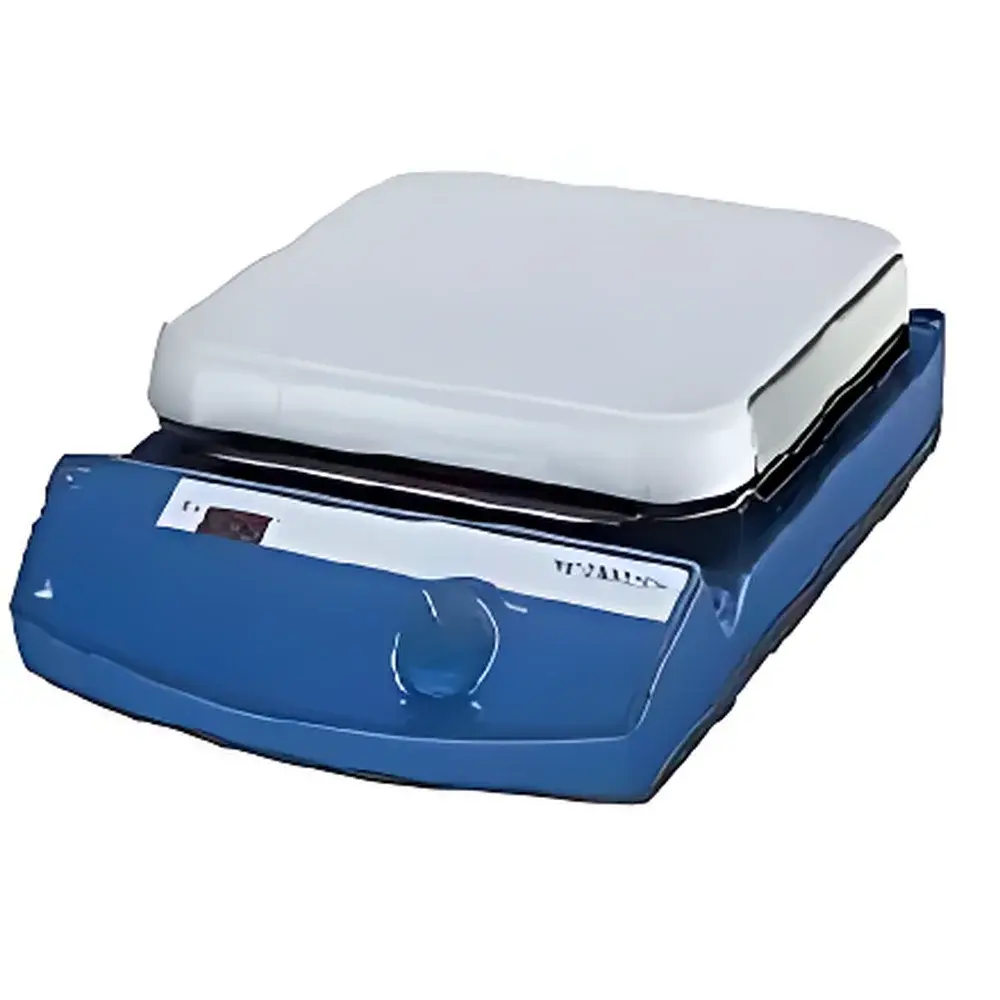
IKA C-MAG HP10 Electric Heating Plate
| Brand | IKA |
|---|---|
| Origin | Germany |
| Model | C-MAG HP10 |
| Heating Power | 1500 W |
| Max. Heating Temperature | 500 °C |
| Temperature Uniformity | ±10 °C |
| Plate Dimensions | 260 × 260 mm |
| Heating Zone Dimensions | 260 × 260 mm |
| Display Type | LED |
| Safety Cut-off | 550 °C |
| External Sensor Interface | ETSD5 |
| Sensor-Controlled Temp. Accuracy | ±3 K |
| Media Temperature Stability | ±3 K |
| Heating Rate (1 L H₂O) | 5 K/min |
| Housing Protection Rating | IP21 |
| Operating Ambient | 5–40 °C, ≤80 % RH |
| Voltage | 100 / 120 / 230 V, 50/60 Hz |
| Weight | 6 kg |
Overview
The IKA C-MAG HP10 Electric Heating Plate is a high-power, precision-engineered laboratory heating platform designed for demanding sample preparation, digestion, evaporation, and reaction support applications. Built on IKA’s decades-long heritage in laboratory thermal instrumentation, the HP10 employs resistive ceramic heating elements embedded beneath a monolithic, seamless ceramic plate—ensuring rapid thermal response, long-term chemical inertness, and exceptional mechanical robustness. Unlike conventional metal-sheathed heaters, the all-ceramic surface resists corrosion from strong acids (e.g., HNO₃, HCl, HF), alkalis, and organic solvents—making it suitable for EPA Method 3050B/3051A acid digestions, ASTM D5291 sample ashing pre-treatment, and ISO 11885 metal extraction protocols. The device operates on closed-loop microprocessor control: real-time feedback from internal thermistors and optional external Pt100 sensors (via ETSD5 interface) enables dynamic power modulation to maintain setpoint stability under variable load conditions. Its fixed overtemperature safety limit of 550 °C complies with EN 61000-6-3 and IEC 61010-1 requirements for Class II laboratory equipment.
Key Features
- 1500 W high-power heating capacity for rapid ramp-up and sustained thermal delivery across large-volume vessels (up to 5 L round-bottom flasks or 4 L beakers)
- Monolithic 260 × 260 mm ceramic plate with zero seams—eliminating crevices where reagents can accumulate and degrade performance
- Dual-mode temperature control: LED-displayed setpoint regulation (±10 K accuracy) + optional external sensor feedback (±3 K accuracy with ETSD5 probe)
- Elevated control panel design minimizes liquid splash ingress and improves ergonomics during prolonged operation
- Integrated thermal warning system: blinking LED indicator alerts users to active heating state and surface hazard
- Compliance-ready architecture: meets IEC 61010-1 Edition 3 for electrical safety and EN 60529 IP21 for limited protection against vertically falling solids and dripping water
- Multi-voltage compatibility (100 / 120 / 230 V, 50/60 Hz) ensures global deployment without hardware modification
Sample Compatibility & Compliance
The C-MAG HP10 accommodates standard laboratory glassware—including borosilicate beakers (up to 4 L), Erlenmeyer flasks, digestion vessels (e.g., Teflon®-lined Parr bombs), and quartz crucibles—without thermal distortion or edge overheating. Its uniform 260 × 260 mm heating zone supports consistent energy distribution, critical for multi-vessel parallel processing in QA/QC labs. The unit is routinely validated in GLP environments per ASTM E2735 (Standard Practice for Calibration of Laboratory Heaters) and supports audit trails when paired with IKA’s lab software suite. It satisfies essential requirements for USP balance calibration warm-up procedures, FDA 21 CFR Part 11-compliant temperature logging (when used with certified data acquisition systems), and ISO/IEC 17025-accredited method validation workflows.
Software & Data Management
While the C-MAG HP10 operates as a standalone instrument, its ETSD5 sensor port enables integration into centralized monitoring networks via RS232 or optional USB-to-RS232 adapters. When connected to IKA Labworldsoft™ or third-party SCADA platforms (e.g., LabVIEW™, DeltaV™), users can log real-time plate temperature, power draw, and runtime—enabling full traceability for SOP-driven processes. All sensor-triggered events (e.g., overtemperature cut-off, sensor disconnect) are timestamped and storable for 21 CFR Part 11 compliance when deployed with electronic signature-enabled systems. Firmware updates are delivered via IKA’s secure portal, ensuring continued alignment with evolving IEC 62304 medical device software standards.
Applications
- Acid digestion of environmental soils and sediments (EPA SW-846 Methods 3050B, 3051A, 3052)
- Controlled evaporation of solvent extracts prior to GC-MS or ICP-MS analysis
- Pre-heating and temperature stabilization of viscometry baths and density measurement cells
- Support heating for reflux condensation setups in synthetic organic chemistry
- Thermal conditioning of calibration standards in metrology laboratories
- Pre-drying of filter papers and gravimetric crucibles in total suspended solids (TSS) and volatile solids (VS) assays
FAQ
Can the C-MAG HP10 be used with temperature probes other than the IKA ETSD5?
Yes—any Pt100-class RTD with standard 2-wire or 4-wire configuration and 0–100 °C or 0–300 °C range may be interfaced, though IKA calibration certificates and firmware optimization apply exclusively to ETSD5.
Is the ceramic plate resistant to hydrofluoric acid (HF)?
The Al₂O₃-based ceramic surface exhibits high resistance to HF at concentrations ≤5 % and temperatures ≤80 °C for short-term exposure; prolonged contact or elevated temperatures require evaluation per ISO 15190 Annex B.
Does the unit support programmable ramp-soak profiles?
No—the C-MAG HP10 provides manual setpoint control only; for multi-step thermal protocols, integration with external programmable controllers or IKA’s RCT digital hotplate-stirrers is recommended.
What maintenance is required to ensure long-term temperature accuracy?
Annual verification using NIST-traceable dry-block calibrators (e.g., Fluke 9142) is advised; cleaning must use non-abrasive, pH-neutral solutions—never steel wool or chlorinated solvents.
Can it operate continuously at 500 °C?
Yes—rated for indefinite operation at maximum temperature under proper ventilation; however, continuous use above 450 °C accelerates thermal aging of internal insulation and is not recommended for routine applications.



