
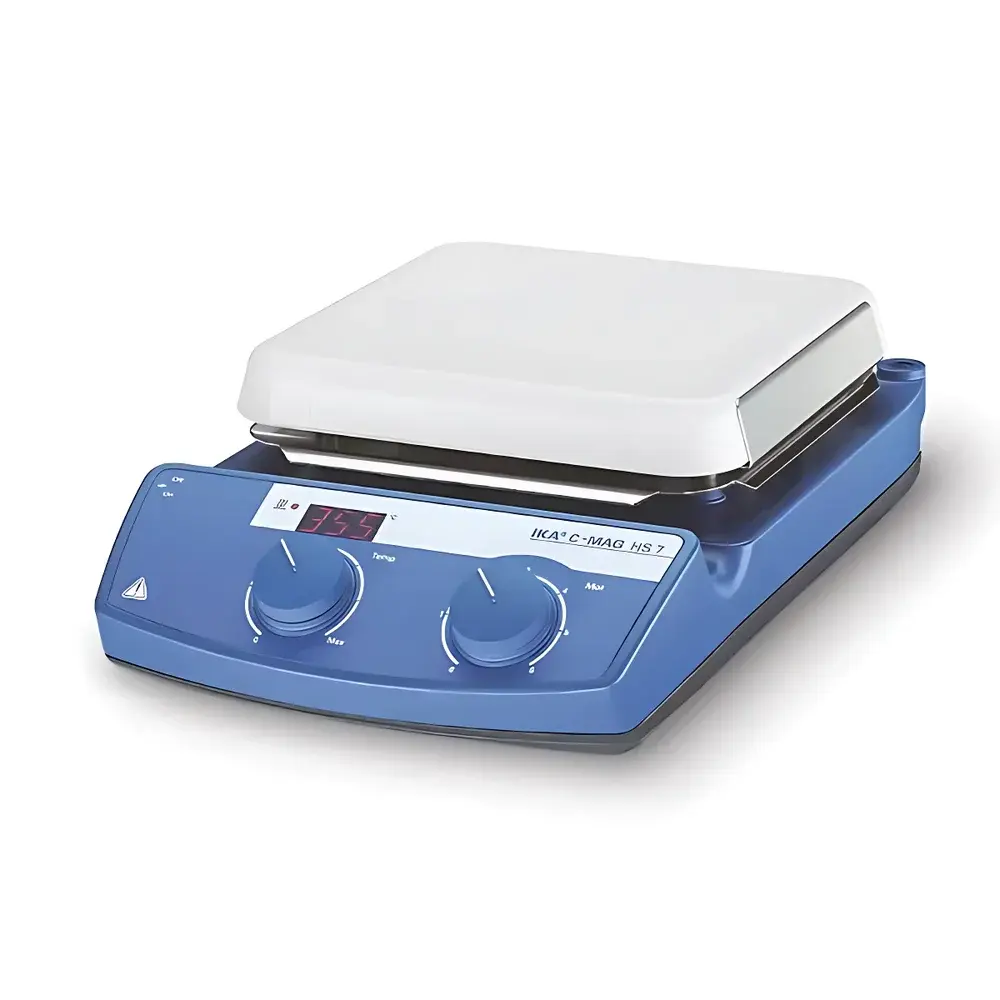
IKA C-MAG HS 7 Magnetic Stirrer with Hotplate
| Brand | IKA |
|---|---|
| Origin | Germany |
| Model | C-MAG HS 7 |
| Max. Stirring Volume (H2O) | 10 L |
| Motor Output Power | 1.5 W |
| Speed Range | 100–1500 rpm |
| Stirrer Rotation Direction | Counter-Clockwise |
| Speed Control | Analog Dial (0–6 scale) |
| Max. Stir Bar Length | 80 mm |
| Heating Power | 1000 W |
| Heating Temperature Range | 50–500 °C |
| Heating Rate | 5 K/min |
| Temperature Setting Accuracy | ±5 K |
| External Temperature Sensor Interface | ETS-D5 compatible |
| Safety Overtemperature Cut-off | 550 °C |
| Working Plate Material | Ceramic |
| Plate Dimensions | 180 × 180 mm |
| Device Dimensions (W × H × D) | 220 × 105 × 335 mm |
| Weight | 5 kg |
| Ambient Operating Conditions | 5–40 °C, ≤80 % RH |
| Protection Class | IP21 (DIN EN 60529) |
| Voltage | 230 V AC, 50/60 Hz |
| Total Input Power | 1020 W |
Overview
The IKA C-MAG HS 7 is a high-performance magnetic stirrer and hotplate combination engineered for precision thermal and mechanical control in analytical, quality control, and synthetic chemistry laboratories. Designed around a robust microprocessor-controlled architecture, it integrates independent regulation of stirring speed and heating plate temperature—enabling simultaneous, stable agitation and thermal conditioning of samples up to 10 L (water equivalent). Its operation relies on a permanent magnet drive system coupled with a high-torque DC motor, delivering consistent rotational force across the full speed range (100–1500 rpm), even under viscous or dense media conditions. The ceramic heating plate provides uniform thermal distribution and exceptional resistance to chemical attack from acids, bases, and organic solvents—critical for long-term reliability in demanding lab environments.
Key Features
- Integrated dual-control system: Independent analog dials for precise adjustment of stirring speed (0–6 scale, corresponding to 100–1500 rpm) and heating temperature (50–500 °C)
- Ceramic working surface (180 × 180 mm): Seamless, chemically inert, scratch-resistant, and thermally stable up to 500 °C
- Microprocessor feedback loop: Real-time monitoring of motor load and plate temperature ensures consistent speed maintenance and thermal setpoint accuracy (±5 K)
- Enhanced safety architecture: Fixed overtemperature cut-off at 550 °C, visual thermal warning indicator (flashing LED during heating), and elevated control panel design to minimize liquid ingress risk
- External temperature sensing compatibility: Supports optional IKA ETS-D5 electronic contact thermometer for closed-loop solution temperature control—meeting requirements for GLP-compliant thermal validation workflows
- Robust mechanical construction: Compact footprint (220 × 105 × 335 mm), 5 kg mass ensuring stability during high-speed agitation, and IP21-rated enclosure for protection against vertically falling solids and limited moisture exposure
Sample Compatibility & Compliance
The C-MAG HS 7 accommodates standard laboratory glassware including beakers (up to 10 L capacity), round-bottom flasks, and crystallization dishes. Its strong magnetic coupling supports stirring bars up to 80 mm in length, enabling efficient mixing of heterogeneous suspensions, polymer solutions, and high-viscosity reagents. The device complies with DIN EN 60529 (IP21), IEC 61010-1 (safety requirements for electrical equipment for measurement, control, and laboratory use), and meets electromagnetic compatibility standards per EN 61326-1. When used with an ETS-D5 sensor and appropriate SOP documentation, it supports temperature-critical applications aligned with USP , ISO/IEC 17025, and FDA 21 CFR Part 11 data integrity expectations for audit trails in regulated environments.
Software & Data Management
While the C-MAG HS 7 operates via analog controls without embedded digital connectivity, its design facilitates integration into documented laboratory workflows. The ETS-D5 external temperature probe enables analog voltage output (0–10 V) proportional to measured solution temperature—allowing connection to third-party data loggers or PLC-based monitoring systems. All parameter settings (speed dial position, temperature dial position, and thermal status indicators) are physically observable and reproducible, supporting manual recordkeeping in paper-based or electronic lab notebooks (ELN). For facilities requiring traceability, the device’s fixed safety thresholds (e.g., 550 °C cut-off) and calibrated thermal response characteristics provide verifiable operational boundaries essential for GMP and ISO 9001 process validation.
Applications
- Controlled dissolution testing in pharmaceutical development
- Polymer synthesis requiring simultaneous heating and shear-stable agitation
- Preparation of calibration standards and reference materials under defined thermal profiles
- Sample homogenization prior to ICP-MS, HPLC, or titration analysis
- Accelerated stability studies involving temperature-dependent reaction kinetics
- Buffer and media preparation in microbiology and cell culture labs
FAQ
Does the C-MAG HS 7 support programmable ramp-soak temperature profiles?
No—temperature is set manually via analog control; however, external controllers or data loggers may be used with the ETS-D5 interface to implement custom thermal protocols.
Can the unit maintain constant speed when viscosity changes during a reaction?
Yes—the microprocessor continuously adjusts motor current to compensate for load variation, preserving set rpm within specification across the operating range.
Is the ceramic plate resistant to hydrofluoric acid (HF)?
No—while highly resistant to most common laboratory chemicals, ceramic surfaces are not HF-compatible; alternative PTFE-coated or glass-lined hotplates are recommended for HF handling.
What is the minimum ambient temperature for safe operation?
5 °C—the device is rated for operation between 5 and 40 °C; extended use below 5 °C may affect sensor accuracy and condensation management.
Does the unit include a built-in temperature sensor for solution monitoring?
No—solution temperature monitoring requires the optional ETS-D5 probe; the plate temperature display reflects only the ceramic surface temperature.



