
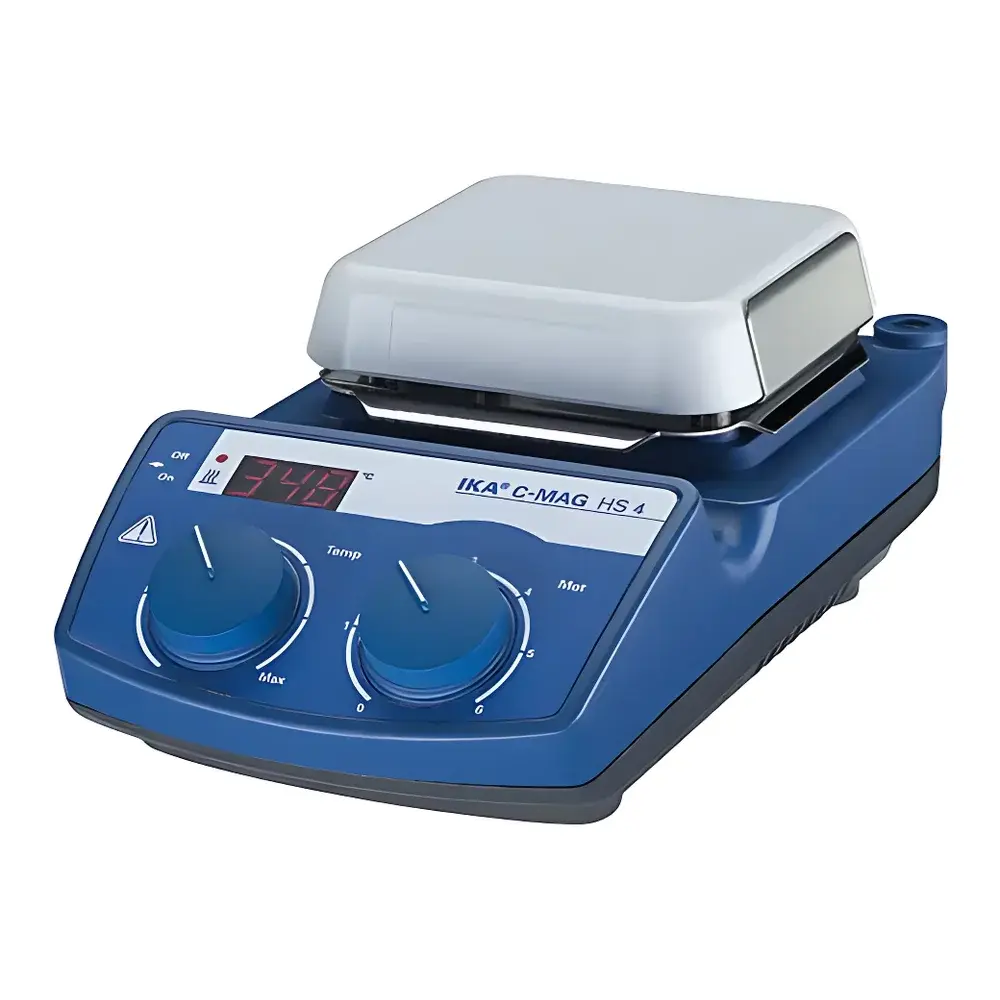
IKA C-MAG HS4 Heating Magnetic Stirrer
| Brand | IKA |
|---|---|
| Origin | Germany (manufactured under IKA global quality standards |
| Model | C-MAG HS4 |
| Stirring Position(s) | 1 |
| Max. Stirring Volume (H₂O) | 5 L |
| Speed Range | 100–1500 rpm |
| Heating Temperature Range | 50–500 °C |
| Heating Power | 250 W |
| Plate Material | Ceramic (monolithic, seamless) |
| Plate Dimensions | 100 × 100 mm |
| Device Dimensions (W × D × H) | 150 × 105 × 260 mm |
| Weight | 3 kg |
| Protection Class | IP21 (per DIN EN 60529) |
| Operating Ambient | 5–40 °C, ≤80 % RH |
| Input Voltage/Frequency | 100–230 V, 50/60 Hz |
| Motor Output Power | 1.5 W |
| Safety Cut-off Temperature | 550 °C |
| Temp. Control Accuracy | ±10 K (with external probe) |
| Display | LED digital display for speed and temperature |
| Control Logic | Microprocessor-based closed-loop feedback for speed stability and thermal regulation |
Overview
The IKA C-MAG HS4 is a compact, single-position heating magnetic stirrer engineered for precision, safety, and reproducibility in routine laboratory workflows involving temperature-controlled mixing of low-to-moderate viscosity samples. It operates on the principle of magnetic coupling: a rotating permanent magnet beneath the ceramic plate induces synchronous rotation of a PTFE- or glass-coated magnetic stir bar immersed in the sample vessel. Simultaneous resistive heating of the ceramic plate enables independent or coupled control of agitation and thermal input—critical for applications such as dissolution testing, buffer preparation, catalyst activation, and pre-heating prior to analytical assays. Designed and validated per IKA’s global engineering specifications, the HS4 complies with IEC 61010-1 for electrical safety and incorporates fail-safe thermal protection architecture to meet GLP-aligned lab infrastructure requirements.
Key Features
- Ceramic heating plate (100 × 100 mm): Monolithic, chemically inert surface resistant to strong acids, bases, and organic solvents—eliminates risk of delamination or etching common in coated steel plates.
- Microprocessor-controlled dual-loop regulation: Real-time feedback from internal thermistors and motor tachometry ensures stable rotational speed (±5 rpm repeatability) and consistent thermal output—even under load variations or ambient drift.
- Digital LED interface: Displays both setpoint and actual values for speed (rpm) and plate temperature (°C), enabling precise method documentation and inter-lab protocol transfer.
- Elevated control panel design: Minimizes liquid ingress risk during splash-prone operations and improves ergonomics for visual verification and manual adjustment.
- Integrated safety circuitry: Automatic shutdown at 550 °C prevents thermal runaway; flashing LED indicator warns users of elevated surface temperature (>60 °C) during operation.
- Optimized magnetic drive system: High-torque neodymium magnet array maintains coupling integrity up to 5 L aqueous loads (or equivalent viscosity), reducing “jumping” or decoupling even with off-center vessels.
Sample Compatibility & Compliance
The C-MAG HS4 accommodates standard round-bottom flasks (up to 1000 mL), beakers (up to 2000 mL), and crystallization dishes compatible with magnetic stirring. Its ceramic surface supports use with aggressive reagents including concentrated HNO₃, NaOH (≤50 % w/w), and acetone without degradation. The device conforms to IEC 61010-1:2010 for laboratory electrical equipment safety and carries CE marking. While not intrinsically rated for hazardous area use, its IP21 enclosure provides basic protection against vertically falling solids and limited drip exposure—suitable for general-purpose chemistry, QC, and teaching labs operating under ISO/IEC 17025 or FDA 21 CFR Part 11–aligned documentation practices.
Software & Data Management
The C-MAG HS4 is a stand-alone analog-digital hybrid instrument with no embedded firmware update capability or USB/Ethernet connectivity. All operational parameters are set manually via calibrated rotary dials and confirmed on the LED display. For traceable temperature control, it supports integration with IKA’s ETS-D5 or ETS-D6 external contact temperature probes (sold separately), enabling solution-phase temperature monitoring with ±0.5 K resolution. When used with validated probe calibration certificates and manual logbook entries, the system satisfies basic audit requirements for GLP-compliant dissolution or stability studies. No proprietary software or cloud platform dependency is introduced—ensuring long-term operational continuity and IT security compliance.
Applications
- Preparation of standardized buffers and reagent solutions requiring uniform thermal homogenization (e.g., PBS, Tris-HCl, EDTA).
- Controlled heating and mixing during solid-phase synthesis, nanoparticle precipitation, or polymer dissolution protocols.
- Accelerated extraction procedures in environmental and food testing labs (e.g., Soxhlet pre-extraction, acid digestion support).
- QC release testing where defined agitation rate and bath-equivalent temperature profiles are specified (e.g., USP disintegration apparatus auxiliary heating).
- Teaching laboratories performing kinetic studies, reaction optimization, or viscosity benchmarking across temperature gradients.
FAQ
Does the C-MAG HS4 support external temperature probe feedback for closed-loop solution temperature control?
Yes—when paired with an IKA ETS-D5 or ETS-D6 probe (via optional H38 support rod), the unit accepts real-time sensor input to regulate heater output based on measured solution temperature, not just plate surface temperature.
What is the maximum recommended vessel size for stable stirring at 1500 rpm?
For optimal vortex formation and magnetic coupling stability, use cylindrical vessels ≤100 mm in diameter and ≤200 mm in height; larger formats may require reduced speed or specialized stir bars.
Can the ceramic plate withstand thermal shock from rapid cooling with water or ice?
No—sudden thermal gradients exceeding 150 K/min may induce microfractures; allow natural cooldown or use forced-air cooling only after power-off.
Is the device suitable for use with non-aqueous, high-boiling-point solvents like DMF or ethylene glycol?
Yes, provided the set temperature remains below the solvent’s flash point and vapor pressure limits; always verify chemical compatibility of stir bars and vessel materials separately.
How is calibration verified for routine maintenance?
Speed accuracy is confirmed using a certified optical tachometer; temperature calibration requires NIST-traceable dry-block calibrator or reference thermometer at three points across the 50–500 °C range, per internal SOP or ISO/IEC 17025 Clause 6.5.



