
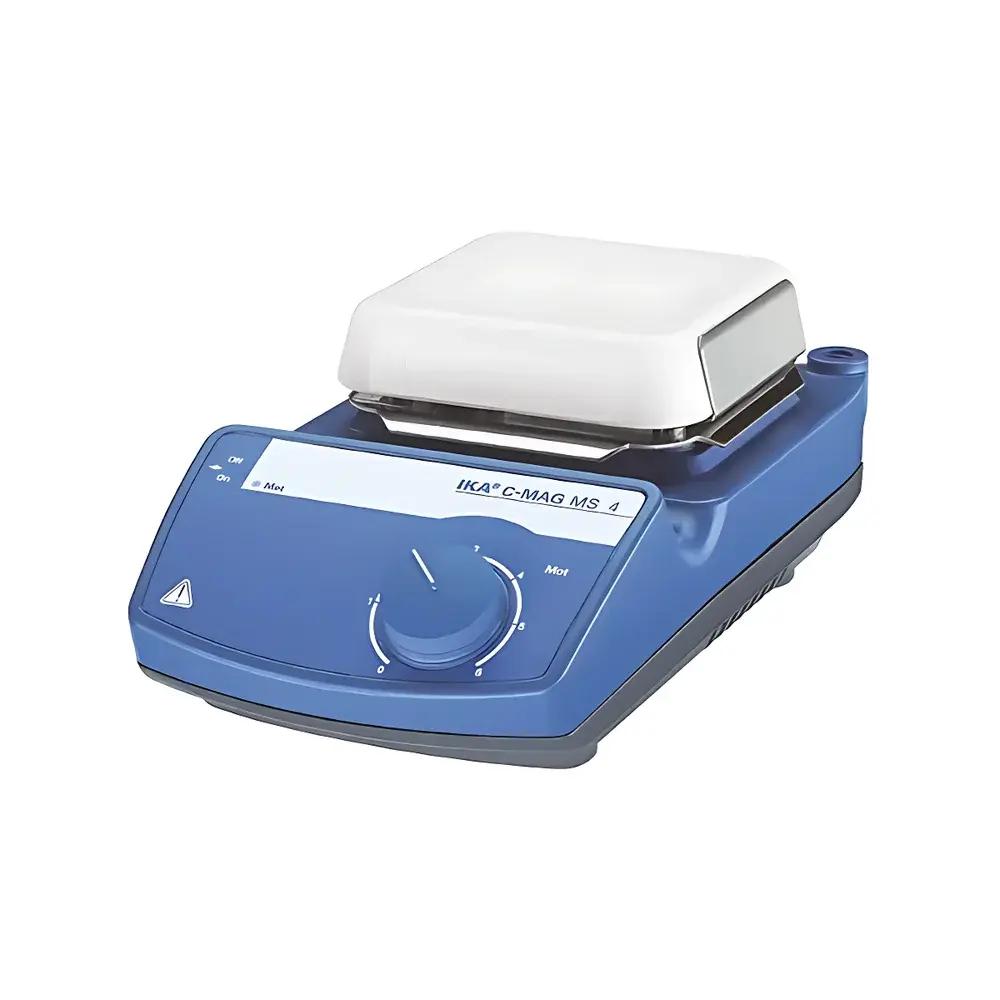
IKA C-MAG MS 4 Magnetic Stirrer
| Brand | IKA |
|---|---|
| Origin | Germany |
| Model | C-MAG MS 4 S025 |
| Stirrer Type | Magnetic Stirrer |
| Max. Stirring Volume (H₂O) | 5 L |
| Speed Range | 100–1500 rpm |
| Heating Plate Self-Heating (22°C, 1 h) | +2 K |
| Workplate Material | Ceramic |
| Workplate Dimensions | 100 × 100 mm |
| Overall Dimensions | 150 × 105 × 260 mm |
| Weight | 3 kg |
| Ambient Temperature Range | 5–40 °C |
| Relative Humidity Limit | 80 % |
| Protection Class | IP21 |
| Voltage | 230 V (also available in 120 V / 100 V) |
| Frequency | 50/60 Hz |
| Input Power | 30 W |
| Motor Output Power | 1.5 W |
| Max. Load Capacity | 7.5 kg |
| Rotation Direction | Counter-clockwise |
| Speed Control | Analog dial (0–6 scale) |
| Panel Height | Elevated for splash resistance and ergonomic readability |
Overview
The IKA C-MAG MS 4 is a compact, microprocessor-controlled magnetic stirrer engineered for reliable, low-noise operation in routine laboratory environments. Designed around a high-torque permanent magnet drive system, it delivers consistent rotational motion to magnetic stir bars across a wide viscosity range—enabling effective homogenization of aqueous, organic, and moderately viscous solutions up to 5 L. Its core operational principle relies on electromagnetic coupling between the rotating internal magnet assembly and the external stir bar, eliminating mechanical shafts or seals that could compromise containment or introduce contamination. The unit operates without integrated heating, distinguishing it from hotplate stirrers; instead, it prioritizes precise speed regulation and chemical resistance—making it ideal for applications requiring thermal isolation, inert atmosphere compatibility, or integration with external temperature control systems (e.g., water baths or cryostats). Built to meet DIN EN 60529 IP21 ingress protection standards, the device resists incidental splashes and dust accumulation while maintaining stable performance under ambient lab conditions (5–40 °C, ≤80 % RH).
Key Features
- High-strength neodymium magnet drive ensures robust coupling with stir bars—even in dense or high-viscosity media—minimizing “jumping” or decoupling during extended operation.
- Microprocessor-based speed regulation with real-time motor feedback maintains setpoint accuracy within ±5 rpm across the full 100–1500 rpm range, independent of load fluctuations or voltage drift.
- Seamless ceramic workplate (100 × 100 mm) offers exceptional resistance to acids, alkalis, solvents, and thermal shock—supporting long-term use with aggressive reagents including concentrated HNO₃, NaOH, and acetone.
- Elevated control panel improves ergonomics and reduces risk of liquid ingress; digital speed indication remains legible during active stirring, even with condensation or minor splashes.
- Compact footprint (150 × 105 × 260 mm) and lightweight construction (3 kg) facilitate placement on fume hood shelves, biosafety cabinets, or mobile lab carts without compromising stability.
- Universal voltage compatibility (230 V standard; optional 120 V / 100 V variants) enables seamless deployment across North American, Japanese, and European electrical infrastructures without external transformers.
Sample Compatibility & Compliance
The C-MAG MS 4 accommodates standard PTFE- or glass-coated stir bars (lengths 20–60 mm), supporting mixing in borosilicate glass, polypropylene, and stainless-steel vessels. It is routinely deployed in GLP-compliant quality control labs for pH adjustment, titrant equilibration, and buffer preparation where trace metal contamination must be avoided—leveraging its non-metallic work surface and absence of heating elements. While not certified for ATEX or IECEx hazardous area use, its IP21 rating and lack of ignition sources permit safe operation in general chemistry laboratories handling Class I flammable vapors under controlled ventilation. Device design conforms to IEC 61010-1 safety requirements for electrical equipment used in laboratory settings.
Software & Data Management
As a standalone analog-controlled instrument, the C-MAG MS 4 does not feature digital connectivity (USB/Ethernet), programmable protocols, or data logging capabilities. Speed is adjusted manually via a calibrated 0–6 dial corresponding to the 100–1500 rpm range; no firmware updates, audit trails, or electronic records are generated. This architecture aligns with ISO/IEC 17025 Clause 6.4.7 requirements for equipment with fixed functional scope—eliminating validation overhead associated with software-driven devices. For labs requiring 21 CFR Part 11 compliance, the unit may be operated as a manual component within broader SOP-defined workflows, with speed settings documented contemporaneously in paper or LIMS-based batch records.
Applications
- Preparation of homogeneous calibration standards and reference solutions in analytical chemistry labs (e.g., ICP-MS, HPLC mobile phase blending).
- Continuous agitation during enzymatic assays, cell lysis, or immunoassay incubations where temperature-sensitive biomolecules require non-thermal mixing.
- Stirring of viscous polymer solutions (e.g., PVA, agarose) prior to casting or filtration, leveraging torque stability at lower speeds (100–400 rpm).
- Supporting dissolution testing per USP when paired with jacketed vessels and external thermostats—ensuring reproducible hydrodynamic conditions without heat interference.
- Routine maintenance of stock reagent stability (e.g., EDTA, Tris-HCl) through periodic low-speed agitation to prevent sedimentation or crystallization.
FAQ
Does the C-MAG MS 4 include a heating function?
No. This model is a dedicated magnetic stirrer without integrated heating. For combined stirring and heating, consider IKA’s RCT basic or HS series hotplate stirrers.
What is the maximum vessel weight the unit can support?
The workplate supports up to 7.5 kg, accommodating standard 5 L glass or plastic containers filled with aqueous solutions.
Is the ceramic plate resistant to hydrofluoric acid (HF)?
No. While highly resistant to most common laboratory chemicals, standard alumina-based ceramic plates are not HF-compatible. Use PTFE-coated stir bars and HF-resistant vessels separately.
Can the rotation direction be reversed?
No. The motor is configured for counter-clockwise rotation only, consistent with standard stir bar dynamics in most labware geometries.
What maintenance is required for long-term reliability?
Routine cleaning with isopropanol and soft lint-free cloth; no lubrication or calibration is needed. Avoid abrasive cleaners or thermal shock to preserve ceramic integrity.



