
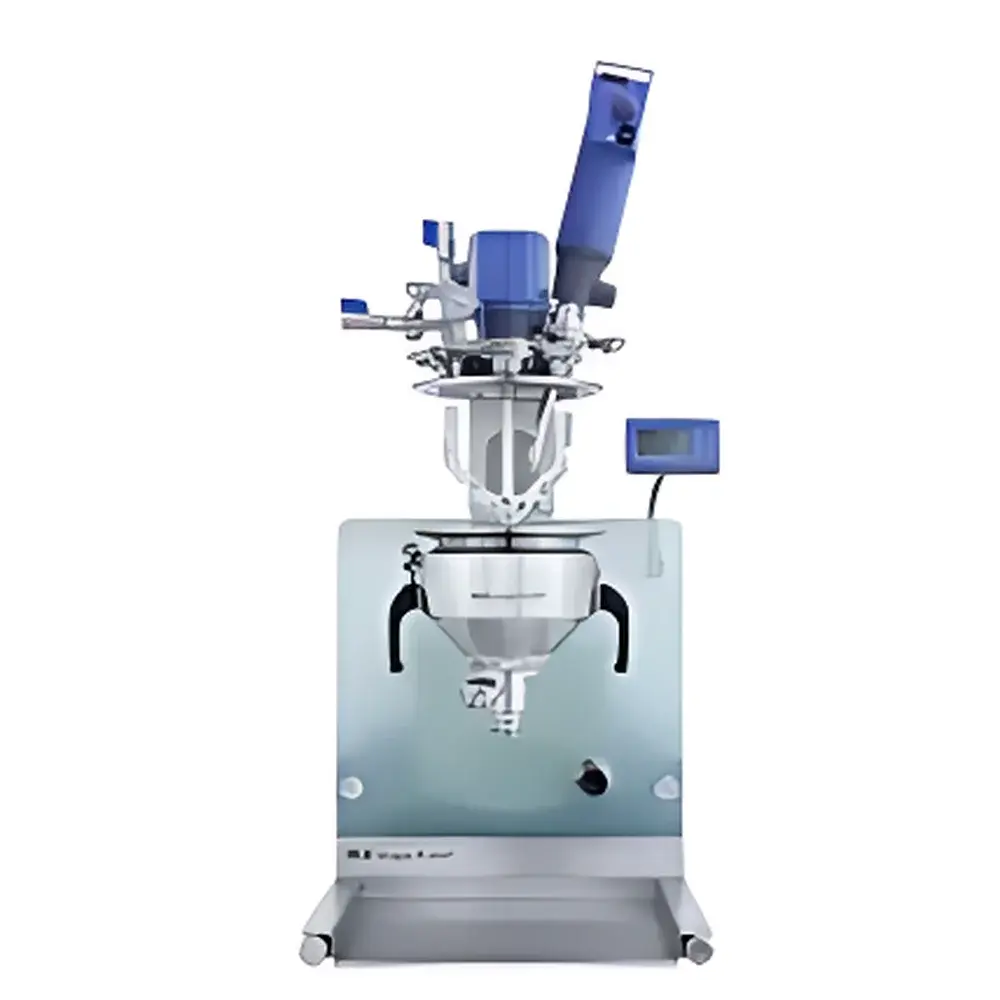
IKA magic PLANT Laboratory Reactor System
| Brand | IKA |
|---|---|
| Origin | Germany |
| Model | magic PLANT |
| Vessel Capacity | Small-scale (typically 1–20 L) |
| Construction Material | Stainless Steel (AISI 316L) |
| Maximum Operating Pressure | Up to 10 bar (g) |
| Configuration Options | Batch, In-line Circulation, Powder Processing |
| Modular Integration | Compatible with IKA magic LAB® and ULTRA-TURRAX® UTC T25 modules |
| Thermal Management | Jacketed Vessel with Steam/Electric/Thermostatic Fluid Heating & Cooling |
| Drive Type | Digital Speed-Controlled Torque Motor |
| Sealing | Mechanical Seal or Magnetic Coupling (pressure-rated) |
| Compliance | CE, PED 2014/68/EU, ATEX Option Available |
Overview
The IKA magic PLANT is a modular, small-scale laboratory reactor system engineered for scalable process development in pilot and R&D environments. Designed as a bridge between benchtop instrumentation and industrial-scale production, it operates on fundamental principles of mechanical agitation, controlled thermal transfer, and hydrodynamic shear—enabling precise replication of batch, recirculation, and powder-processing unit operations. Its core architecture follows the Couette–Taylor flow regime for viscous mixing, while the in-line configuration leverages high-shear rotor-stator dispersion physics (based on the IKA magic LAB® platform) to achieve sub-5 µm droplet or particle size distributions in emulsions and suspensions. The system supports pressure-rated operation up to 10 bar (g), making it suitable for reactions involving volatile solvents, hydrogenation, or pressurized gas dissolution under controlled atmospheres. Unlike fixed-function reactors, the magic PLANT’s standardized flange interfaces (DIN 2817, ISO-K) allow seamless integration of interchangeable drive units, sealing systems, and process modules—ensuring method transfer fidelity from lab to pilot plant.
Key Features
- Modular platform supporting three operational modes: Batch (magic PLANT Base), In-line Recirculation (magic PLANT In-line), and Powder Processing (magic PLANT Powder)
- Jacketed stainless steel (AISI 316L) vessel with conical bottom for complete drainage and low-volume processing (as low as 10% of nominal capacity)
- Digital torque-controlled motor with speed range 0–500 rpm and real-time torque monitoring for rheological profiling
- Pressure-rated design compliant with PED 2014/68/EU; optional ATEX-certified versions available for hazardous area use
- Interchangeable agitator systems: axial-flow impellers with adjustable scrapers, high-shear rotor-stator heads (1–3 stage), and dual-direction helical ribbon mixers for powders
- Integrated thermal management via jacketed vessel connected to external thermostats (−20°C to +200°C)
- Process-ready interfaces: DIN 11851 ports for pH/DO probes, pressure transducers, sampling valves, and gas sparging nozzles
Sample Compatibility & Compliance
The magic PLANT accommodates a broad spectrum of process materials—from low-viscosity aqueous solutions (50,000 mPa·s)—without requiring hardware modification. Its conical geometry and scraper-equipped impellers prevent wall buildup during high-solids mixing, while the in-line recirculation loop ensures uniform shear history across heterogeneous phases. For pharmaceutical applications, the system meets key elements of FDA 21 CFR Part 11 when paired with validated IKA Labworldsoft® software (audit trail, electronic signatures, user access levels). It supports GLP/GMP-aligned documentation through configurable SOP templates and raw data export in CSV/Excel formats. All wetted parts comply with USP Class VI and EC 1935/2004 food-contact regulations. Vessels are electropolished to Ra ≤ 0.4 µm and passivated per ASTM A967.
Software & Data Management
Control and data acquisition are managed via IKA Labworldsoft®, a Windows-based platform supporting multi-parameter logging (temperature, pressure, torque, speed, pH, conductivity) at up to 10 Hz sampling rate. The software enables recipe-driven operation with stepwise parameter sequencing, deviation alarms, and automatic report generation compliant with ALCOA+ principles. Raw datasets include timestamped metadata (operator ID, version-controlled method file, instrument serial number) required for regulatory submissions. Optional OPC UA connectivity allows integration into MES/SCADA environments (e.g., Siemens SIMATIC, Rockwell FactoryTalk). All data files are stored in non-proprietary binary format with SHA-256 checksums for integrity verification.
Applications
- Pharmaceutical: Formulation development of ointments, suspensions, and nanoemulsions; API crystallization under controlled supersaturation; lyophilization pre-concentration
- Food & Beverage: High-intensity homogenization of dressings and sauces; enzymatic reaction optimization under sterile conditions; fermentation broth blending
- Cosmetics: Cold-process emulsification of thermolabile actives; pigment dispersion in anhydrous bases; rheology modifier incorporation
- Chemical Synthesis: Catalytic hydrogenation (H₂ up to 10 bar); Grignard and lithiation reactions under inert atmosphere; solvent-free polymerization
- Materials Science: Ceramic slurry deagglomeration; battery electrode slurry mixing with conductive additives; MOF synthesis under reflux
FAQ
What is the maximum allowable working temperature for the jacketed vessel?
Standard configuration supports jacket fluid temperatures from −20°C to +200°C; continuous operation above 150°C requires optional high-temp gasketing and thermal insulation.
Can the magic PLANT be used for sterile processing?
Yes—when equipped with steam-in-place (SIP)-compatible seals, polished surfaces (Ra ≤ 0.4 µm), and validated CIP/SIP protocols, it meets ISO 13408-1 for aseptic processing.
Is remote monitoring supported?
Via Labworldsoft®’s built-in web server module, real-time parameter dashboards and alarm notifications can be accessed over secure HTTPS from any authorized network endpoint.
How is scalability ensured from magic PLANT to production scale?
IKA provides geometric and dynamic similarity guidelines (Re, Fr, Po numbers) and dimensionless power curves for each agitator type, enabling direct scale-up using constant tip speed or constant power per volume criteria.
Does the system support PAT (Process Analytical Technology)?
Yes—standard DIN 11851 ports accept third-party inline sensors (e.g., FBRM, PVM, Raman probes) and integrate their signals into Labworldsoft® for multivariate process control.



