
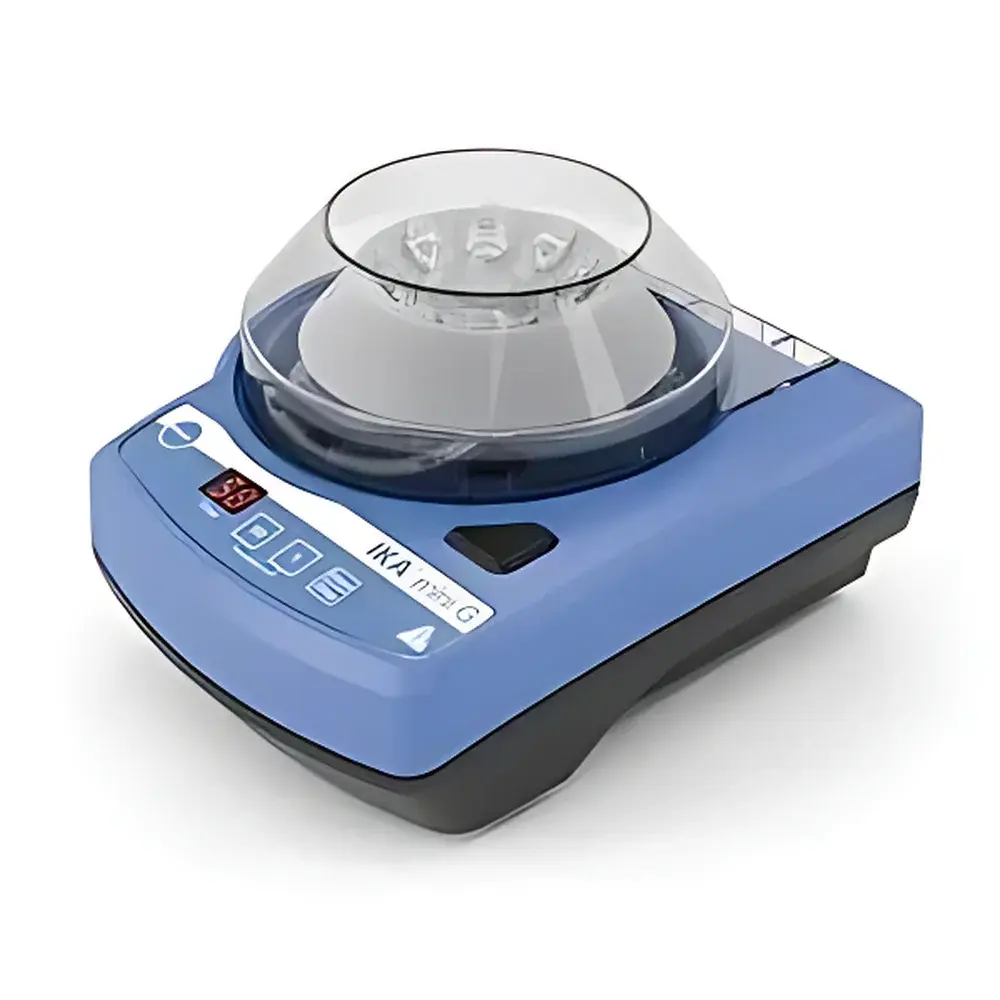
IKA mini G Compact Centrifuge
| Brand | IKA |
|---|---|
| Origin | Germany |
| Model | mini G |
| Maximum Capacity | 8 × 2.0 mL |
| Maximum Speed | 6000 rpm |
| Dimensions | 155 × 175 × 105 mm |
| Weight | 1.4 kg |
| Operating Temperature Range | 5–40 °C |
| Relative Humidity Limit | ≤80% |
| Power Supply | 24 V DC |
| Rotor Acceleration | 2000 × g |
| Motor Input/Output Power | 12 W / 8 W |
| Timer Range | 1–99 min |
| Speed Accuracy | ±5% |
| Rotor Exchange | Tool-Free |
| Lid Interlock | Yes |
| Quick-Stop Function | Yes |
| Duty Cycle | Continuous (100%) |
| Maximum Sample Density | 1.2 kg/dm³ |
| Kinetic Energy | 20 N·m |
Overview
The IKA mini G Compact Centrifuge is a benchtop microcentrifuge engineered for precision, safety, and operational simplicity in routine laboratory workflows. Designed around the principles of fixed-speed rotor dynamics and passive thermal management, it delivers consistent centrifugal force (up to 2000 × g) at a nominal rotational speed of 6000 rpm—optimized for low-to-moderate g-force applications including microfiltration, bacterial pellet recovery, PCR tube preparation, and small-volume sample clarification. Its compact footprint (155 × 175 × 105 mm) and lightweight construction (1.4 kg) make it ideal for crowded workbenches, biosafety cabinets, and mobile lab environments. The unit operates on a regulated 24 V DC power supply, eliminating mains voltage hazards and enabling stable performance across variable electrical infrastructures. All mechanical and electronic subsystems—including brushless DC motor control, lid interlock logic, and LED-based timer interface—are integrated into a single robust housing conforming to IEC 61010-1 safety standards for laboratory electrical equipment.
Key Features
- Lid-Interlocked Safety System: Motor activation is physically inhibited unless the transparent polycarbonate lid is fully closed and latched—preventing accidental exposure during operation and meeting essential EN 61010-2-020 requirements for centrifuge-specific safeguards.
- Tool-Free Rotor Exchange: The fixed-angle rotor (designed for 2.0 mL tubes) mounts via a precision-machined bayonet interface; no wrenches or alignment tools are required for installation or removal, minimizing cross-contamination risk and downtime.
- Intelligent Quick-Stop Deceleration: Upon timer completion or manual stop command, the rotor decelerates under controlled electromagnetic braking—reaching standstill within seconds without coast-down delay, improving throughput in high-frequency use scenarios.
- Touch-Sensitive Control Panel: A sealed membrane keypad with seven-segment LED display enables intuitive setting of run time (1–99 minutes) and provides real-time status feedback; no mechanical switches reduce long-term wear and ingress vulnerability.
- Acoustically Optimized Housing: Vibration-damping feet, balanced rotor geometry, and low-noise motor winding design collectively limit operational sound pressure to <45 dB(A) at 1 m—supporting quiet environments such as teaching labs and QC cleanrooms.
- Thermally Stable Operation: Passive convection cooling and low-power motor architecture (8 W output) prevent significant heat buildup during continuous duty cycles, maintaining sample integrity for temperature-sensitive biomolecules.
Sample Compatibility & Compliance
The mini G accommodates up to eight standard 2.0 mL microcentrifuge tubes (including PCR strip-compatible configurations), with a maximum permissible sample density of 1.2 kg/dm³—suitable for aqueous buffers, cell suspensions, and diluted organic extracts. It is not rated for hazardous, volatile, or high-density media (e.g., cesium chloride gradients or iodixanol solutions). The device complies with EU Directive 2014/30/EU (EMC), 2014/35/EU (LVD), and carries CE marking. While not validated for GLP/GMP-regulated production environments, its deterministic timer function, non-volatile run history (via LED recall), and mechanical repeatability support documentation practices aligned with ISO/IEC 17025 clause 5.9 for testing laboratories.
Software & Data Management
The IKA mini G operates as a standalone instrument without proprietary software or connectivity interfaces (USB, Bluetooth, or Ethernet). All operational parameters—including elapsed time, remaining time, and active status—are conveyed through the integrated 7-segment LED display. No data logging, remote control, or audit trail functionality is provided; therefore, it does not meet FDA 21 CFR Part 11 requirements for electronic records. Users intending to integrate the device into validated workflows must implement external documentation protocols (e.g., handwritten logbooks or LIMS entries) to satisfy traceability expectations under ISO 15189 or CLIA guidelines.
Applications
- Routine pelleting of bacterial cultures (e.g., E. coli, Bacillus spp.) prior to lysis or genomic DNA extraction
- Clarification of clarified lysates and supernatants in molecular biology workflows
- Microfiltration of enzyme reaction mixtures using 0.22 µm spin filters
- Spin-down of PCR/qPCR plates and strips to eliminate bubble formation and ensure uniform cap contact
- Concentration of dilute protein samples in low-volume tubes prior to SDS-PAGE or mass spectrometry analysis
- Preparative separation of small-volume immiscible phases (e.g., aqueous/organic extractions in metabolomics)
FAQ
Is the IKA mini G suitable for clinical diagnostic sample processing?
Yes—provided the application falls within its defined centrifugal force envelope (≤2000 × g) and uses compatible 2.0 mL tubes. However, it lacks regulatory validation for IVD use under IVDR 2017/746 and should not be deployed in certified diagnostic laboratories without site-specific risk assessment and procedural validation.
Can the mini G accommodate 0.5 mL tubes or PCR strips?
It accepts standard 2.0 mL microcentrifuge tubes and 8-tube PCR strips designed for 2.0 mL footprint compatibility. Adapters for smaller volumes (e.g., 0.5 mL) are not supplied or supported by IKA.
Does the device support variable speed control?
No—the mini G operates exclusively at a fixed rotational speed of 6000 rpm. Speed modulation is not available; users requiring adjustable g-force must select a programmable centrifuge model.
What maintenance is required?
Routine cleaning of the rotor chamber and lid seal with 70% ethanol is recommended after each use. No lubrication, calibration, or scheduled service intervals are specified by the manufacturer; annual visual inspection of rotor integrity is advised per IKA’s general centrifuge maintenance guidance.
Is the rotor autoclavable?
No—the aluminum rotor is not designed for steam sterilization. Autoclaving may compromise dimensional stability and balance certification. Surface decontamination using approved disinfectants is the recommended method.



