
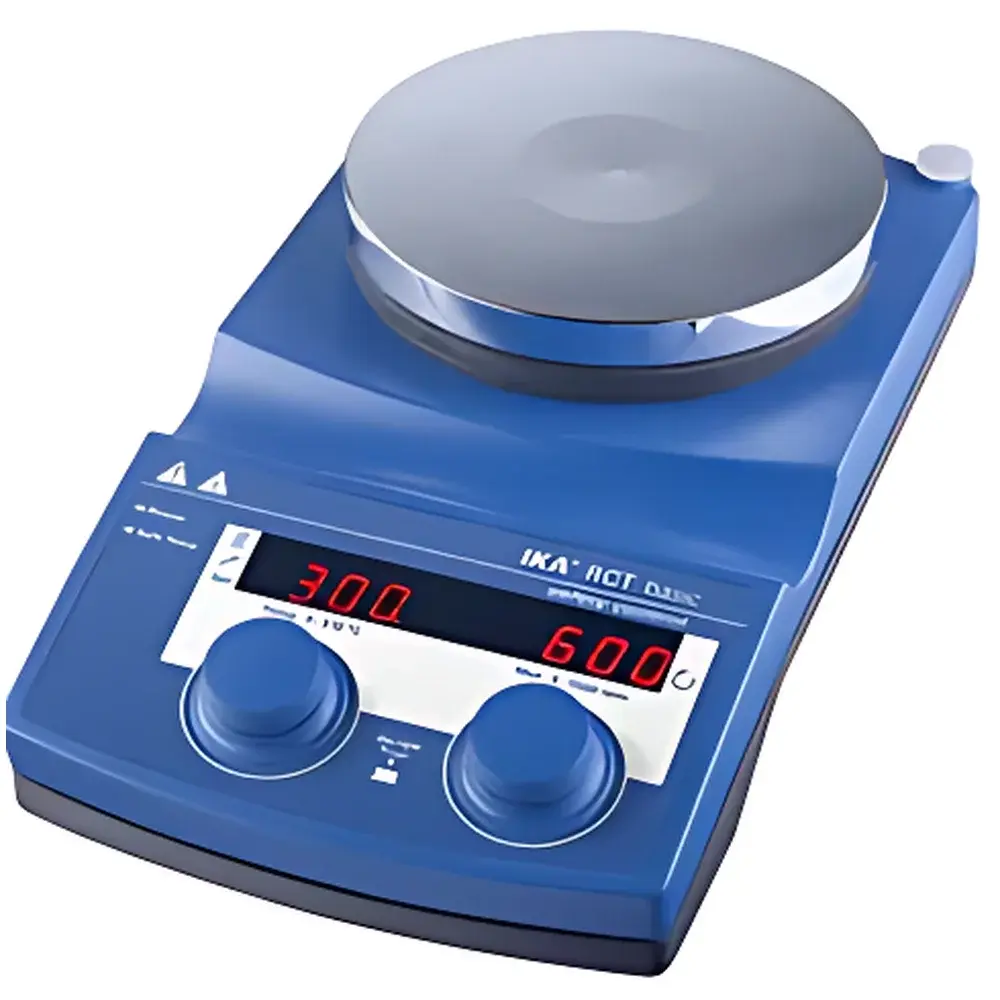
IKA RCT Basic Heating Magnetic Stirrer with Aluminum Heating Plate
| Brand | IKA |
|---|---|
| Origin | Germany |
| Model | RCT Basic |
| Maximum Stirring Volume | 20 L |
| Speed Range | 50–1500 rpm |
| Temperature Control Range | Ambient to 310 °C |
| Heating Power | 600 W |
| Safety Temperature Limit Adjustable | 50–360 °C |
| Dimensions | 160 × 85 × 270 mm |
| Weight | 2.5 kg |
| Input Voltage | 220–230 V / 115 V / 100 V, 50/60 Hz |
Overview
The IKA RCT Basic is a precision-engineered heating magnetic stirrer designed for reliable, reproducible thermal and mechanical agitation in demanding laboratory environments. Utilizing Couette flow principles, it delivers consistent torque transfer via high-strength neodymium magnets beneath an anodized aluminum heating plate—optimized for rapid, uniform heat distribution and long-term corrosion resistance. Unlike basic stirrers with passive heating elements, the RCT Basic integrates dual-mode temperature regulation: direct plate-surface control and optional external feedback via DIN 12878-compliant PT1000 sensors (e.g., ETSD5), enabling closed-loop accuracy of ±1 K across its full 20 L water-equivalent capacity. Its robust architecture supports unattended operation under GLP-compliant workflows, making it suitable for routine QC testing, synthesis scale-up, buffer preparation, and dissolution studies where traceable thermal stability and mechanical consistency are critical.
Key Features
- High-torque brushless motor delivering stable rotation from 50 to 1500 rpm with ≤5% speed deviation at maximum load (20 L H₂O)
- Aluminum heating plate (Ø135 mm) with optimized thermal mass and surface emissivity for rapid ramp rates—up to 6.5 K/min when heating 1 L water in standard IKA H15 vessel
- Dual temperature control architecture: independent digital setpoint for plate surface + configurable external sensor input (PT1000) for sample-core monitoring
- Integrated safety circuitry including adjustable overtemperature cutoff (50–360 °C), real-time hotplate warning indicator, and error-code diagnostics displayed on LED screen
- IP42-rated enclosure ensuring protection against solid objects >1 mm and vertically falling droplets—validated per DIN EN 60529 for use in general lab spaces with ambient humidity ≤80%
- Front-panel digital interface with dedicated LED displays for both speed and temperature, plus tactile rotary encoder for intuitive parameter adjustment
- Included accessories: PT1000.60 probe (kit-dependent), IKAFLON® PTFE-coated stir bars (20/30/40 mm), vertical support rods (H16V, H38), and universal clamp (H44)
Sample Compatibility & Compliance
The RCT Basic accommodates a wide range of vessel geometries—including round-bottom flasks (up to 5 L), beakers (up to 20 L), and custom reactors—when paired with appropriately sized magnetic stir bars (recommended length: 80 mm for optimal vortex formation). Its aluminum plate surface complies with DIN 12878 for standardized sensor mounting, facilitating integration into regulated workflows requiring documented temperature traceability. While not certified for explosive atmospheres, the unit meets CE marking requirements under Directive 2014/30/EU (EMC) and 2014/35/EU (LVD), and supports audit-ready operation under ISO/IEC 17025 and FDA 21 CFR Part 11 when used with validated software interfaces and electronic logbooks.
Software & Data Management
The RCT Basic operates as a standalone instrument without proprietary PC software; however, its analog/digital hybrid architecture enables seamless integration into centralized lab management systems. The PT1000 sensor port supports third-party data acquisition modules compliant with Modbus RTU or 0–10 V analog output protocols. For GxP environments, users may connect the unit to validated environmental monitoring platforms (e.g., DeltaTrak, SensiLog) to capture timestamped temperature and speed logs with electronic signatures and audit trails. All internal settings—including safety limits, default speeds, and sensor calibration offsets—are retained during power cycling, eliminating reconfiguration overhead in multi-shift operations.
Applications
- Precise temperature-controlled dissolution testing in pharmaceutical QA/QC labs
- Buffer and media preparation for cell culture and molecular biology workflows
- Catalytic reaction monitoring under isothermal conditions up to 310 °C
- Viscosity assessment of polymer solutions during thermal ramping protocols
- Standardized sample homogenization prior to HPLC, GC, or ICP-MS analysis
- Calibration verification of thermocouples and RTDs using NIST-traceable reference probes
FAQ
Does the RCT Basic support external temperature feedback for closed-loop control?
Yes—it features a DIN 12878-standard PT1000 interface compatible with IKA’s ETSD5 contact thermometer or third-party Class A platinum RTDs.
What is the maximum recommended vessel diameter for stable stirring at 1500 rpm?
For optimal vortex formation and minimal splashing, vessels with diameters ≤120 mm are recommended at top speed; larger volumes require reduced rpm or extended stabilization time.
Can the safety temperature limit be locked to prevent accidental override?
No physical lock exists, but the safety threshold remains persistent across power cycles and requires deliberate menu navigation to modify—reducing risk of unintended changes during routine use.
Is the aluminum plate resistant to aggressive solvents like chloroform or DMF?
The anodized surface provides moderate chemical resistance; prolonged exposure to halogenated or strongly acidic/basic solvents may degrade the oxide layer—use of IKAFLON®-coated stir bars and glass-lined vessels is advised.
How does the RCT Basic differ from the RCT digital model?
The RCT Basic lacks RS232/USB connectivity, programmable ramps, and timer functions found in the RCT digital variant—making it ideal for cost-sensitive, high-reliability applications where manual control suffices.
Related Products



