
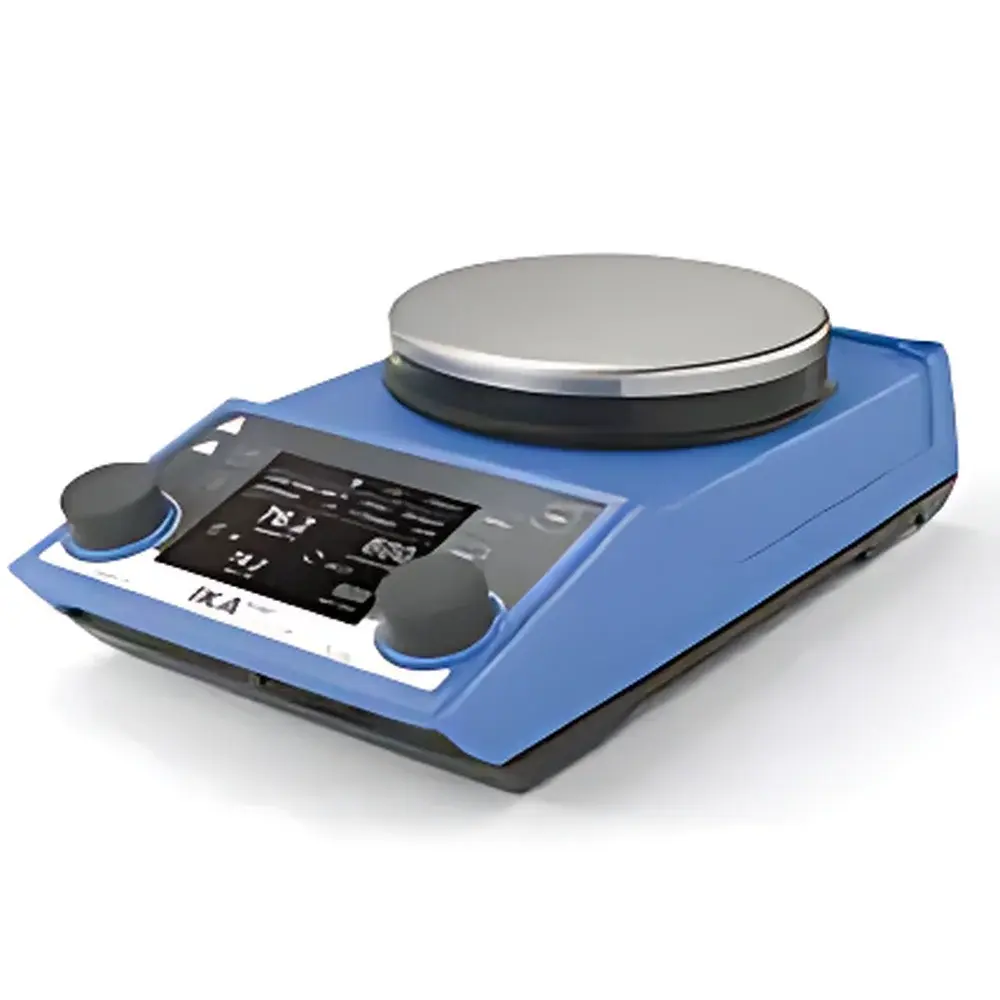
IKA RET control-visc Magnetic Stirrer with Integrated Heating and Weighing
| Brand | IKA |
|---|---|
| Origin | Germany |
| Model | RET control-visc |
| Stirrer Type | Magnetic Stirrer |
| Max. Stirring Volume | 20 L |
| Speed Range | 50–1700 rpm |
| Temperature Control Range | Ambient to 340 °C |
| Heating Power | 600 W |
| Weighing Capacity | 0–5000 g (±1 g <50 g |
| Plate Material | Stainless Steel 1.4301 |
| Plate Diameter | Ø135 mm |
| Dimensions (W×H×D) | 160 × 270 × 85 mm |
| Weight | 3 kg |
| Protection Class | IP42 |
| Interfaces | RS232, USB |
| Safety Temp. Range | 50–380 °C |
| External Temp. Sensor | PT100 compatible |
| Temp. Control Accuracy | ±0.2 K (with PT100), ±0.1 K (plate sensor) |
| Speed & Temp. Display | TFT touchscreen |
| Power Supply | 220–240 V / 115 V / 100 V, 50/60 Hz |
| Input Power | 650 W |
Overview
The IKA RET control-visc is a high-precision magnetic stirrer engineered for advanced laboratory workflows requiring simultaneous heating, real-time torque monitoring, temperature regulation, and mass measurement. Unlike conventional magnetic stirrers, it integrates a calibrated load cell into the heated plate—enabling direct in-situ weighing of vessels during stirring and thermal processing. Its core operation relies on a brushless DC motor driving rotation via magnetic coupling, while a resistive stainless steel (1.4301) heating plate delivers uniform thermal energy up to 340 °C. Temperature is regulated either via built-in platinum resistance (Pt100-compatible) sensing or external probe feedback, supporting both rapid ramp-up and high-stability PID-controlled modes. Designed for unattended operation under GLP-compliant conditions, the device meets DIN EN 60529 IP42 ingress protection standards and supports audit-ready data export via RS232 and USB interfaces.
Key Features
- Integrated precision weighing system (0–5000 g; accuracy ±1 g below 50 g, ±5 g above)
- TFT touchscreen interface with multilingual support (English, German, French, Spanish, Chinese, Japanese)
- Dual-mode temperature control: “Fast Ramp” for rapid heating and “Precise Hold” for ±0.2 K stability (with external PT100)
- Real-time torque trend visualization for viscosity estimation and process endpoint detection
- Stir bar centering detection algorithm to identify misalignment or stalling
- Programmable timer and countdown functions with automatic shutdown
- Intermittent stirring mode for shear-sensitive samples or controlled reaction kinetics
- Configurable safety temperature limits (50–380 °C) with independent hardware-based cutoff circuitry
- BNC port for direct pH electrode integration and synchronized parameter logging
- Lock-key function to prevent accidental parameter modification during active runs
- Post-shutdown plate temperature display until surface cools below 50 °C
- Transparent polycarbonate safety shield included as standard equipment
Sample Compatibility & Compliance
The RET control-visc accommodates standard laboratory glassware (e.g., beakers, flasks, reaction vessels) up to 20 L volume when used with appropriately sized stir bars (max. 80 mm length). Its stainless steel plate resists corrosion from common solvents and acids, and its elevated maximum temperature (340 °C) supports applications involving high-boiling-point media such as silicone oils or molten salts. The unit complies with IEC 61010-1 for electrical safety and conforms to electromagnetic compatibility requirements per EN 61326-1. For regulated environments, its RS232/USB data export capability enables traceable parameter recording aligned with FDA 21 CFR Part 11 principles when paired with validated software. The IP42 rating ensures reliable performance in standard laboratory humidity (≤80% RH) and ambient temperatures (5–40 °C).
Software & Data Management
Data acquisition and remote control are supported via native IKA Labworldsoft software (Windows-compatible), which enables real-time plotting of speed, temperature, torque, and weight over time. All logged parameters—including timestamps, setpoints, and error codes—are exportable in CSV format for integration into LIMS or statistical analysis platforms. Firmware updates are performed securely through the USB interface. The device maintains internal event logs for critical operational states (e.g., overtemperature events, stir bar ejection alerts), supporting root-cause analysis during QA/QC investigations. Audit trails can be generated manually or scheduled, meeting documentation requirements for ISO/IEC 17025-accredited laboratories.
Applications
- Controlled synthesis of polymers and nanomaterials requiring precise thermal and mechanical input
- Viscosity profiling of non-Newtonian fluids (e.g., hydrogels, emulsions, slurries) using torque-derived trends
- pH-coupled titrations with synchronized stirring, heating, and acid/base addition
- Accelerated solvent extraction protocols where temperature, mass loss, and agitation must be concurrently monitored
- Preparation of calibration standards under thermostatically stabilized conditions
- Long-duration stability studies (e.g., shelf-life testing) with unattended operation and automated shutdown
- Teaching labs requiring intuitive interface design and multi-parameter visualization for student training
FAQ
Can the RET control-visc be used with metal containers or aluminum heating blocks?
No. The magnetic drive requires ferromagnetic or diamagnetic vessel bases; stainless steel 304/316 containers may attenuate coupling efficiency. Aluminum or copper plates are incompatible due to eddy current losses.
Is the weighing function calibrated according to ISO/IEC 17025?
The integrated scale is factory-calibrated and traceable to national standards. Full recalibration requires certified weights and is recommended annually or after mechanical shock.
Does the device support external temperature feedback from multiple probes simultaneously?
It accepts only one external PT100 input. Dual-temperature control (sample + bath) requires manual switching or external logic controllers.
What is the minimum detectable torque change for viscosity estimation?
Torque resolution is derived from motor current sensing and is suitable for relative trend analysis—not absolute rheological quantification. For quantitative viscosity, a dedicated rotational rheometer is required.
How does the stir bar detection algorithm work?
It analyzes rotational inertia deviations and current draw anomalies during acceleration phases to infer eccentricity or slippage, triggering audible and visual alerts before complete stall occurs.



