
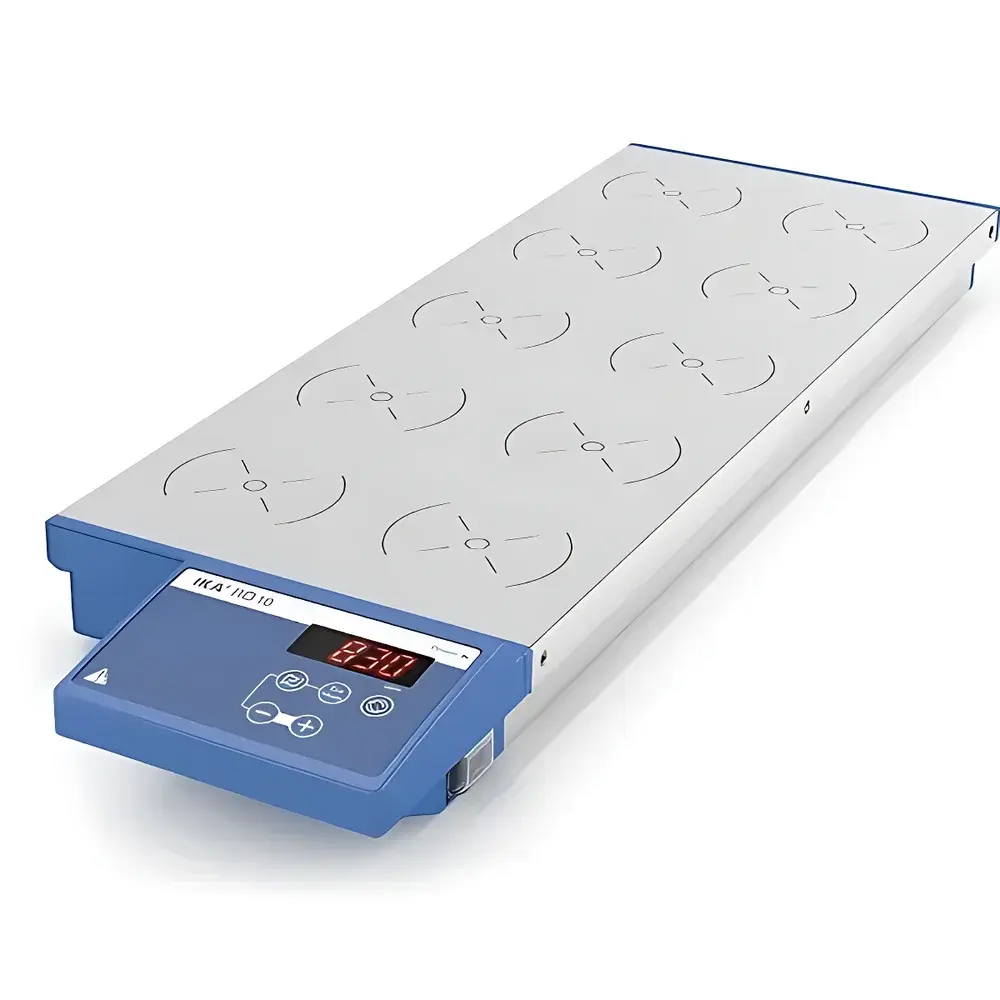
IKA RO 10 10-Position Digital Magnetic Stirrer
| Brand | IKA |
|---|---|
| Origin | Germany |
| Model | RO 10 |
| Stirring Positions | 10 |
| Position Spacing | 90 mm |
| Speed Range | 0–1200 rpm |
| Speed Resolution | 10 rpm steps |
| Speed Stability | ±0% deviation per position under load |
| Max. Stirring Volume (H₂O) | 0.4 L per position |
| Stir Bar Length Compatibility | 25–30 mm |
| Plate Material | Stainless Steel 1.4301 (AISI 304) |
| Plate Dimensions | 190 × 470 mm |
| Device Dimensions | 190 × 60 × 570 mm (W × H × D) |
| Weight | 5 kg |
| Ambient Temperature Range | 5–40 °C |
| Relative Humidity Limit | ≤80 % RH (non-condensing) |
| Ingress Protection | IP40 per DIN EN 60529 |
| Input Voltage | 100–240 V AC, 50/60 Hz |
| Power Consumption | 25 W |
| Internal DC Supply | 24 V = |
| Current Draw | 1000 mA |
| Control Interface | Touch-sensitive keypad |
| Operation Mode | Continuous duty |
| Direction Control | Adjustable forward/reverse rotation |
| Safety Features | Overheat protection, error code display, spill-resistant sealed housing |
| Accessories | Removable transparent non-slip mat |
| Heating Function | None |
Overview
The IKA RO 10 is a precision-engineered 10-position digital magnetic stirrer designed for high-throughput laboratory environments where reproducible, synchronized agitation across multiple vessels is essential. Unlike conventional multi-stirrer systems relying on mechanical gear trains or shared motor drives, the RO 10 employs individually controlled, brushless DC magnetic drive units — one per position — enabling independent yet perfectly synchronized rotational control without mechanical coupling. Each stirring point operates via contactless magnetic coupling between the internal coil and external stir bar, eliminating wear, friction, and acoustic noise. The system adheres to fundamental principles of electromagnetic torque transmission, ensuring consistent angular velocity regardless of viscosity-induced load fluctuations — a critical requirement for kinetic studies, dissolution testing, and parallel sample preparation under GLP-compliant workflows.
Key Features
- 10 fully independent stirring positions with identical speed control and real-time stability (0% speed deviation between positions, even during dynamic load changes)
- True digital speed regulation from 0 to 1200 rpm in precise 10-rpm increments, enabled by closed-loop feedback from integrated Hall-effect sensors
- Patented wear-free magnetic drive technology: no moving parts in the drive unit, eliminating maintenance intervals and long-term drift
- Sealed stainless steel (1.4301/AISI 304) working surface with smooth, crevice-free topology for rapid decontamination and compliance with ISO 14644-1 Class 8 cleanroom-compatible handling
- IP40-rated enclosure per DIN EN 60529, providing protection against solid objects ≥1 mm and limited ingress of vertically falling water droplets — suitable for standard wet-lab benchtop use
- Reversible rotation mode programmable per session, supporting applications requiring bidirectional mixing (e.g., particle suspension homogenization, crystallization nucleation control)
- Integrated error diagnostics with alphanumeric LED display (e.g., E1 = overtemperature, E2 = sensor fault), facilitating rapid troubleshooting without service intervention
- Touch-sensitive membrane keypad with haptic feedback and backlighting for intuitive operation under variable ambient lighting conditions
Sample Compatibility & Compliance
The RO 10 accommodates standard laboratory glassware including 10–50 mL test tubes, 50–250 mL Erlenmeyer flasks, and multi-well plates when used with compatible stir bars (25–30 mm length, PTFE- or glass-coated). Its non-heating design ensures thermal integrity for temperature-sensitive assays — particularly valuable in enzymatic kinetics, cell culture media equilibration, and pharmaceutical stability testing where exogenous heating may compromise assay validity. The device conforms to IEC 61010-1:2010 for electrical safety in laboratory equipment and carries CE marking for EMC (2014/30/EU) and Low Voltage (2014/35/EU) directives. While not intrinsically rated for hazardous locations, its sealed architecture supports routine use in ISO/IEC 17025-accredited testing laboratories performing method validation per ASTM D2196 or USP <701>.
Software & Data Management
The RO 10 operates as a standalone instrument with no embedded software stack or data logging capability — aligning with risk-based validation strategies for non-critical ancillary equipment. All operational parameters are set locally via front-panel interface; no firmware updates, network connectivity, or audit trail functionality are provided. This architecture simplifies 21 CFR Part 11 compliance for regulated environments: absence of electronic records eliminates requirements for electronic signature controls, change management, or system validation documentation. Users maintaining GxP workflows may document operating conditions manually or integrate the RO 10 into broader process logs via external environmental monitoring systems (e.g., connected to validated temperature/humidity loggers).
Applications
- High-throughput reagent preparation and buffer equilibration across 10 parallel vessels in QC/QA labs
- Dissolution profile screening in pharmaceutical development per USP <711>, where consistent agitation intensity directly impacts release rate reproducibility
- Cell culture media conditioning prior to inoculation, minimizing shear stress through low-RPM, high-torque stirring
- Standardized suspension of insoluble reference standards for gravimetric calibration procedures
- Parallel synthesis support in combinatorial chemistry, enabling uniform mixing during multi-vessel reaction setup
- Environmental sample homogenization (e.g., soil leachates, wastewater extracts) prior to filtration or instrumental analysis
FAQ
Does the RO 10 support external computer control or RS232/USB connectivity?
No. The RO 10 is a manually operated, stand-alone instrument with no digital communication interfaces.
Can it be used with ferrofluids or highly viscous solutions?
It is optimized for low-to-medium viscosity aqueous and organic media (up to ~500 mPa·s); performance with ferrofluids or >1000 mPa·s fluids is not validated and may exceed torque capacity.
Is the stainless steel plate autoclavable?
No. The plate is not designed for steam sterilization; cleaning is recommended with 70% ethanol or mild detergent followed by air drying.
What stir bar specifications are recommended for optimal coupling?
Cylindrical PTFE-coated bars 25–30 mm in length and 6–8 mm in diameter provide maximum torque transfer efficiency at speeds up to 1200 rpm.
Does the device include overload or stall detection?
Yes. Integrated current sensing triggers automatic shutdown and displays error code E2 if rotational resistance exceeds nominal torque limits for >5 seconds.



