
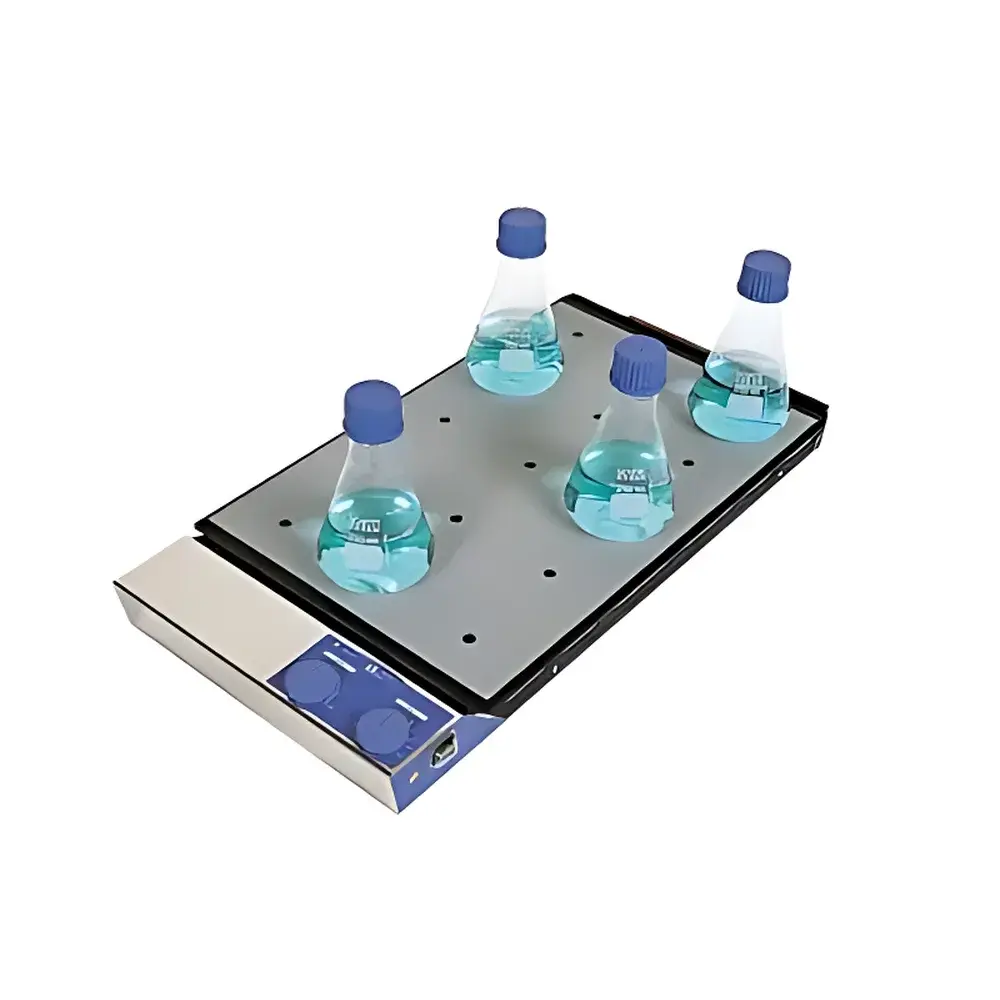
IKA RT15 15-Position Heating Magnetic Stirrer
| Brand | IKA |
|---|---|
| Origin | Germany |
| Model | RT15 |
| Instrument Type | Magnetic Stirrer |
| Max. Total Stirring Volume (H₂O) | 6 L |
| Speed Range | 0–1100 rpm |
| Temperature Control Range | Ambient to 120 °C |
| Heating Power | 580 W |
| Stirring Points | 15 |
| Point-to-Point Spacing | 90 mm |
| Max. Stir Bar Length | 30 mm |
| Plate Material | Silicone Film-Coated Aluminum |
| Plate Dimensions | 270 × 450 mm |
| Overall Dimensions | 288 × 65 × 552 mm |
| Weight | 6 kg |
| IP Rating | IP42 |
| Input Voltage | 230/115/100 V, 50/60 Hz |
| Max. Input Power | 600 W |
| Temp. Stability | ±2 K |
| Max. Medium Temp. (dependent on vessel) | 70 °C |
| Relative Humidity Limit | 80 % |
| Ambient Operating Temp. | 5–40 °C |
Overview
The IKA RT15 is a precision-engineered 15-position heating magnetic stirrer designed for high-throughput laboratory workflows requiring simultaneous, independent thermal and mechanical agitation of multiple samples. Based on the proven Couette flow principle, it employs rotating magnetic fields generated by internal drive coils beneath a chemically resistant silicone film-coated aluminum plate to induce rotation of PTFE- or glass-coated stir bars in vessels placed across its standardized array. Unlike single-point stirrers, the RT15 enables parallel processing of up to fifteen 400 mL aqueous samples (or proportionally scaled volumes), significantly improving reproducibility in comparative kinetic studies, dissolution testing, buffer equilibration, and reagent preparation protocols. Its robust architecture integrates discrete electromagnetic actuation per position with uniform resistive heating—ensuring minimal inter-channel crosstalk and consistent thermal distribution across the entire plate surface.
Key Features
- 15 precisely spaced stirring positions (90 mm center-to-center) optimized for standard labware including 50–500 mL beakers, Erlenmeyer flasks, and multi-well reaction blocks
- Independent speed control via analog dial (scale 1–10) delivering 0–1100 rpm with ≤5% rotational deviation per channel under load
- Heating function adjustable via calibrated dial (scale 1–10), covering ambient temperature to 120 °C with ±2 K stability at setpoint (measured at plate surface)
- Silicone film-coated aluminum work surface offering chemical resistance, thermal uniformity, and non-slip retention of glass and plastic vessels
- Integrated safety logic including overtemperature cutoff, motor stall detection, and automatic shutdown after 48 hours of continuous operation
- Compliance with DIN EN 60529 (IP42 rating) for protection against solid objects >1 mm and vertically falling water droplets—suitable for standard wet-lab environments
- Universal voltage compatibility (100/115/230 V, 50/60 Hz) and low acoustic emission (<45 dB(A)) for shared instrumentation spaces
Sample Compatibility & Compliance
The RT15 accommodates a broad range of vessel geometries and materials, including borosilicate glass, polypropylene, and stainless steel containers up to 120 mm in diameter. Maximum recommended medium temperature is 70 °C when using standard thin-walled glassware; higher setpoints (up to 120 °C) are intended for thermal pre-conditioning of plates or use with high-thermal-mass vessels under supervised conditions. The instrument conforms to IEC 61010-1 for electrical safety in laboratory equipment and meets CE marking requirements for EMC (EN 61326-1) and low-voltage directives. While not inherently 21 CFR Part 11 compliant due to its analog interface, the RT15 supports GLP/GMP-aligned documentation practices when used with external loggers or integrated into validated workflows where manual parameter recording is defined in SOPs.
Software & Data Management
The RT15 operates as a standalone analog instrument without embedded microprocessor control or digital connectivity. All operational parameters—including speed setting, heating level, and runtime—are manually configured and visually monitored via front-panel dials and LED indicators. This design prioritizes operational simplicity, long-term reliability, and immunity to firmware-related obsolescence or cybersecurity vulnerabilities. For laboratories requiring electronic audit trails, integration with external temperature data loggers (e.g., compliant with ASTM E2858 for thermal mapping) or time-stamped video monitoring is recommended. Calibration verification can be performed using NIST-traceable RPM tachometers and PT100 contact probes per ISO/IEC 17025 guidelines.
Applications
- High-volume buffer and media preparation across microbiology, molecular biology, and cell culture labs
- Parallel dissolution testing in pharmaceutical QC according to USP <711> (when combined with validated vessel geometry and stir bar selection)
- Controlled heating/stirring during polymerization reactions, catalyst screening, and ligand-binding assays
- Equilibration of calibration standards and reference solutions prior to spectrophotometric or titrimetric analysis
- Teaching laboratories requiring robust, multi-station platforms for student experiments in general chemistry and analytical techniques
- Environmental sample digestion protocols where consistent, low-shear agitation minimizes volatile loss
FAQ
Can the RT15 be used with closed vessels such as sealed vials or pressure tubes?
No—this instrument is designed exclusively for open or loosely covered vessels. Sealed systems may generate unsafe pressure buildup or impede heat dissipation.
What is the maximum recommended stir bar length for reliable coupling?
Stir bars up to 30 mm in length are fully supported; longer bars risk mechanical interference with adjacent positions or reduced torque transmission.
Does the RT15 support external temperature probe feedback for PID-controlled regulation?
No—it uses open-loop analog heating control. For closed-loop thermal regulation, consider the IKA RCT series with integrated Pt100 sensor input.
Is the work plate removable for cleaning or replacement?
The silicone film is permanently bonded to the aluminum substrate and is not user-replaceable; cleaning requires mild detergent and non-abrasive cloths only.
Can the unit operate continuously for extended periods (e.g., overnight or weekend runs)?
Yes—its thermal management and duty-cycle-rated components allow unattended operation up to 48 hours, after which automatic shutdown engages as a safety safeguard.
Related Products



