
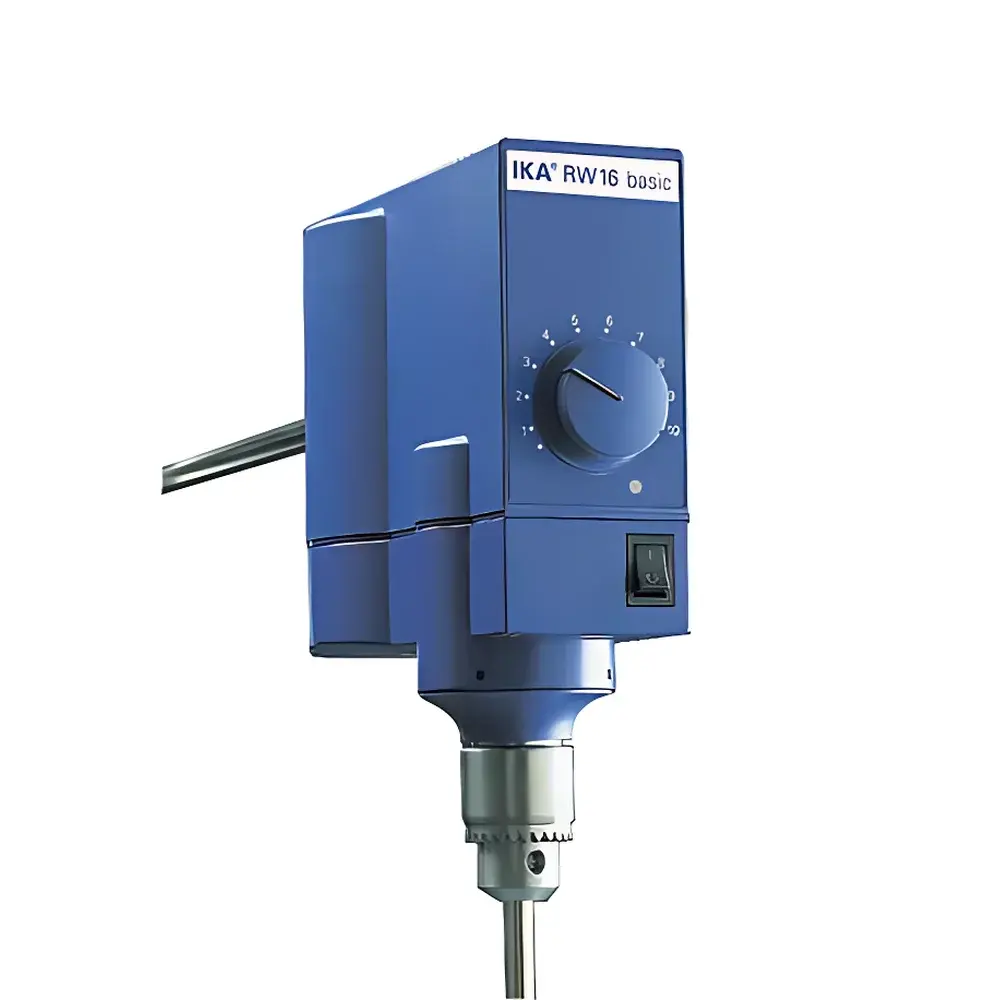
IKA RW16 Basic Overhead Stirrer
| Brand | IKA |
|---|---|
| Origin | Germany |
| Model | RW16 Basic |
| Stirrer Type | Electronic Overhead Stirrer |
| Max. Mixing Volume (H₂O) | 10 L |
| Speed Range | 40–1200 rpm |
| Operating Ambient Temperature | 5–40 °C |
| Motor Input Power | 75 W |
| Motor Output Power | 55 W |
| Max. Viscosity | 10,000 mPa·s |
| Max. Torque (at 60 rpm, overload) | 50 N·cm |
| Shaft Clamp Range | 0.5–10 mm |
| Hollow Shaft ID | 11 mm |
| Dimensions (W×H×D) | 80×222×190 mm |
| Weight | 2.8 kg |
| Protection Class | IP42 |
| Voltage | 230 / 115 / 100 V |
| Frequency | 50/60 Hz |
Overview
The IKA RW16 Basic is a compact, robust electronic overhead stirrer engineered for precision and reliability in routine laboratory mixing applications. Designed according to the principles of Couette flow dynamics and torque-controlled rotational agitation, it delivers consistent shear input across a wide viscosity range — from low-viscosity aqueous solutions to moderately viscous polymer dispersions and suspension systems. Its brushless motor architecture ensures stable speed maintenance under variable load conditions, while the integrated thermal management system enables uninterrupted 100% duty-cycle operation within ambient temperatures of 5–40 °C. As a CE-marked instrument manufactured in Staufen, Germany, the RW16 Basic conforms to DIN EN 60529 (IP42) for protection against solid objects ≥1 mm and vertically falling water droplets — making it suitable for standard wet-lab environments including teaching labs, QC laboratories, and pilot-scale R&D settings.
Key Features
- Stepless electronic speed control (40–1200 rpm) with analog dial interface — no gear shifting required, ensuring smooth acceleration and reproducible setpoint accuracy.
- High-torque motor delivering up to 50 N·cm at 60 rpm (overload condition), enabling reliable handling of viscosities up to 10,000 mPa·s using appropriate impellers.
- Compact footprint (80 × 222 × 190 mm) and lightweight design (2.8 kg) facilitate easy integration onto fume hoods, benchtop reactors, or modular lab platforms.
- Hollow shaft (11 mm internal diameter) allows simultaneous insertion of temperature probes, pH electrodes, or sampling tubes without interrupting agitation — critical for kinetic studies and process monitoring.
- Integrated safety circuitry includes thermal cut-off, electronic overload protection, and stall-resistant motor design to prevent rotor lock-up during high-viscosity starts or sudden load changes.
- Low-noise operation (<55 dB(A)) supports use in shared laboratory spaces and undergraduate teaching environments where acoustic comfort is prioritized.
Sample Compatibility & Compliance
The RW16 Basic accommodates standard laboratory vessels (e.g., beakers, flasks, jacketed reactors) up to 10 L capacity when filled with water-equivalent media. Its universal chuck accepts stirring rods and impellers with shank diameters from 0.5 mm to 10 mm, supporting common geometries including paddle, propeller, and anchor types. The unit complies with IEC 61000-6-3 (EMC emission limits) and IEC 61000-6-2 (immunity requirements), and meets essential health and safety requirements under the EU Machinery Directive 2006/42/EC. While not equipped with digital audit trails or 21 CFR Part 11–compliant software, its mechanical stability and repeatable performance support GLP-aligned documentation workflows when paired with calibrated tachometers and validated impeller configurations.
Software & Data Management
The RW16 Basic operates as a standalone analog-controlled instrument without embedded microprocessor logic, RS-232 connectivity, or data logging capability. Speed is indicated via a fixed analog scale; no digital display or external interface is provided. This design philosophy emphasizes operational simplicity, long-term serviceability, and minimal failure points — aligning with ISO/IEC 17025 clause 6.4.7 on equipment suitability for intended use. Users requiring traceable speed records may integrate third-party optical tachometers or laser Doppler velocimetry systems for independent verification. Firmware updates or cloud-based calibration management are not applicable to this model.
Applications
- Routine homogenization of buffer solutions, cell culture media, and reagent preparations in academic and industrial life science labs.
- Controlled dispersion of nanoparticles, pigments, or insoluble APIs in pharmaceutical formulation development.
- Stirring of viscous reaction mixtures in organic synthesis, including Grignard reactions and esterification processes conducted in thermostatted reactors.
- Supporting ASTM D2196 (viscosity of non-Newtonian materials) and ISO 2555 (solution viscosity determination) test protocols through standardized impeller selection and rotational speed documentation.
- Teaching fundamental fluid dynamics concepts — such as Reynolds number estimation, laminar vs. turbulent flow regimes, and power number correlations — in undergraduate chemical engineering laboratories.
FAQ
Does the RW16 Basic support temperature control?
No — this model does not include integrated heating or cooling functionality. It is designed exclusively for mechanical agitation. Temperature regulation must be achieved externally via water baths, Peltier plates, or jacketed vessels.
Can it be used with corrosive solvents?
Yes, provided the stirrer shaft, impeller, and vessel materials are chemically compatible. The motor housing and control electronics are sealed to IP42; however, direct solvent exposure to the chuck or shaft interface is not recommended without appropriate chemical barriers.
Is continuous operation supported?
Yes — the RW16 Basic is rated for 100% duty cycle under nominal load conditions within the specified ambient temperature and humidity ranges (5–40 °C, ≤80% RH).
What impeller types are recommended for high-viscosity applications?
Anchor or helical ribbon impellers with full-vessel clearance are advised for viscosities >5,000 mPa·s. Propeller-type impellers are optimal for low-to-medium viscosities (<2,000 mPa·s) requiring axial flow patterns.
Does IKA provide calibration certificates for this model?
Factory calibration is performed per internal quality standards. Traceable NIST-traceable calibration certificates are available upon request as an optional service — contact your authorized IKA distributor for scheduling and documentation scope.



