
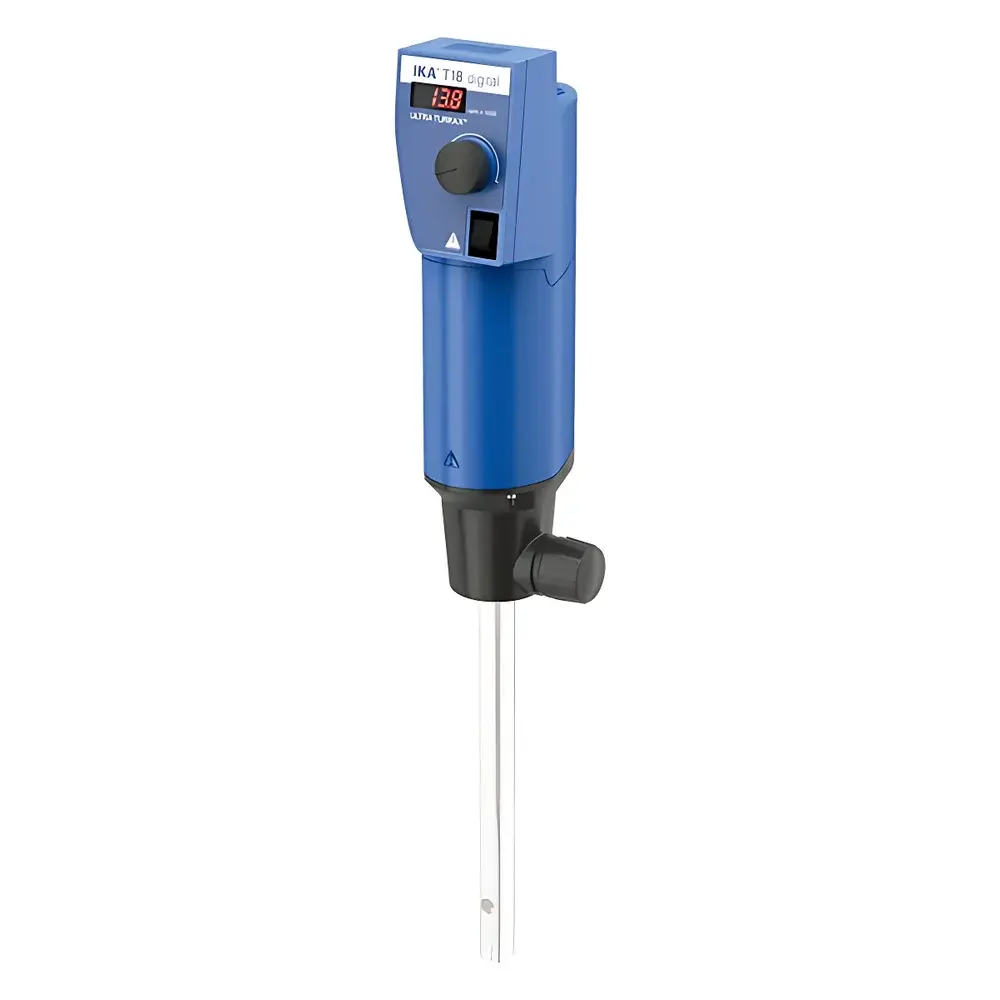
IKA T18 Digital Display Homogenizer
| Brand | IKA |
|---|---|
| Origin | Germany |
| Model | T18 |
| Motor Input/Output Power | 500 / 300 W |
| Processing Volume (H₂O) | 1–1,500 mL |
| Max. Viscosity | 5,000 mPa·s |
| Speed Range | 500–25,000 rpm |
| Speed Control | Continuous (Stepless) |
| Speed Display | LED |
| No-Load Noise Level | 75 dB(A) |
| Overload Protection | Yes |
| Probe Diameter/Length | 13 mm / 175 mm |
| Dimensions (W×D×H) | 87 × 271 × 106 mm |
| Weight | 2.5 kg |
| Ambient Temperature Range | 5–40 °C |
| Relative Humidity Limit | ≤80 % RH |
| Protection Class | IP20 |
| Optional Accessories | Dispersion Probes |
Overview
The IKA T18 Digital Display Homogenizer is a high-performance, benchtop rotor-stator homogenizer engineered for reproducible sample disruption, emulsification, and fine dispersion in life science, pharmaceutical, and quality control laboratories. Operating on the principle of high-shear mechanical homogenization, the T18 utilizes rotating probe tips that generate intense hydrodynamic forces—including cavitation, turbulence, and radial shear—within the liquid phase to achieve uniform particle size reduction and stable suspension formation. Its robust 500 W input motor delivers up to 300 W of continuous mechanical output power, enabling consistent processing across a wide viscosity range (up to 5,000 mPa·s) and volume span (1–1,500 mL H₂O equivalent). Designed and manufactured in Staufen, Germany, the T18 conforms to IKA’s long-standing engineering standards for precision, durability, and operator safety—reflecting over four decades of expertise in laboratory mixing and dispersion technology.
Key Features
- Digitally controlled, stepless speed regulation from 500 to 25,000 rpm ensures precise optimization for diverse sample matrices—from soft tissue homogenates to viscous polymer solutions.
- Integrated electronic overload protection safeguards both motor and drive electronics during transient torque spikes or probe stalling, extending service life and ensuring operational continuity.
- Ergonomic quick-release probe coupling allows tool-free detachment of dispersion probes within seconds—minimizing cross-contamination risk and facilitating rapid cleaning or probe exchange between experiments.
- LED digital speed display provides real-time, non-contact rotational speed feedback, eliminating reliance on external tachometers unless traceable calibration is required.
- Compact footprint (87 × 271 × 106 mm) and lightweight construction (2.5 kg) enable flexible placement on laminar flow hoods, biosafety cabinets, or shared lab benches without compromising stability.
- IP20-rated housing meets basic electrical safety requirements for indoor laboratory environments with ambient temperatures between 5–40 °C and relative humidity ≤80 % RH (non-condensing).
Sample Compatibility & Compliance
The T18 accommodates a broad spectrum of biological, chemical, and industrial samples—including mammalian tissues, bacterial pellets, plant extracts, colloidal suspensions, and low-to-medium-viscosity emulsions. When paired with compatible stainless-steel or PTFE-coated probes (e.g., S18N-10G, S18N-19G), it supports workflows aligned with ISO 17025-accredited testing protocols and GLP-compliant documentation practices. Though not intrinsically compliant with FDA 21 CFR Part 11, its digital speed logging capability—when integrated with optional DZM tachometer modules and validated LIMS interfaces—supports audit-ready data capture in regulated QC/QA environments. All accessories (stands R 1825–R 1827, vessel clamps RH3) are mechanically engineered to minimize vibration transmission and ensure probe immersion depth consistency—critical for inter-laboratory method transfer.
Software & Data Management
The T18 operates as a standalone instrument without embedded firmware or proprietary software dependencies. Speed settings are retained via non-volatile memory upon power cycling, supporting repeatable method execution. For traceable operation, the DZM tachometer interface enables analog voltage output (0–10 V) proportional to actual shaft speed—compatible with third-party data acquisition systems (e.g., LabVIEW, MATLAB, or PLC-based SCADA platforms). When used in conjunction with IKA’s optional Labworldsoft suite (via RS232 or USB-to-serial adapters), users may log timestamped speed profiles, trigger events, and export CSV-formatted datasets for statistical process control (SPC) analysis or regulatory submission packages.
Applications
- Cell lysis and subcellular fractionation in molecular biology workflows.
- Preparation of homogeneous reference standards for particle size distribution validation (e.g., prior to laser diffraction or dynamic light scattering).
- Routine homogenization of food, cosmetic, or agrochemical formulations during R&D and batch release testing.
- Dispersion of nanomaterials (e.g., graphene oxide, metal oxides) into aqueous or organic carriers for stability assessment.
- Emulsification of oil-in-water or water-in-oil systems under controlled shear history—supporting formulation development per ASTM D3924 or ISO 7389.
FAQ
Is the dispersion probe included with the T18 unit?
No—the T18 is supplied without a dispersion probe. Probes must be selected and ordered separately based on application requirements (e.g., geometry, material compatibility, sterilizability).
Can the T18 be used for sterile applications?
Yes—when equipped with autoclavable probes (e.g., S18N-10G, stainless steel grade 1.4404) and operated within validated parameters, the T18 supports aseptic processing under ISO 5 cleanroom conditions.
What stands and clamps are recommended for reproducible probe immersion depth?
IKA R 1825 (universal base stand), R 1826 (low-profile version), and RH3 (adjustable vessel clamp) are calibrated to maintain ±0.5 mm vertical positioning repeatability across repeated runs.
Does the T18 meet electromagnetic compatibility (EMC) directives for EU laboratories?
Yes—it complies with EN 61326-1:2013 for laboratory equipment and carries CE marking for use within the European Economic Area.
How is speed accuracy verified during routine maintenance?
Speed linearity and repeatability can be confirmed using a NIST-traceable handheld tachometer at three points across the operating range (e.g., 5,000 / 15,000 / 25,000 rpm) per ISO/IEC 17025 clause 6.5.2.



