
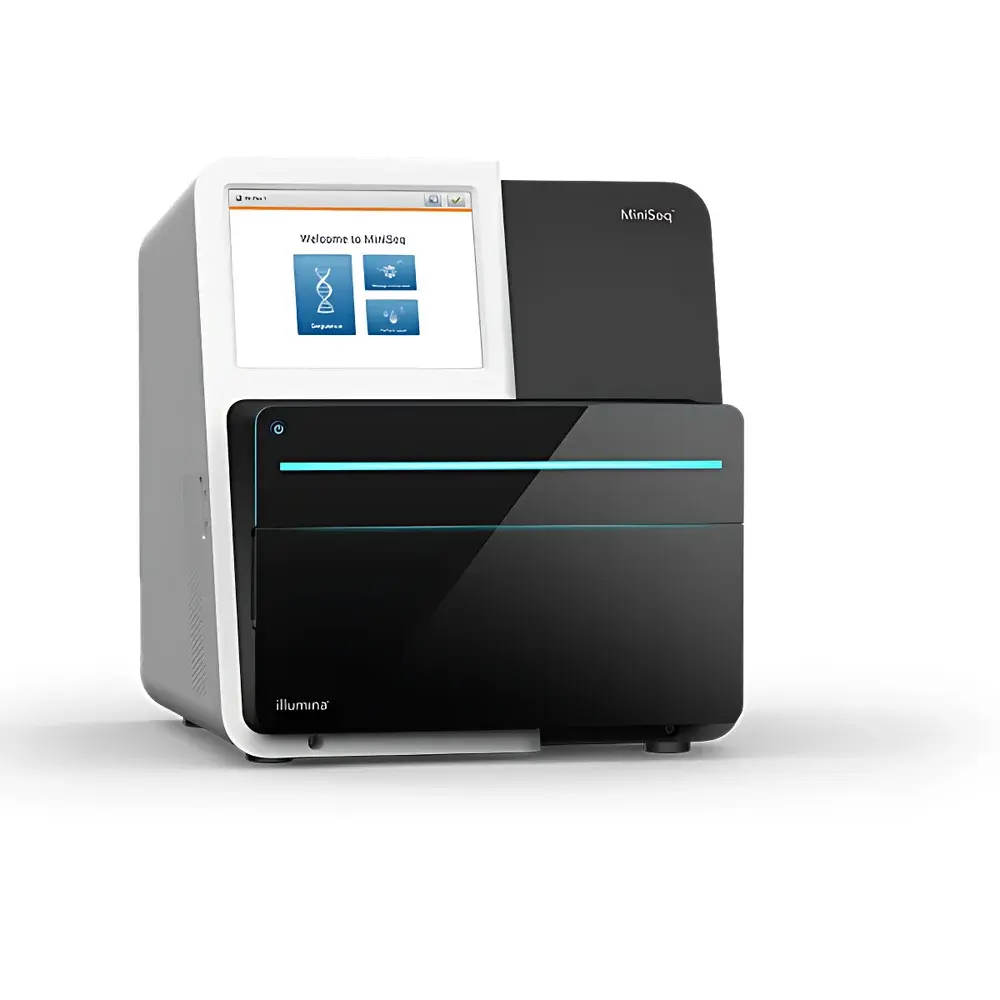
Illumina MiniSeq Desktop Sequencing System
| Brand | Illumina |
|---|---|
| Origin | Shanghai, China |
| Manufacturer Type | Authorized Distributor |
| Product Category | Domestic |
| Model | MiniSeq |
| Instrument Class | Next-Generation Sequencing (NGS) Platform |
| Medical Device Classification | Non-Medical Device |
| Form Factor | Benchtop Sequencer |
| Read Length | 2 × 150 bp |
| Throughput | Up to 25 Gb per run |
| Run Time | ~17–32 hours depending on workflow |
| Supported Applications | Targeted sequencing, small RNA-seq, amplicon sequencing, gene expression profiling, and microbiome analysis |
| Library Prep Compatibility | Illumina-compatible library kits (e.g., TruSight, Nextera XT, RNA Prep with Enrichment) |
Overview
The Illumina MiniSeq Desktop Sequencing System is a compact, integrated next-generation sequencing (NGS) platform engineered for laboratories seeking reliable, scalable, and accessible NGS capabilities without infrastructure overhead. Leveraging Illumina’s proven sequencing-by-synthesis (SBS) chemistry and patterned flow cell technology, the MiniSeq delivers high-accuracy, clonal cluster-based sequencing with low error rates and exceptional base-calling reproducibility. Designed as a benchtop instrument, it eliminates the need for dedicated server rooms, chilled water systems, or external cluster generation units—enabling deployment in standard molecular biology labs, core facilities, and translational research environments. Its architecture supports dual-indexed, paired-end sequencing up to 2 × 150 bp, delivering up to 25 gigabases of data per run with uniform coverage and low duplication rates. The system is optimized for targeted resequencing, focused transcriptome profiling, and small-genome applications—including bacterial whole-genome sequencing, viral variant detection, and oncology hotspot panels.
Key Features
- Benchtop footprint (48 × 51 × 41 cm) with integrated cluster generation, sequencing, and primary data analysis—no external instruments required.
- On-instrument real-time monitoring of run progress, including cluster density, phasing/pre-phasing metrics, and Q30 scores per cycle.
- Automated workflow from loaded library to FASTQ files: library denaturation, loading, cluster amplification, sequencing, and base calling are fully controlled by the MiniSeq Control Software (MCS).
- Two throughput modes: High Output (up to 25 Gb, ~32 hrs) and Rapid Run (up to 6 Gb, ~17 hrs), enabling flexibility across experimental scale and turnaround requirements.
- Support for Illumina’s validated library preparation kits—including TruSight Tumor 170, Nextera XT DNA Library Prep, and RNA Prep with Enrichment—ensuring compatibility with established QC and validation protocols.
- Embedded compute module with 16 GB RAM and 500 GB SSD for onboard demultiplexing and FASTQ generation; raw BCL files exportable via USB 3.0 or network transfer.
Sample Compatibility & Compliance
The MiniSeq accepts standard Illumina-compatible libraries prepared from genomic DNA, FFPE-derived DNA, cDNA, small RNA, and amplicons. Input requirements range from 1–2 nM pooled libraries (10–20 µL volume), accommodating low-input workflows with minimal sample loss. All consumables—including MiniSeq Reagent Kits (v2) and Flow Cells—are manufactured under ISO 13485–aligned quality systems and traceable to lot-specific certificates of analysis. While the MiniSeq itself is not classified as a medical device per FDA 21 CFR Part 809 or EU IVDR Annex XVI, its outputs support research-use-only (RUO) applications aligned with CLIA-waived laboratory practices. Data integrity is maintained through audit-trail-enabled software logging (per ALCOA+ principles), supporting GLP/GMP-aligned internal SOPs and ISO/IEC 17025 documentation requirements.
Software & Data Management
The MiniSeq Control Software (MCS) v3.x provides intuitive, wizard-driven instrument control, real-time QC visualization, and automated FASTQ generation. Demultiplexing uses bcl2fastq v2.20, supporting custom index combinations and sample sheet validation prior to run initiation. Output files conform to Illumina’s standard FASTQ format with embedded read-group tags (RG tags) for downstream alignment and variant calling. Integration with BaseSpace Sequence Hub (cloud-based) or local deployment of Illumina DRAGEN Bio-IT Platform enables secondary and tertiary analysis—including alignment (BWA-MEM), variant calling (GATK HaplotypeCaller), and expression quantification (STAR/RSEM). All software modules comply with FDA 21 CFR Part 11 requirements when deployed in validated configurations with electronic signatures and role-based access controls.
Applications
- Targeted DNA sequencing for cancer hotspot panels, inherited disease screening, and pharmacogenomic marker validation.
- Small RNA and miRNA profiling in biomarker discovery studies.
- Amplicon-based pathogen detection and strain typing in public health and food safety labs.
- Transcriptome characterization of model organisms or limited clinical samples where deep coverage is not required.
- NGS method development and training—ideal for introducing students and technicians to Illumina SBS workflows.
- Quality control of CRISPR editing outcomes via amplicon sequencing of edited loci.
FAQ
Is the MiniSeq suitable for de novo genome assembly?
No—the MiniSeq is optimized for resequencing and targeted applications; its read length and throughput are insufficient for robust de novo assembly of large or complex genomes.
Can the MiniSeq be used in a regulated diagnostic environment?
The MiniSeq is designated RUO and not CE-IVD or FDA-cleared; however, it may serve as part of a validated LDT workflow under appropriate laboratory-developed test protocols and QA oversight.
What level of bioinformatics expertise is required to operate the MiniSeq?
Basic operation requires only library prep and run initiation; primary analysis (FASTQ generation) is fully automated. Secondary analysis assumes familiarity with command-line tools or cloud-based platforms such as BaseSpace or DRAGEN.
Does the MiniSeq support single-read sequencing?
Yes—single-read 150-cycle runs are supported in both High Output and Rapid modes, though paired-end is recommended for most applications requiring strand-specificity or improved mapping accuracy.
How frequently does the flow cell require cleaning or replacement?
Each MiniSeq flow cell is single-use and disposed of after one run; no cleaning or refurbishment is possible or recommended due to irreversible surface chemistry depletion.



