
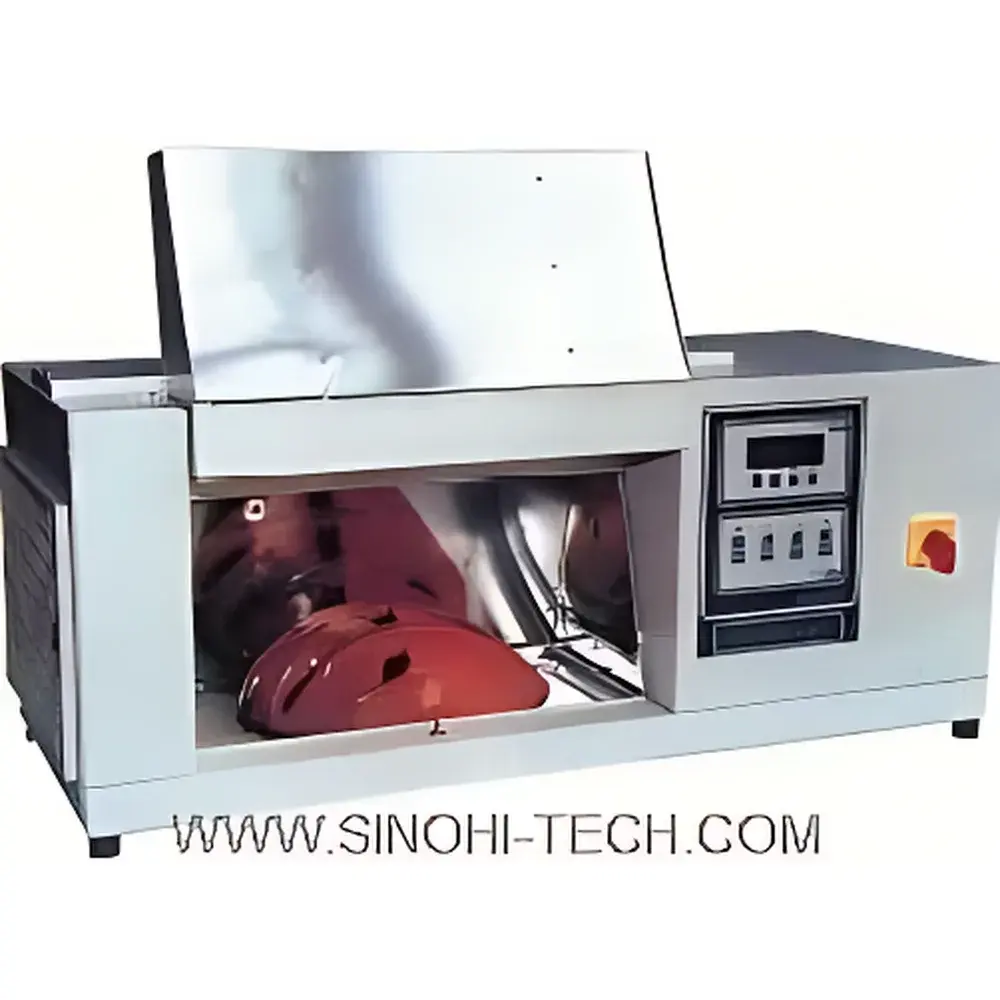
ILSIN #522 Xenon Arc Weathering Chamber
| Origin | Germany |
|---|---|
| Type | Xenon arc exposure chamber |
| Model | #522 |
| Lamp power options | 1.5 kW / 2.5 kW |
| Illuminated area (W×D) | 280 × 220 mm / 420 × 200 mm |
| Chamber dimensions (W×D×H) | 750 × 390 × 400 mm / 890 × 390 × 400 mm |
| Weight | 29 kg / 31 kg |
| Sample capacity (15 × 30 mm) | >120 pcs / >180 pcs |
| Irradiance range | 0.25–1.0 kW/m² (290–800 nm) |
| Black panel temperature control | Yes |
| Chamber temperature & humidity display | Yes |
| Timer range | 0–9999 h |
| Timer preset | 0–999 h |
| Control interface | 4-line LCD display |
| Programmable test sequences | Up to 15 |
| Communication | RS232-C |
| Software | XEN 32 “Report” / “Rep+Cal” |
| Standard filter | 280 nm cutoff |
| Optional filters | 310 nm cutoff, IR rejection filter |
| Cooling | Water-cooled sample stage, air-cooling system |
| Humidity control | Integrated programmable water injection system (optional thermostatic control: 30–50 °C) |
| Stirring accessory | Magnetic stirrer for liquid samples |
| Power supply | 230 VAC, 50/60 Hz |
Overview
The ILSIN #522 Xenon Arc Weathering Chamber is an engineered solution for accelerated material aging under controlled solar-spectrum irradiation. Based on xenon arc lamp technology, it replicates full-spectrum sunlight—including critical UV, visible, and near-infrared regions (290–800 nm)—to simulate outdoor weathering conditions in a reproducible laboratory environment. Designed to ASTM G155, ISO 4892-2, and SAE J2527 test standards, the chamber supports quantitative evaluation of photodegradation, color fading, gloss loss, cracking, chalking, and mechanical property deterioration in polymers, coatings, textiles, automotive components, and architectural materials. Its modular architecture enables configuration flexibility across irradiance levels (0.25–1.0 kW/m²), sample geometry, and environmental conditioning—making it suitable for both R&D screening and compliance-driven validation protocols.
Key Features
- Xenon arc lamp options: 1.5 kW and 2.5 kW configurations for scalable irradiance output and throughput requirements
- Precisely calibrated irradiance monitoring with real-time digital display and closed-loop control
- Black panel temperature sensor integrated into the sample plane for accurate surface thermal loading assessment
- Programmable multi-step test sequences (up to 15 independent profiles) stored and executed via intuitive 4-line LCD interface
- Water-cooled sample stage and optional IR-rejection filter minimize non-photochemical heating effects, preserving spectral fidelity
- Integrated programmable water injection system enables precise humidity modulation (30–50 °C thermostatically controlled option available)
- Magnetic stirrer accessory for uniform exposure of liquid-phase samples (e.g., pigment dispersions, UV-curable resins)
- RS232-C serial interface for external data logging and remote parameter synchronization
- Comprehensive software suite: XEN 32 “Report” for test documentation and traceability; “Rep+Cal” for irradiance calibration certificate generation per ISO/IEC 17025 guidelines
Sample Compatibility & Compliance
The #522 accommodates diverse sample formats—including rigid panels (15 × 30 mm standard), flexible films, molded parts, and liquid specimens—via its adjustable sample tray and magnetic stirrer integration. Its illumination geometry ensures uniform irradiance distribution across the active test area (280 × 220 mm or 420 × 200 mm). The chamber meets essential regulatory and industry-standard requirements: ISO 4892-2 (plastics—exposure to laboratory light sources), ASTM G155 (non-metallic materials in xenon arc devices), and SAE J2527 (automotive interior materials). All software modules support audit-ready data management aligned with GLP and FDA 21 CFR Part 11 principles—including electronic signatures, change history logs, and secure user access levels.
Software & Data Management
XEN 32 software provides end-to-end test lifecycle management. “Report” generates compliant PDF test records containing irradiance history, black panel temperature profiles, chamber humidity/temperature logs, and operator metadata. “Rep+Cal” extends functionality with NIST-traceable irradiance calibration workflows, including spectral power distribution (SPD) verification and filter aging compensation algorithms. Raw data export (CSV/Excel) supports third-party statistical analysis. All test parameters—including timer settings, irradiance setpoints, and sequence logic—are stored with timestamped revision history, ensuring full traceability for internal QA audits or regulatory submissions.
Applications
The #522 is routinely deployed in quality assurance laboratories for evaluating UV stabilizer efficacy in polyolefins, predicting service life of exterior automotive trim, validating fade resistance of textile dyes, assessing durability of architectural sealants, and qualifying packaging film barrier integrity under photolytic stress. It also supports formulation development for UV-curable inks and adhesives, where dose-response relationships between irradiance, exposure time, and crosslink density must be quantified under tightly controlled thermal-hygrometric conditions.
FAQ
What spectral range does the #522 replicate, and how is it filtered?
The chamber emits continuous spectrum from 290 nm to 800 nm. Standard configuration includes a 280 nm cutoff filter; optional 310 nm and IR-rejection filters are available to tailor spectral output for specific material sensitivity profiles.
Can the #522 perform cyclic testing with alternating light/dark or wet/dry phases?
Yes—programmable sequences support timed transitions between irradiance levels, temperature setpoints, and water injection cycles, enabling simulation of diurnal or seasonal weathering patterns.
Is black panel temperature measurement traceable to national standards?
Black panel sensors are factory-calibrated against reference thermometers accredited to ISO/IEC 17025; calibration certificates are generated using the XEN 32 “Rep+Cal” module.
Does the system comply with FDA 21 CFR Part 11 for electronic records?
When configured with XEN 32 “Rep+Cal” and user-access controls enabled, the system supports audit trails, electronic signatures, and data integrity safeguards required under Part 11 for regulated pharmaceutical and medical device testing environments.
What maintenance intervals are recommended for lamp and filter replacement?
Xenon lamps require replacement after ~1500 hours (1.5 kW) or ~2000 hours (2.5 kW); optical filters should be inspected every 500 hours and replaced based on spectral transmittance degradation measured via optional spectroradiometer integration.



