
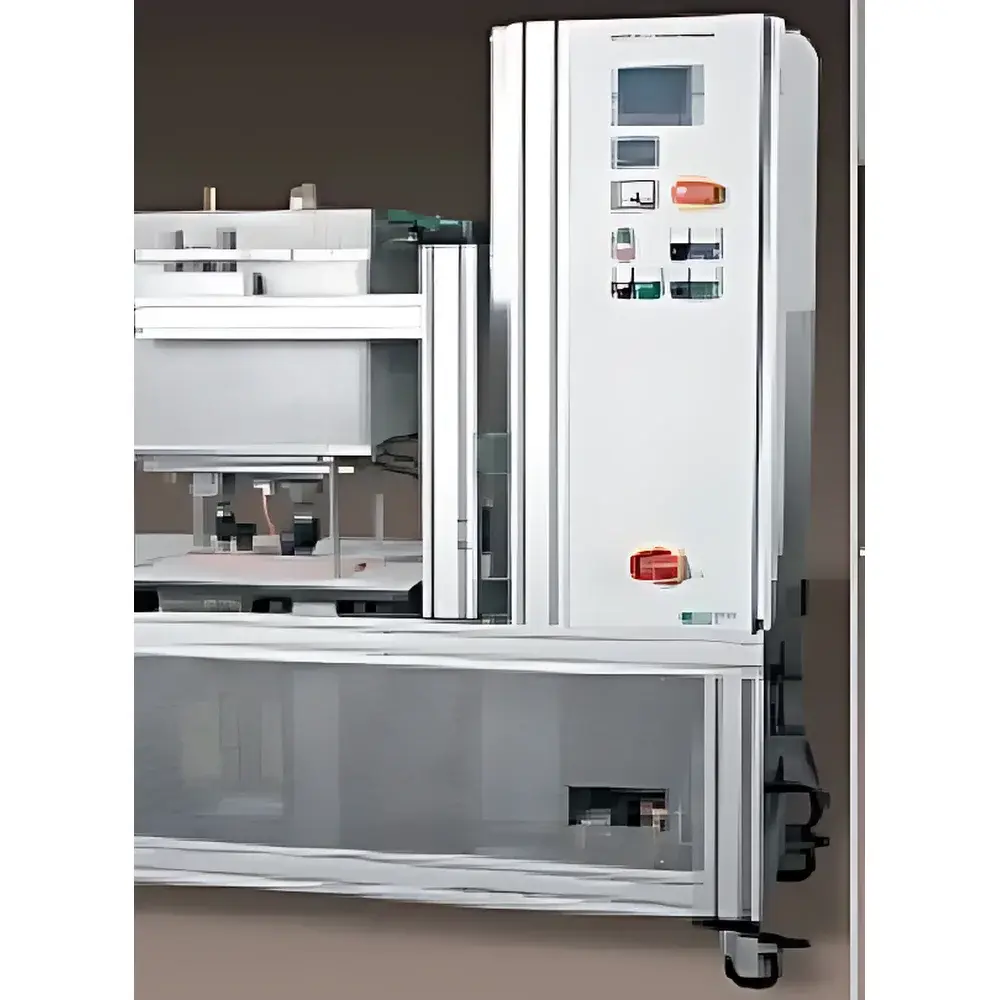
IMCE HT1600-DS Dual-Sample High-Temperature Elastic Modulus Analyzer
| Brand | IMCE |
|---|---|
| Origin | Belgium |
| Model | HT1600-DS |
| Sample Capacity | 2 simultaneous specimens |
| Operating Temperature Range | Up to 1600 °C |
| Optional Vertical Dilatometer Integration | Yes |
| Compliance | ASTM E1876, ISO 12680, DIN 51045 |
Overview
The IMCE HT1600-DS Dual-Sample High-Temperature Elastic Modulus Analyzer is an advanced resonant frequency-based testing system engineered for precise, non-contact determination of dynamic Young’s modulus, shear modulus, and Poisson’s ratio in solid materials under controlled high-temperature environments. Utilizing impulse excitation methodology (IEM) in accordance with ASTM E1876 and ISO 12680, the instrument measures the natural flexural and torsional resonance frequencies of rectangular, cylindrical, or disc-shaped specimens while heated in a programmable furnace. The HT1600-DS extends the proven architecture of the single-sample HT1600 platform by integrating a dual-specimen support assembly and independent signal acquisition channels—enabling concurrent measurement of two samples without cross-talk or thermal interference. This configuration maintains full metrological equivalence to the base model while doubling throughput for routine quality control, R&D screening, and inter-laboratory comparison studies.
Key Features
- Dual-specimen holder with thermally isolated ceramic supports and precision-machined contact points, ensuring mechanical decoupling and uniform thermal exposure for both samples.
- High-stability silicon carbide or molybdenum disilicide (MoSi₂) furnace with ±1 °C temperature uniformity across the 30–1600 °C operating range and programmable ramp rates from 0.1 to 20 °C/min.
- Integrated piezoelectric impactor and high-sensitivity MEMS accelerometers calibrated traceably to NIST standards; signal-to-noise ratio >75 dB over the 1–100 kHz acquisition bandwidth.
- Real-time resonance peak tracking with adaptive FFT windowing and automated mode identification, minimizing operator dependency and reducing analysis time per test cycle.
- Modular hardware design supporting optional vertical dilatometer integration—enabling simultaneous elastic modulus and linear thermal expansion coefficient (CTE) measurement on identical specimen geometry and thermal history.
- Robust mechanical frame with vibration-damping granite base and electromagnetic shielding compliant with IEC 61326-1 for operation in shared laboratory environments.
Sample Compatibility & Compliance
The HT1600-DS accommodates standard geometries including bars (3–6 mm × 20–100 mm), rods (Ø3–10 mm × 25–100 mm), and discs (Ø10–25 mm × 1–5 mm thick), with material compatibility spanning technical ceramics (Al₂O₃, SiC, ZrO₂), refractory metals (Mo, W, Nb), CMCs, sintered carbides, and high-performance glasses. All measurements adhere to the fundamental requirements of ASTM E1876 (Standard Test Method for Dynamic Young’s Modulus, Shear Modulus, and Poisson’s Ratio by Impulse Excitation of Vibration), ISO 12680-1 (Refractory products — Determination of dynamic Young’s modulus), and DIN 51045 (Testing of refractory materials — Determination of elastic properties at elevated temperatures). Data integrity meets GLP/GMP documentation standards, with full audit trail support for FDA 21 CFR Part 11–compliant software configurations.
Software & Data Management
Control and analysis are executed via IMCE’s proprietary ModuLab HT Suite v4.x—a Windows-based application offering multi-language UI, real-time thermal profile synchronization, and automated pass/fail evaluation against user-defined specification limits. Raw time-domain signals, spectral plots, temperature-resolved modulus curves, and CTE overlays (when dilatometer is installed) are stored in HDF5 format with embedded metadata (operator ID, calibration certificate ID, furnace thermocouple type, sample ID). Export options include CSV, XML, and PDF reports conforming to ISO/IEC 17025 reporting guidelines. Software validation packages—including IQ/OQ documentation, electronic signature workflows, and change control logs—are available upon request for regulated environments.
Applications
- High-temperature qualification of aerospace-grade ceramic matrix composites during thermal cycling and aging studies.
- Batch-to-batch consistency verification of sintered alumina substrates used in semiconductor packaging.
- Thermo-mechanical mapping of modulus degradation onset in nuclear fuel cladding candidates (e.g., SiC/SiC composites).
- Correlation of microstructural evolution (via post-test SEM/EBSD) with dynamic modulus trends across annealing temperatures.
- Supporting development of ASTM WK78922 (new practice for modulus measurement of ultra-high-temperature ceramics).
FAQ
What is the maximum recommended sample mass per position in the dual holder?
The dual-specimen support is rated for up to 50 g per sample at 1600 °C; total combined mass must not exceed 90 g to maintain thermal homogeneity and mechanical stability.
Can the HT1600-DS perform measurements under inert or reducing atmospheres?
Yes—furnace chamber is compatible with argon, nitrogen, hydrogen/nitrogen mixtures, and vacuum down to 10⁻² mbar when equipped with optional gas inlet/outlet ports and quartz or alumina tube liners.
Is the vertical dilatometer option factory-installed or retrofittable?
The dilatometer module is designed for field installation by IMCE-certified service engineers and requires firmware update and mechanical alignment verification.
How is temperature calibration verified during operation?
Each system includes dual-point NIST-traceable calibration using PtRh10/Pt thermocouples at 1000 °C and 1500 °C; in-situ verification is supported via optional blackbody pyrometer integration.
Does the dual-sample mode affect measurement uncertainty compared to single-sample operation?
No—uncertainty budgets (k=2) remain identical (≤±1.8% for Young’s modulus at 1000 °C) as both channels undergo independent calibration and signal processing without shared analog components.



