
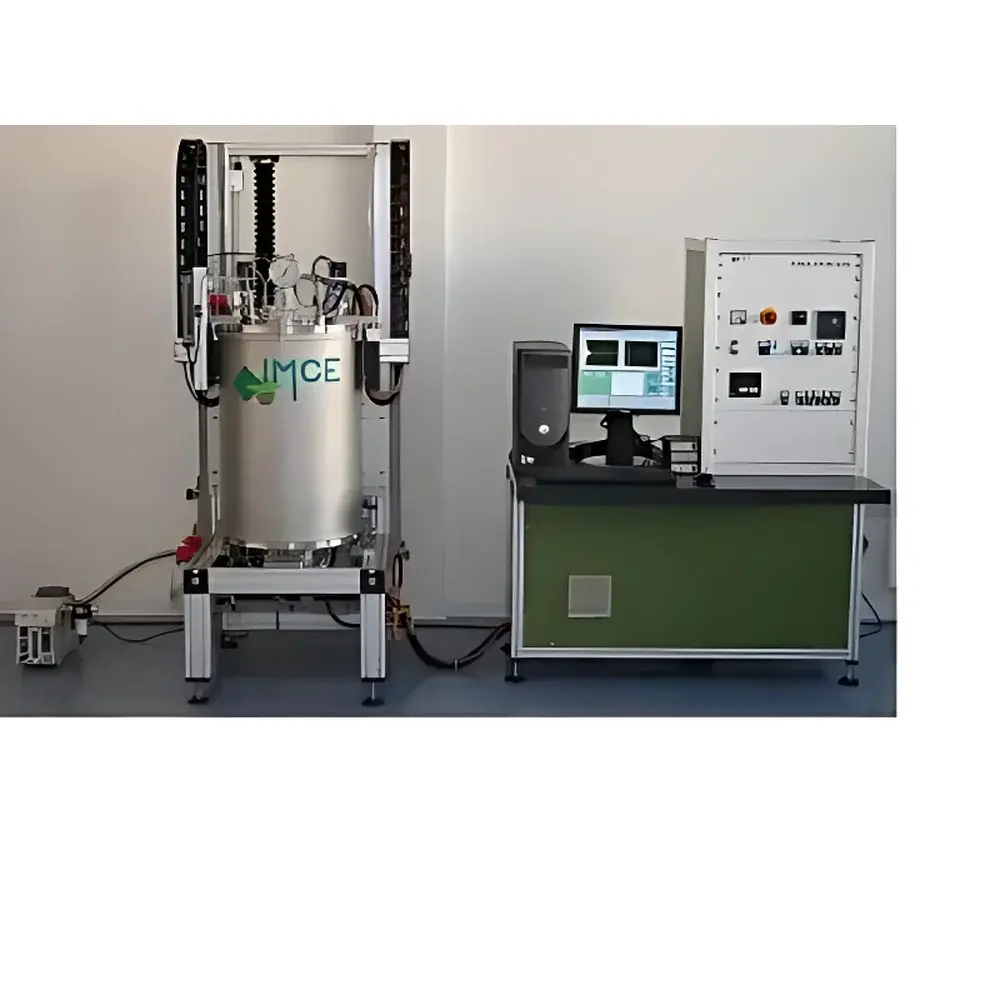
IMCE HTVP1600C Dynamic Elastic Modulus and Damping Analyzer
| Brand | IMCE |
|---|---|
| Model | HTVP1600C |
| Measurement Principle | Resonant Frequency Method |
| Frequency Range | 1–100 kHz |
| Damping Factor (tan δ) | 1×10⁻⁵ to 0.1 |
| Temperature Range | Ambient to 1600 °C |
| Atmosphere Control | Yes |
| Compliance | ASTM E1876-99 |
| Output Parameters | Young’s Modulus, Shear Modulus, Poisson’s Ratio, Internal Friction (Q⁻¹) |
Overview
The IMCE HTVP1600C Dynamic Elastic Modulus and Damping Analyzer is a high-temperature, atmosphere-controlled resonant frequency testing system engineered for precise, non-destructive characterization of mechanical properties in advanced structural materials. Based on the fundamental principles of free-free or forced flexural/longitudinal resonance, the system determines dynamic elastic moduli—Young’s modulus (E), shear modulus (G), and Poisson’s ratio (ν)—by analyzing natural vibration frequencies and decay behavior of rectangular, cylindrical, or disc-shaped specimens. Unlike static or indentation-based methods, this dynamic approach operates under true thermomechanical equilibrium conditions, enabling real-time monitoring of modulus evolution during thermal cycling, phase transitions, or sintering processes. The HTVP1600C integrates a vacuum-tight, multi-zone high-temperature furnace with programmable gas handling (inert, reducing, oxidizing, or controlled partial pressure atmospheres), making it suitable for research and quality control applications involving ceramics, refractory metals, CMCs, and high-entropy alloys.
Key Features
- Non-destructive evaluation: No sample machining beyond standard geometry preparation; preserves microstructural integrity throughout testing.
- High-temperature capability: Continuous operation from ambient up to 1600 °C with ±1 °C thermal stability and ramp rates up to 20 °C/min.
- Atmosphere flexibility: Integrated mass flow controllers support N₂, Ar, H₂/N₂ mixtures, CO/CO₂, O₂, and vacuum (10⁻³ mbar base pressure).
- Resonance excitation & detection: Electromagnetic transducers coupled with high-sensitivity laser Doppler vibrometry or piezoelectric accelerometers ensure signal-to-noise ratios >60 dB across 1–100 kHz bandwidth.
- Compliance with ASTM E1876-99: Fully implements the standard test method for determining dynamic Young’s modulus, shear modulus, and Poisson’s ratio by impulse excitation of vibration.
- Modular furnace design: Interchangeable hot zones allow adaptation for RFDA-MF System 21/23 compatibility and future upgrade paths to 1750 °C configurations (e.g., HTVP1750C).
Sample Compatibility & Compliance
The HTVP1600C accommodates specimens ranging from 2 mm × 2 mm × 10 mm rods to 25 mm diameter discs, with minimal geometric constraints imposed by boundary condition modeling (e.g., free–free, clamped–free). It supports both linear viscoelastic analysis (small-strain regime) and non-linear damping assessment via amplitude-dependent frequency shift and Q-factor mapping. All measurements are traceable to NIST-calibrated reference standards and fully compliant with ISO/IEC 17025 requirements for accredited laboratories. Data acquisition meets FDA 21 CFR Part 11 criteria when configured with RFDA MF Software’s audit-trail-enabled mode, supporting GLP/GMP environments in aerospace, nuclear, and biomedical implant material qualification.
Software & Data Management
The RFDA MF Software suite provides full instrument control, automated resonance peak identification, multi-mode curve fitting (Rayleigh–Ritz, Timoshenko beam theory), and thermomechanical property mapping. It calculates temperature-dependent E(T), G(T), ν(T), and internal friction Q⁻¹(T) with uncertainty propagation based on measurement repeatability (typically <0.3% RSD for modulus at constant T). Export formats include CSV, MATLAB (.mat), and HDF5 for integration into statistical process control (SPC) platforms or finite element model calibration workflows. Software validation documentation—including IQ/OQ protocols—is available upon request for regulated industry deployment.
Applications
- Development and certification of oxide and non-oxide ceramics (Al₂O₃, SiC, ZrO₂, Si₃N₄) used in turbine components and armor systems.
- In-process monitoring of solid-state sintering kinetics and densification behavior in powder metallurgy and additive manufacturing feedstocks.
- Phase transformation studies (e.g., martensitic, perovskite, spinel) through abrupt modulus anomalies and damping peaks.
- Thermal barrier coating (TBC) adhesion and degradation assessment under cyclic oxidation and thermal shock.
- Quality assurance of nuclear-grade graphite and refractory metal alloys (Mo, W, Nb) under simulated reactor coolant atmospheres.
- Fundamental research on anelasticity mechanisms—including dislocation damping, grain boundary sliding, and magnetic domain wall motion—in functional materials.
FAQ
What standards does the HTVP1600C comply with?
ASTM E1876-99 is natively implemented; additional alignment with ISO 12215, DIN 51069, and GB/T 23634 is achievable via user-defined analysis templates.
Can the system measure damping under mechanical load?
No—it operates exclusively in free-vibration or low-energy impulse-excited modes; sustained mechanical loading requires complementary creep or fatigue rigs.
Is sample mounting automated?
Mounting is manual but standardized using ceramic fiber fixtures; optional robotic sample handlers are available for high-throughput labs.
How is temperature uniformity verified within the hot zone?
Calibration includes three-point thermocouple mapping (Type S) and post-test pyrometric validation using blackbody reference sources.
Does the system support in-situ quenching?
Yes—rapid cooling (<100 °C/s) is enabled via inert gas jet modules integrated into the furnace chamber design.



