
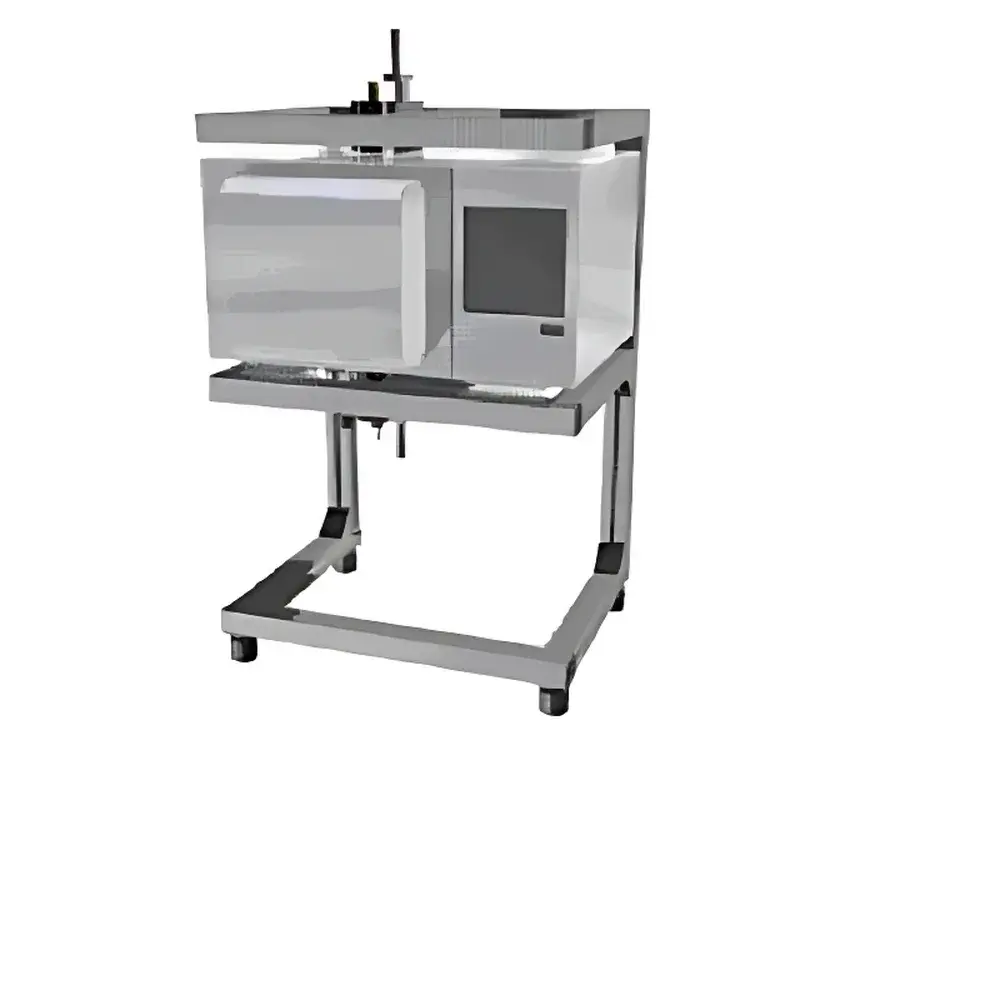
IMCE HTVP650C Dynamic Elastic Modulus Analyzer
| Brand | IMCE |
|---|---|
| Model | HTVP650C |
| Measurement Principle | Impulse Excitation Technique (IET) / Resonance Frequency Analysis |
| Frequency Range | 1–100 kHz |
| Elastic Modulus Accuracy | < ±0.1% |
| Repeatability | < ±0.2% |
| Damping Resolution | down to 1×10⁻⁵ |
| Sample Dimensions | Length 20–300 mm, Width 2–130 mm |
| Maximum Operating Temperature | 650 °C (upgradable to 1100 °C) |
| Compliance | ASTM C1259, ASTM E1187 |
| Software | Integrated IET data acquisition & analysis suite with temperature correlation module |
| Excitation | Automated electromagnetic impulse system |
| Data Output | Young’s modulus (E), Shear modulus (G), Poisson’s ratio (ν), Resonant frequencies (f₁, f₂, …), Internal friction (Q⁻¹) |
Overview
The IMCE HTVP650C Dynamic Elastic Modulus Analyzer is a precision instrument engineered for non-destructive, high-reproducibility characterization of mechanical properties in solid materials—particularly metals, ceramics, refractories, and advanced composites. It operates on the well-established Impulse Excitation Technique (IET), wherein a transient mechanical impulse excites free vibration modes in a freely suspended sample; the resulting resonant frequencies are captured via high-sensitivity accelerometers or laser Doppler vibrometry. From these fundamental flexural and torsional resonance frequencies—and with precise knowledge of sample geometry, density, and boundary conditions—the system calculates Young’s modulus (E), shear modulus (G), Poisson’s ratio (ν), and internal friction (Q⁻¹) using standardized analytical models derived from Euler–Bernoulli beam theory and Timoshenko corrections where applicable. Unlike static tensile or indentation methods, IET delivers rapid, temperature-dependent modulus data without inducing plastic deformation, making it ideal for quality control, sintering monitoring, thermal cycling studies, and R&D validation of microstructural evolution.
Key Features
- Automated electromagnetic impulse excitation ensures consistent energy input and eliminates operator-induced variability across repeated measurements.
- High-resolution frequency acquisition (1–100 kHz range) with digital signal processing enables detection of subtle shifts in resonant behavior—critical for detecting early-stage microcracking, phase transitions, or grain boundary relaxation.
- Integrated high-temperature furnace with PID-controlled heating up to 650 °C (field-upgradable to 1100 °C), featuring uniform axial temperature distribution (< ±2 °C over 50 mm zone) and inert atmosphere compatibility (N₂, Ar).
- Modulus accuracy better than ±0.1% and repeatability better than ±0.2%—validated against NIST-traceable reference standards per ISO 12226 and ASTM E1875 guidelines.
- Damping resolution down to Q⁻¹ = 1×10⁻⁵ supports quantitative analysis of viscoelastic loss mechanisms, including thermoelastic damping and dislocation-mediated internal friction.
- Flexible sample accommodation: accepts rectangular bars (20–300 mm length, 2–130 mm width) and cylindrical rods (diameter 3–25 mm), with optional custom support fixtures for irregular geometries.
Sample Compatibility & Compliance
The HTVP650C accommodates a broad spectrum of rigid, isotropic, or quasi-isotropic solids—including sintered oxides (Al₂O₃, ZrO₂), technical ceramics (SiC, Si₃N₄), superalloys (Inconel, Hastelloy), cast irons, and additively manufactured metal parts. Sample preparation follows ASTM C1259 (for ceramics) and ASTM E1187 (for metallics), ensuring dimensional tolerances, surface finish (Ra < 0.8 µm), and edge chamfering comply with standard test protocols. The system supports GLP-compliant operation: all measurement parameters (temperature ramp rate, dwell time, excitation voltage, sampling rate) are logged with timestamps and user IDs. Full audit trails meet FDA 21 CFR Part 11 requirements when paired with validated software configuration.
Software & Data Management
The proprietary IMCE IET Suite provides real-time spectral analysis, automated peak identification, and multi-parameter curve fitting. It includes temperature-correlated modulus mapping, comparative trend analysis across batch lots, and export-ready reports compliant with ISO/IEC 17025 documentation frameworks. Raw time-domain signals and FFT spectra are stored in HDF5 format for third-party post-processing (MATLAB®, Python SciPy). Calibration certificates, uncertainty budgets (GUM-compliant), and traceability records are embedded within project files. Remote monitoring and scheduled unattended runs are supported via Ethernet interface and secure HTTPS API.
Applications
- Quality assurance of ceramic green bodies and sintered components during production ramp-up.
- In-process monitoring of modulus evolution during heat treatment, annealing, or HIP cycles.
- Thermo-mechanical property mapping of functionally graded materials (FGMs) and thermal barrier coatings (TBCs).
- Fundamental research into anelasticity, creep recovery, and radiation-induced embrittlement in nuclear structural alloys.
- Validation of finite element models (FEM) requiring temperature-dependent elastic constants as input.
- Failure analysis of thermally cycled turbine blades or electronic substrate materials exhibiting modulus hysteresis.
FAQ
What standards does the HTVP650C comply with for modulus measurement?
ASTM C1259 (Standard Test Method for Dynamic Young’s Modulus, Shear Modulus, and Poisson’s Ratio by Impulse Excitation of Vibration of Rock Materials) and ASTM E1187 (Standard Test Method for Dynamic Young’s Modulus of Metallic Materials by Impulse Excitation of Vibration).
Can the system measure anisotropic materials?
Yes—by rotating the sample and acquiring orthogonal resonance modes, the HTVP650C supports biaxial modulus evaluation; full tensor reconstruction requires supplemental orientation-specific calibration and is available as an advanced software option.
Is vacuum or controlled-atmosphere testing possible?
The furnace chamber is compatible with vacuum (10⁻³ mbar) and inert/reducing gas environments (N₂, Ar, H₂/N₂ mixtures); quartz or alumina tube liners ensure chemical compatibility.
How is temperature uniformity verified during high-temperature runs?
Each unit ships with a factory-verified temperature uniformity map (per ASTM E220), and users may perform in-situ verification using dual-point thermocouple probes mounted at sample midspan and furnace center.
Does the software support automated pass/fail criteria based on specification limits?
Yes—the IET Suite allows definition of upper/lower tolerance bands per parameter (e.g., E ≥ 320 GPa ± 2%), with color-coded results, statistical process control (SPC) charts, and auto-generated non-conformance reports.
Related Products



