
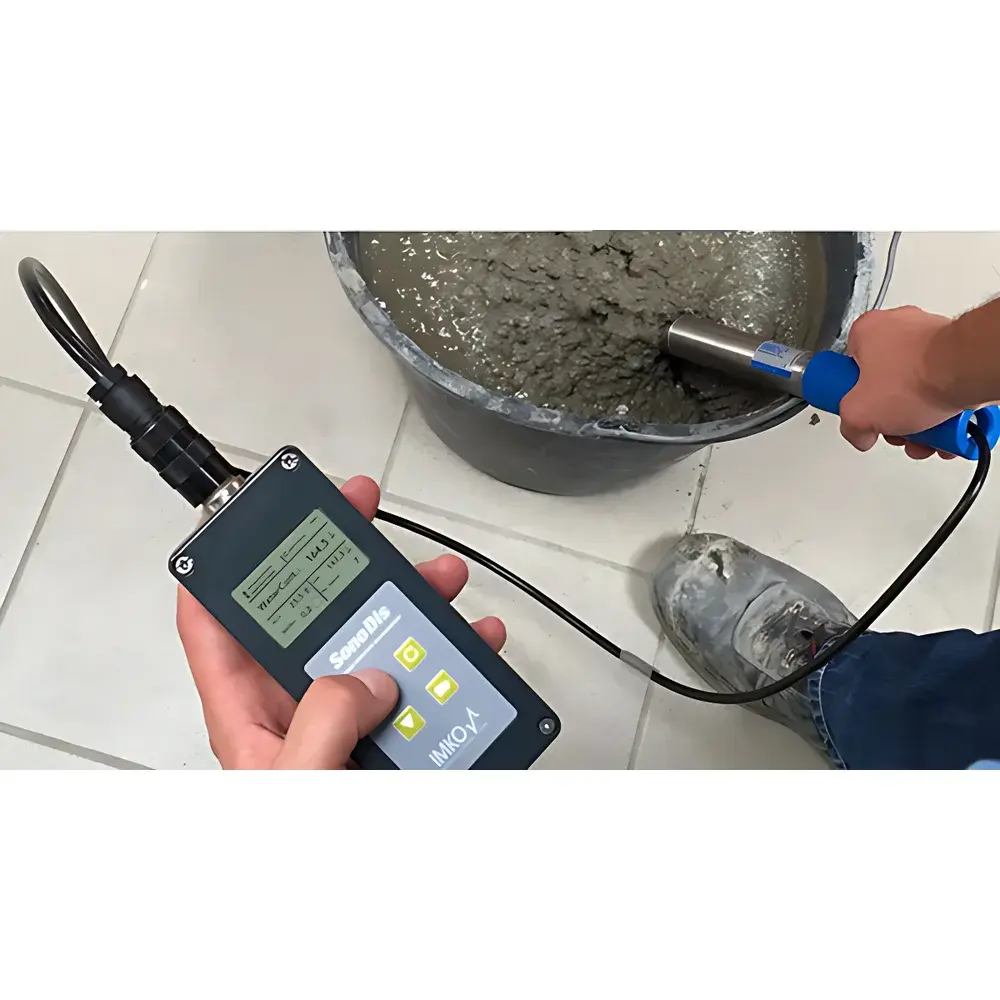
IMKO SONO-WZ Fresh Concrete Moisture Meter
| Brand | IMKO |
|---|---|
| Origin | Germany |
| Model | SONO-WZ |
| Instrument Type | Moisture / Water Potential Analyzer |
| Measurement Principle | TDR (Time-Domain Reflectometry) |
| Power Supply | 7–24 V DC |
| Current Consumption | 100 mA @ 12 V DC (during 2–3 s measurement pulse) |
| Moisture Range | 0–100% vol/vol |
| Absolute Accuracy | ±3% vol/vol |
| Electrical Conductivity Range | 0–50 dS/m |
| Repeatability | ±2 L/m³ |
| W/C Ratio Range | 0.4 to >1 |
| Measurement Volume | ~0.5 L |
| Operating Temperature | 0 °C to 50 °C |
| Sensor Material | Stainless steel body with ceramic sensing surface |
| Ingress Protection | IP68 |
| Dimensions | 155 × 60 mm |
| Cable | 1.5 m, 7-pin connector |
| Calibration | Built-in universal calibration curve |
| Sample Consistency Range | F2 to F6 (according to DIN 1045-2) |
| Sample Mass Capacity | ≥3 kg |
| Measurement Time | 1–2 minutes per reading (averaged over 4–5 individual pulses) |
Overview
The IMKO SONO-WZ Fresh Concrete Moisture Meter is a field-deployable, TDR-based (Time-Domain Reflectometry) instrument engineered for rapid, non-destructive quantification of volumetric water content in freshly mixed concrete at construction sites. Unlike gravimetric oven-drying methods—which require sample extraction, transportation, drying, and mass loss calculation—the SONO-WZ enables in-situ measurement directly within the fresh mix, delivering traceable moisture data within 1–2 minutes. Its operational principle relies on high-frequency electromagnetic pulse propagation along a coaxial sensor probe; the reflected signal’s travel time correlates directly with the bulk dielectric permittivity of the surrounding medium, which—under controlled temperature and salinity conditions—is predominantly governed by water volume fraction. This physics-based approach ensures measurement independence from aggregate gradation, cement type, or minor admixture variations, provided the mix falls within the validated consistency range (F2–F6 per DIN 1045-2).
Key Features
- TDR technology with TRIME® sensor architecture for stable, low-drift signal acquisition in electrically heterogeneous fresh concrete matrices
- Integrated averaging algorithm: automatically computes mean value from 4–5 discrete TDR pulses per measurement cycle, enhancing statistical robustness
- Universal factory calibration embedded in firmware—no user recalibration required for standard Portland cement-based mixes
- IP68-rated stainless-steel probe with ceramic dielectric interface, resistant to abrasion, alkalinity, and prolonged immersion in wet concrete
- Wide operational voltage range (7–24 V DC), compatible with portable battery packs or site power supplies
- Compact handheld display unit with intuitive LED indicators and tactile feedback for glove-compatible operation
- Robust mechanical design optimized for daily use in heavy civil infrastructure environments—drop-tested per IEC 60068-2-32
Sample Compatibility & Compliance
The SONO-WZ is validated for use with fresh concrete exhibiting slump classes F2 through F6 (DIN EN 206 / DIN 1045-2), covering plastic to flowable consistencies commonly employed in precast, tunnel lining, and structural cast-in-place applications. It accommodates minimum sample masses of 3 kg and interrogates a representative volume of approximately 0.5 L around the sensor tip. While not intended for hardened concrete or soil, its TDR response remains insensitive to moderate variations in sand/gravel particle size distribution—a critical advantage when working with locally sourced aggregates. The device complies with CE marking requirements under the EU Electromagnetic Compatibility Directive 2014/30/EU and Low Voltage Directive 2014/35/EU. Its measurement methodology aligns with the physical basis outlined in ASTM D5778 (Standard Test Method for Electronic Friction Cone and Piezocone Penetration Testing) for dielectric-based moisture inference, and supports quality control documentation consistent with ISO 9001:2015 and EN 206:2013 + A2:2021 conformance frameworks.
Software & Data Management
The SONO-WZ operates as a standalone field instrument with no external software dependency. All calibration parameters, measurement logic, and averaging routines reside in flash memory. Measurement results—including volumetric moisture (% v/v), derived water-cement ratio (W/C), and timestamp—are displayed numerically on the integrated LCD and retained in non-volatile memory for up to 1,000 readings. Optional data export is supported via RS-232 or analog output (0–10 V) using third-party DAQ systems. While the device itself does not implement FDA 21 CFR Part 11 electronic signature or audit trail functionality, raw measurement records generated during QC workflows may be imported into validated LIMS or QA documentation platforms compliant with GLP/GMP requirements, provided traceability of instrument ID, operator, location, and environmental conditions (e.g., ambient temperature) is maintained externally.
Applications
- Real-time verification of batch water dosage prior to placement—reducing risk of over- or under-hydration
- On-site validation of mix design compliance during ready-mix delivery and pump-line commissioning
- Moisture profiling across large pours to identify segregation or bleeding anomalies
- Supporting durability assessments by correlating early-age moisture with predicted chloride ingress rates (per DuraCrete models)
- Quality assurance audits for EN 206-compliant concrete production facilities
- Research applications investigating hydration kinetics and early-age shrinkage behavior
FAQ
Can the SONO-WZ measure hardened concrete or cured specimens?
No. The sensor is calibrated exclusively for fresh, unhardened concrete with workable consistency (F2–F6). Dielectric properties change significantly post-set, invalidating the built-in calibration.
Does aggregate type affect measurement accuracy?
Within the specified F2–F6 range and typical natural aggregate gradations, measurement bias remains within ±3% v/v. Extreme quartzite or lightweight aggregates may require supplemental site-specific verification.
Is temperature compensation automatic?
Yes—the internal thermistor continuously monitors probe temperature and applies real-time correction to dielectric calculations across the full 0 °C to 50 °C operating range.
What maintenance is required?
Rinse the ceramic sensor face with clean water after each use; avoid abrasive cleaning agents. Inspect cable integrity and connector pins quarterly. No routine recalibration is needed under normal usage conditions.
Can W/C ratio be determined without knowing cement content?
The device estimates W/C indirectly via empirical correlation between measured moisture, density (assumed or entered), and default cement density (3.15 g/cm³). For highest fidelity, users may input actual cement mass per m³ if known.
Related Products







