
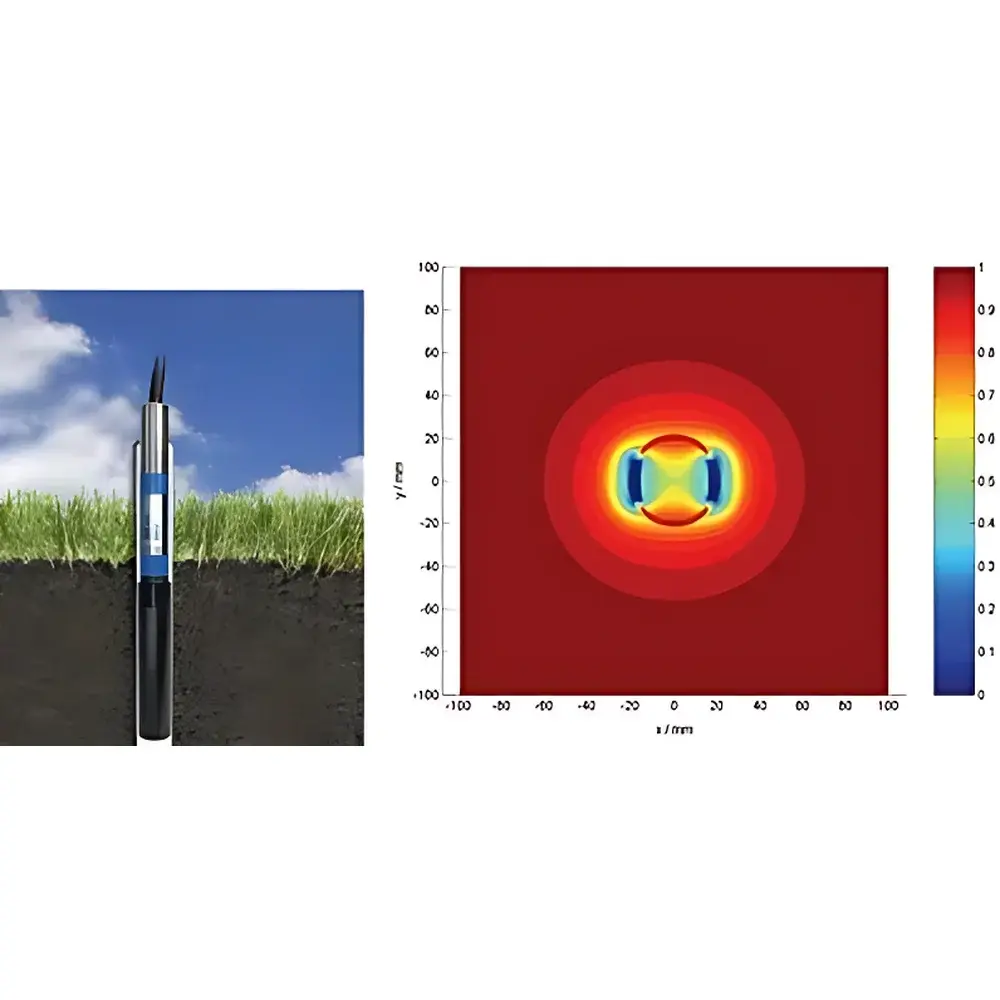
IMKO TRIME-PICO-IPH Profile Soil Moisture Measurement System
| Origin | Germany |
|---|---|
| Manufacturer Type | Authorized Distributor |
| Origin Category | Imported |
| Model | TRIME-PICO-IPH |
| Instrument Type | Soil Water Content / Dielectric Permittivity Analyzer |
| Measurement Principle | TDR (Time Domain Reflectometry) with Intelligent MicroElements (IMKO-patented) |
| Output Parameters | Volumetric Water Content (θv), Bulk Electrical Conductivity (ECb), Soil Temperature |
| Interface | Bluetooth 4.2 (BLE), Android-based mobile app |
| Power Supply | Via Bluetooth module (no external battery required for probe operation) |
| Probe Configuration | Multi-depth profile installation (compatible with TRIME-PICO 64/32 waveguide rods) |
| Compliance | CE, RoHS, ISO 11272:2023 (Soil quality — Determination of soil water content), ASTM D5778-22 (Standard Test Method for Electronic Friction Cone and Piezocone Penetration Testing) |
Overview
The IMKO TRIME-PICO-IPH Profile Soil Moisture Measurement System is an engineered solution for high-resolution, depth-resolved monitoring of volumetric water content (θv) in unsaturated and saturated soils. It operates on the physical principle of Time Domain Reflectometry (TDR) enhanced by IMKO’s proprietary Intelligent MicroElements (IME) signal processing architecture. Unlike conventional TDR systems relying on oscilloscope-based waveform analysis, the TRIME-PICO-IPH employs a 1 GHz electromagnetic pulse generator integrated directly into the probe electronics. This pulse propagates along calibrated stainless-steel waveguide rods (e.g., TRIME-PICO 64/32), establishing a localized electromagnetic field within the surrounding medium. The dielectric permittivity (εr) of the soil—dominated by water’s high εr (~80) relative to dry soil matrix (~3–5)—is derived from the precise time-of-flight measurement of the reflected pulse. With sub-picosecond timing resolution (down to 3 ps), the system achieves robust discrimination between signal propagation delay and dispersion effects, enabling accurate θv calculation without empirical calibration in many mineral soils per ISO 11272:2023 Annex B.
Key Features
- Depth-profiling capability via modular TRIME-PICO 64/32 waveguide rods (standard lengths: 10 cm to 100 cm; customizable multi-segment configurations)
- Simultaneous acquisition of three core parameters: volumetric water content (θv, m³/m³), bulk electrical conductivity (ECb, dS/m), and soil temperature (°C) at each sensing depth
- Integrated Bluetooth 4.2 Low Energy (BLE) communication eliminates cabling constraints; enables real-time data streaming to Android devices
- No external power supply required for probes—energy is delivered bi-directionally through the Bluetooth interface, minimizing field deployment complexity
- HD2 handheld readout unit with built-in calibration curve selection (e.g., Topp equation, Roth et al. 1992, or user-defined polynomial fits) and on-device θv → εr conversion
- AZS-100 advanced field terminal supporting GNSS geotagging (GPS/GLONASS/Galileo), automated sequential profiling, and configurable logging intervals (1 min to 24 h)
Sample Compatibility & Compliance
The TRIME-PICO-IPH is validated for use in mineral soils (sand, loam, clay), organic substrates (peat, compost), and engineered growing media. It is not recommended for highly saline soils (>8 dS/m ECb) without site-specific calibration due to ionic conduction interference in the TDR signal. All hardware complies with CE marking requirements under the EU Electromagnetic Compatibility Directive 2014/30/EU and RoHS 2011/65/EU. Measurement methodology aligns with ISO 11272:2023 (Soil quality — Determination of soil water content) and ASTM D5778-22 (Electronic Cone Penetration Testing), supporting traceable field data collection for environmental monitoring networks, irrigation scheduling, and vadose zone hydrology studies. Data integrity meets GLP-aligned documentation standards when used with AZS-100’s timestamped, georeferenced log files.
Software & Data Management
Field data are captured via the IMKO SoilScan Android application (v3.2+), which provides real-time visualization of vertical θv profiles, trend overlays, and export in CSV/Excel format. The HD2 and AZS-100 units store up to 10,000 measurement sets internally with automatic time/date stamping. For long-term network deployments, raw TDR waveforms and processed parameters can be synchronized to IMKO Cloud (optional subscription) for centralized QA/QC, version-controlled calibration history, and API access to time-series databases. Audit trails—including operator ID, GPS coordinates, probe serial numbers, and firmware versions—are embedded in every exported dataset, satisfying basic requirements for 21 CFR Part 11–informed workflows in regulated agronomic research.
Applications
- High-frequency monitoring of root-zone water dynamics in precision agriculture and smart irrigation control systems
- Vadose zone characterization for landfill cover performance assessment and leachate migration modeling
- Calibration and validation of remote-sensing soil moisture products (e.g., Sentinel-1 SAR, SMAP L-band radiometry)
- Long-term ecological research (LTER) sites requiring low-maintenance, in-situ profile measurements over seasonal cycles
- Green infrastructure evaluation (bioswales, rain gardens) where spatial heterogeneity demands multi-depth resolution
- Soil physics laboratories conducting controlled infiltration and drainage experiments
FAQ
What is the minimum measurable time-of-flight resolution of the TRIME-PICO-IPH system?
The system achieves 3 picoseconds (ps) timing resolution using IMKO’s patented Intelligent MicroElements architecture, enabling detection of subtle permittivity gradients in fine-textured soils.
Can the TRIME-PICO-IPH operate in frozen soils?
No. TDR-based water content measurement assumes liquid-phase dominance of dielectric response; ice has εr ≈ 3.2 and cannot be distinguished from mineral matrix, leading to significant underestimation of unfrozen water content below 0°C.
Is factory calibration traceable to national standards?
Yes. Each TRIME-PICO 64/32 probe undergoes individual verification against NIST-traceable dielectric reference materials (e.g., ethanol-water mixtures) at 20°C, with certificate of conformance supplied.
How often does the system require recalibration in the field?
Under stable soil conditions (no significant texture change or salinity drift), recalibration is not required annually. However, ISO 11272:2023 recommends verification against gravimetric samples at least once per season for critical applications.
Does the Bluetooth interface support simultaneous connection to multiple probes?
No. The BLE protocol operates in point-to-point mode; one mobile device or AZS-100 terminal communicates with one TRIME-PICO-IPH probe at a time. Multi-probe networks require sequential polling or use of IMKO’s optional gateway hub (TRIME-GW-4G).
Related Products







