
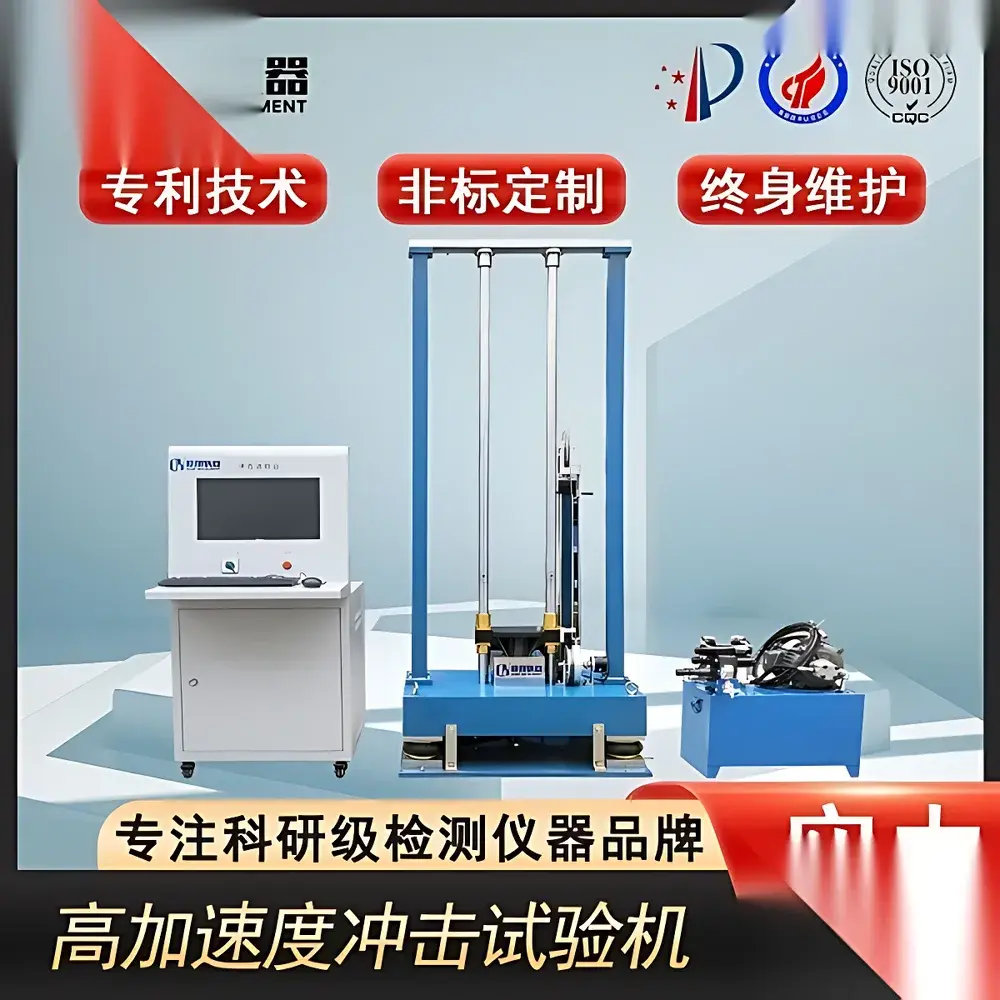
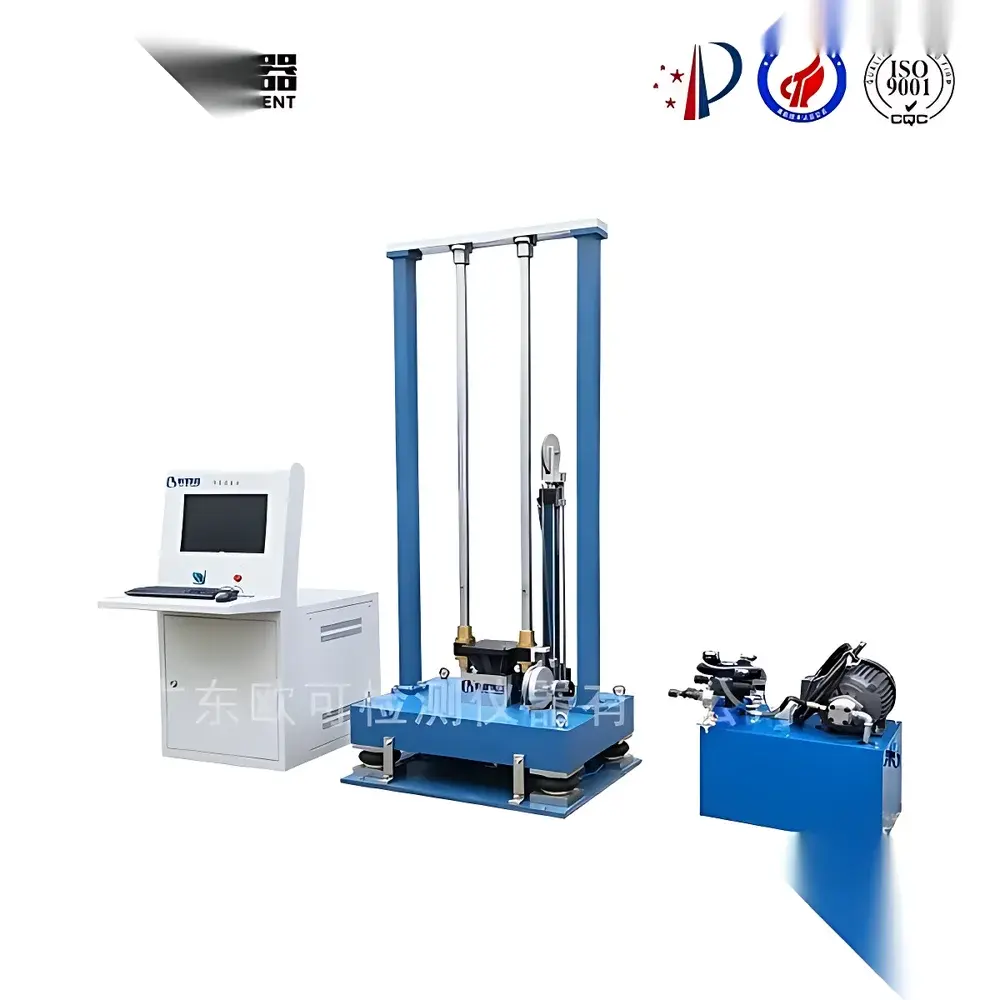
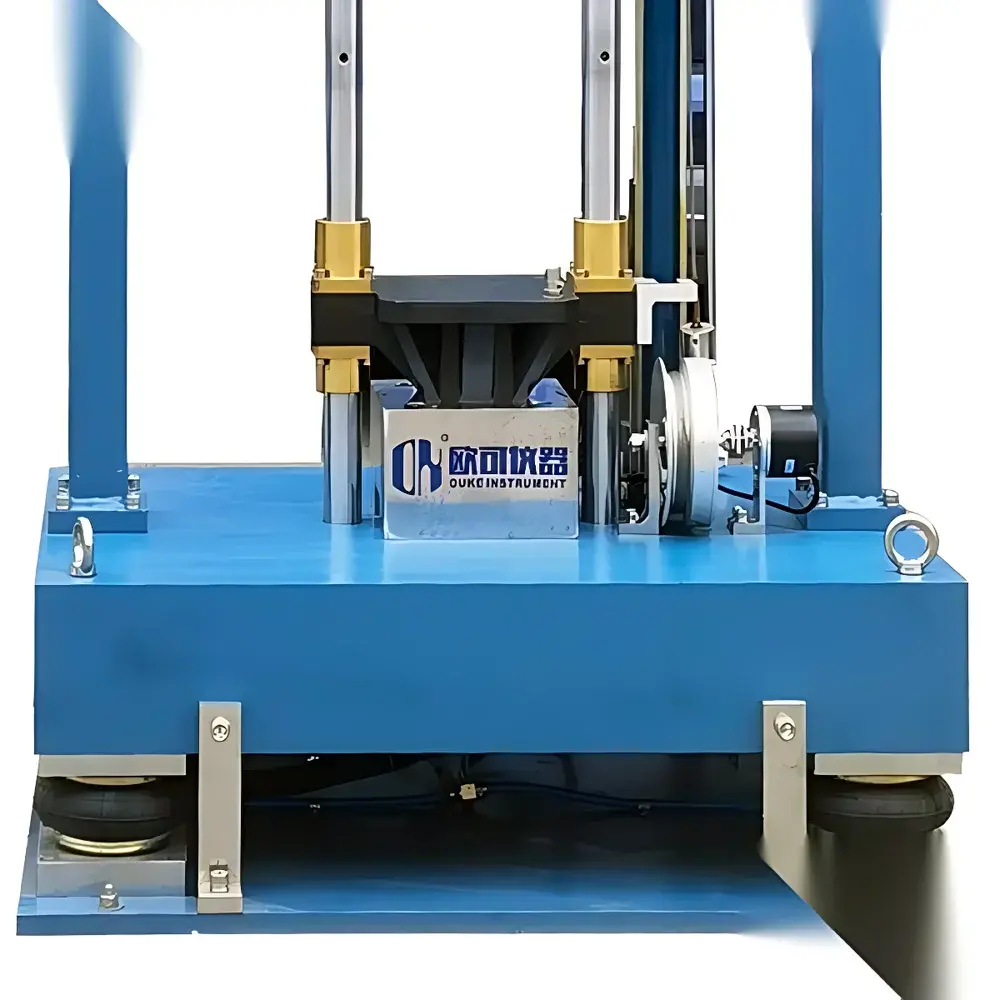
Impact Testing Machine Manufacturer – OK-S Series Electro-Mechanical Shock Test Systems
| Key | Brand: Other Brands |
|---|---|
| Origin | Imported |
| Manufacturer Type | Authorized Distributor |
| Price | USD 14,000–42,000 (FOB) |
| Load Capacity | 10–100 kg |
| Table Size | 20×20 to 80×65 cm |
| Acceleration Range | 150–15,000 m/s² |
| Pulse Duration | 0.5–30 ms |
| Waveform Options | Half-sine, Trapezoidal, Post-peak Sawtooth |
| Power Supply | AC 380 V ±5%, 50/60 Hz, 3-phase 5-wire |
Overview
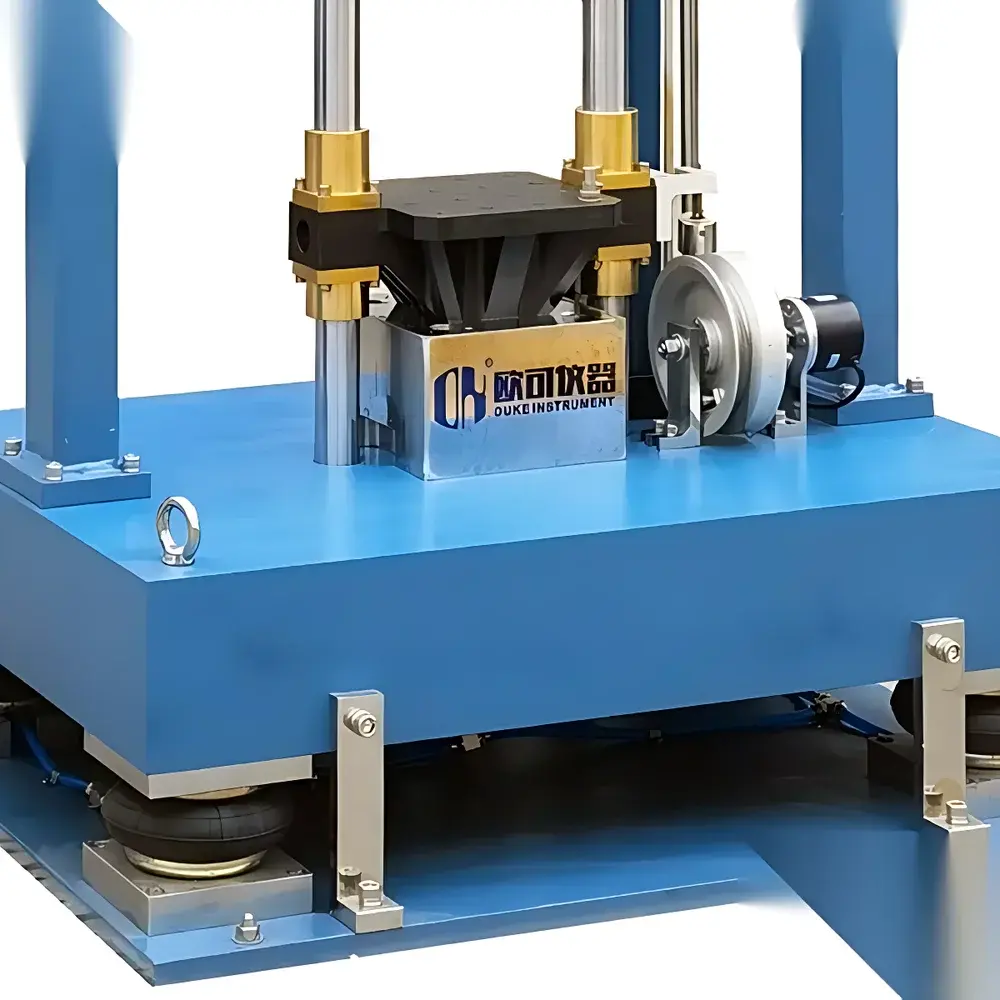
The OK-S Series electro-mechanical shock test systems are precision-engineered impact testing machines designed for laboratory and industrial qualification of electronic components, aerospace subassemblies, automotive ECUs, and packaging systems under controlled mechanical shock conditions. These systems operate on the principle of controlled free-fall impact or spring-driven impulse generation, producing repeatable, traceable shock pulses compliant with standardized waveform definitions per IEC 60068-2-27, MIL-STD-810H Method 516.8, GJB 150.18A, JIS C 0041, and ASTM D999. Unlike pneumatic or hydraulic shock testers, the OK-S series utilizes a DC motor–driven lifting mechanism with planetary gear reduction and roller-guided vertical motion, enabling precise control over impact velocity, pulse amplitude, duration, and repetition rate without reliance on compressed air or high-pressure hydraulics. The system’s base-mounted damping structure isolates the test bench from floor-borne vibrations, ensuring measurement integrity during high-g events and minimizing environmental disturbance.
Key Features
- Electro-mechanical actuation architecture eliminates secondary bounce through integrated kinematic arrest mechanisms and rigid impact interface design.
- Programmable waveform selection: half-sine (standard), trapezoidal, and post-peak sawtooth—each calibrated and verified via onboard piezoelectric accelerometer feedback.
- Adjustable pulse parameters: acceleration amplitude (150–15,000 m/s²), duration (0.5–30 ms), and repetition frequency (user-defined via motor speed control).
- Modular table configurations support load capacities from 10 kg to 100 kg, with reinforced aluminum alloy platforms and precision-machined mounting surfaces conforming to ISO 2041:2019 mounting interface standards.
- Integrated safety interlocks—including emergency stop circuitry, door position sensing, power-loss braking, and real-time overload monitoring—meet EN 60204-1 and IEC 61508 SIL2 functional safety requirements.
- Low-vibration foundation design with elastomeric isolation mounts reduces transmitted vibration to ≤5% of input pulse energy, satisfying ISO 10816-1 Class A ambient noise criteria for adjacent instrumentation.
Sample Compatibility & Compliance
The OK-S series accommodates specimens ranging from small PCB assemblies (mounted on custom fixtures) to full-size enclosures (e.g., avionics racks, battery modules, or medical device housings). All models comply with international shock test standard definitions for pulse shape fidelity, including peak amplitude tolerance (±10%), time-to-peak tolerance (±10%), and total pulse duration tolerance (±15%) as specified in IEC 60068-2-27 Annex B. Calibration certificates are traceable to NIST or PTB-accredited laboratories and include as-found/as-left accelerometer response data. The systems support GLP/GMP environments through optional audit-ready event logging and user-access control features aligned with FDA 21 CFR Part 11 requirements when paired with validated software modules.
Software & Data Management
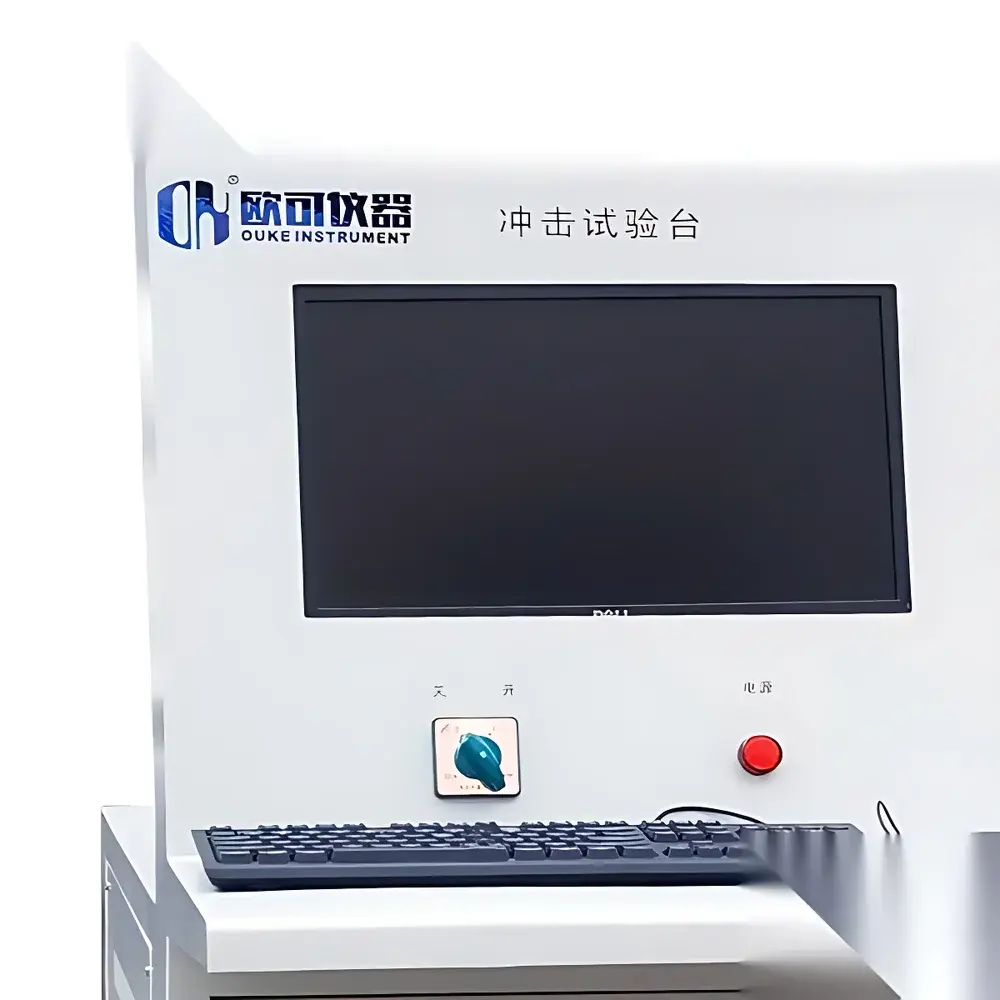
Control and analysis are executed via OK-TestControl v3.2, a Windows-based application supporting local operation and remote supervision over Ethernet. The software enables waveform parameter scripting, real-time oscilloscope-style visualization of acceleration vs. time, automated pass/fail evaluation against user-defined thresholds, and export of raw .csv or .tdms files compatible with MATLAB, Python (NumPy/Pandas), and LabVIEW. Audit trails record operator ID, timestamp, test sequence, parameter set, and calibration status for each executed profile. Optional integration with enterprise LIMS or MES platforms is supported via OPC UA and RESTful API endpoints.
Applications
These shock testers are routinely deployed in R&D labs and QC departments for: qualification testing of consumer electronics per IEC 60068-2-27; drop simulation validation of transport packaging (ASTM D999, ISTA 3A); structural durability assessment of UAV components under launch-induced shock; pre-shipment verification of military-grade connectors (MIL-DTL-38999); and failure mode analysis of MEMS accelerometers and inertial sensors. Their reproducibility (±2.5% inter-run coefficient of variation at 1,000 m/s², 6 ms) makes them suitable for comparative studies across material batches, design iterations, or supplier qualification protocols.
FAQ
What shock standards does the OK-S series support out-of-the-box?
IEC 60068-2-27 (half-sine, trapezoidal, sawtooth), MIL-STD-810H Method 516.8, GJB 150.18A, JIS C 0041, and ASTM D999 — all implemented via firmware-calibrated pulse shaping and verified with certified reference accelerometers.
Is third-party calibration included with delivery?
Yes — each unit ships with a factory calibration certificate traceable to national metrology institutes, covering acceleration amplitude, pulse duration, and waveform symmetry across three load points (25%, 50%, and 100% max capacity).
Can the system be integrated into an automated test cell?
Yes — digital I/O ports (24 VDC, opto-isolated), Ethernet TCP/IP, and Modbus RTU support synchronization with PLCs, robotic handlers, and environmental chambers.
What maintenance is required during routine operation?
Biannual inspection of guide rail lubrication, brake pad wear, and accelerometer mounting torque; annual recalibration recommended or after 500 shock cycles — whichever occurs first.
Does the system meet electromagnetic compatibility (EMC) requirements for lab use?
Yes — fully compliant with EN 61326-1:2013 (industrial environment), including conducted/radiated emissions and immunity testing per EN 61000-4-x series.



