
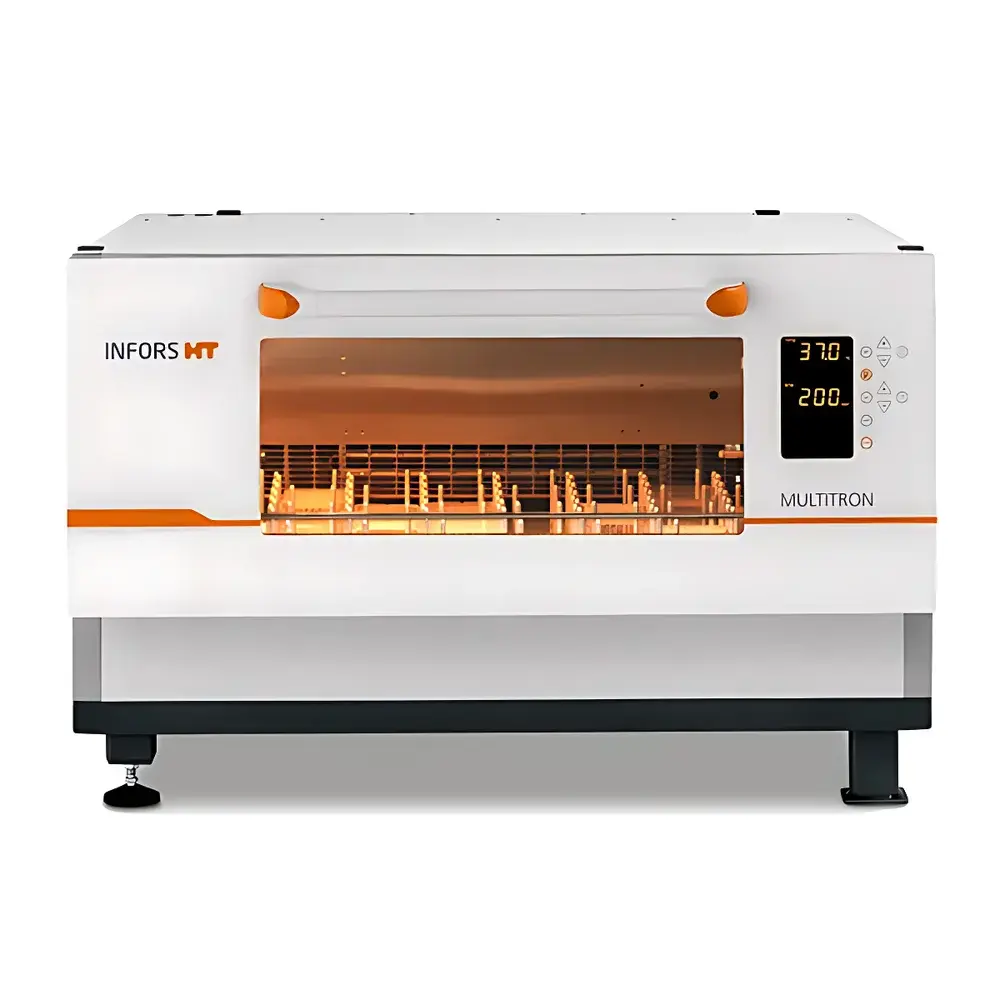
INFORS Multitron 3 mm High-Speed Orbital Shaker Incubator
| Brand | INFORS |
|---|---|
| Origin | Switzerland |
| Model | Multitron 3 mm |
| Instrument Type | Full-temperature Orbital Shaker Incubator |
| Timer Range | Up to 9 days |
| Oscillation Frequency | 20–1000 rpm |
| Oscillation Amplitude | ±3 mm |
| Temperature Range | Ambient +5°C to 60°C (standard) |
| Number of Shaking Platforms | 1 |
| Temperature Stability | ±0.1°C |
| Temperature Uniformity | ±0.2°C |
| Max Load Capacity | 55 kg (single layer), 165 kg (triple stack) |
| Volume | 250 L |
| Humidity Control (optional) | 20–85% RH, ±1% RH accuracy |
| CO₂ Control (optional) | 0.1–20%, ±1% FS, infrared sensor |
| Connectivity | Ethernet interface |
Overview
The INFORS Multitron 3 mm is a high-performance, full-temperature orbital shaker incubator engineered for precision-controlled microbial, mammalian, and insect cell cultivation under dynamic culture conditions. Designed around a robust five-motor drive system with active auto-balancing, it delivers stable, low-vibration orbital motion across the full operational range — from gentle agitation at 20 rpm to high-throughput screening at 1000 rpm — without mechanical resonance or platform drift. Its core oscillation mechanism employs a true circular orbit with fixed ±3 mm amplitude, ensuring reproducible shear stress profiles essential for scalable bioprocess development. The unit integrates tightly regulated thermal management via PID-controlled heating and, in refrigerated configurations, a side-mounted vapor-compression cooling module enabling operation down to 4°C — critical for cold-adapted strains, cryopreservation workflows, and temperature-sensitive expression systems. With a 250 L internal chamber volume and structural support for triple-stack configuration (up to 1850 mm height), the Multitron 3 mm serves as a modular platform for high-density microplate-based experimentation in compliance with GLP and GMP-aligned laboratory practices.
Key Features
- Five independent servo motors with real-time load compensation — maintains consistent orbital kinetics even with asymmetric plate distribution
- Fixed ±3 mm orbital amplitude (±1% tolerance), calibrated and verified per ISO 17025-accredited procedures
- Full-range speed control from 20 to 1000 rpm; all three stacked layers operate independently at maximum speed
- PID-driven temperature regulation with ±0.1°C stability and ±0.2°C uniformity across the entire chamber volume
- Triple-stack architecture supports up to 23,040 parallel assays (72 deep-well plates × 3 layers) or 7,680 wells (96-well plates × 3 layers)
- Optional integrated CO₂ control (0.1–20%, IR sensor, ±1% FS accuracy) and humidity regulation (20–85% RH, ±1% RH)
- Ethernet-enabled controller supporting remote monitoring, audit trail logging, and protocol synchronization via TCP/IP
- UV-C sterilization module (254 nm) for routine decontamination of interior surfaces between runs
Sample Compatibility & Compliance
The Multitron 3 mm accommodates standard SBS-format microplates (96-, 384-, and 1536-well), deep-well plates (up to 25 mL capacity), Erlenmeyer flasks (up to 2 L), and custom carriers for tube racks or bioreactor vessels. Its chamber geometry and airflow design meet ISO 13408-1 requirements for aseptic handling environments. Optional CO₂ and humidity modules comply with USP for cell culture incubation and support FDA 21 CFR Part 11–compliant electronic records when paired with INFORS’ TrakControl software. Temperature and motion parameters are traceable to NIST-traceable references, and the system supports IQ/OQ documentation packages aligned with ASTM E2500 and EU Annex 11 validation frameworks.
Software & Data Management
TrakControl software provides browser-based access to real-time parameter visualization, multi-user role management, and automated data export in CSV and PDF formats. All setpoints, deviations, alarms, and operator actions are time-stamped and stored with cryptographic integrity — fulfilling ALCOA+ principles (Attributable, Legible, Contemporaneous, Original, Accurate, Complete, Consistent, Enduring, Available). The system supports scheduled firmware updates, configurable alarm thresholds (e.g., ±0.3°C deviation for >5 min), and seamless integration with LIMS via HL7 or RESTful API. Audit trails are immutable and exportable for regulatory review, including change history for temperature ramps, speed profiles, and gas concentration sequences.
Applications
- High-throughput strain selection and media optimization for recombinant protein expression
- Monoclonal antibody production in suspension CHO cultures using microplate-scale bioreactors
- CRISPR library screening under controlled hypoxic (low-O₂) or hypercapnic (high-CO₂) conditions
- Microbial growth kinetics modeling across temperature gradients (e.g., Q₁₀ analysis)
- Stem cell expansion and differentiation protocols requiring precise mechanical stimulation
- Pharmaceutical stability testing per ICH Q5C guidelines using oscillatory stress exposure
- Environmental microbiology studies involving psychrophilic or thermophilic isolates
FAQ
What is the maximum number of microplates supported in triple-stack configuration?
Up to 72 deep-well plates (25 mL format) or 96 standard 96-well plates per layer — totaling 23,040 wells across three layers.
Does the refrigerated model maintain 4°C uniformly across the full chamber volume?
Yes — validated per ISO 14644-1 Class 5 airflow mapping; temperature uniformity remains within ±0.2°C at 4°C setpoint.
Can CO₂ and humidity be controlled simultaneously with temperature and shaking?
Yes — all four parameters operate concurrently with independent PID loops and cross-compensation algorithms to minimize inter-parameter drift.
Is the system compliant with FDA 21 CFR Part 11 for electronic signatures?
When deployed with TrakControl v4.2+ and configured with user authentication, digital certificates, and audit trail archiving, full Part 11 compliance is achievable.
What maintenance intervals are recommended for long-term reliability?
Motor calibration and sensor verification every 12 months; CO₂ sensor recalibration every 6 months; UV lamp replacement every 8,000 hours of operation.





