
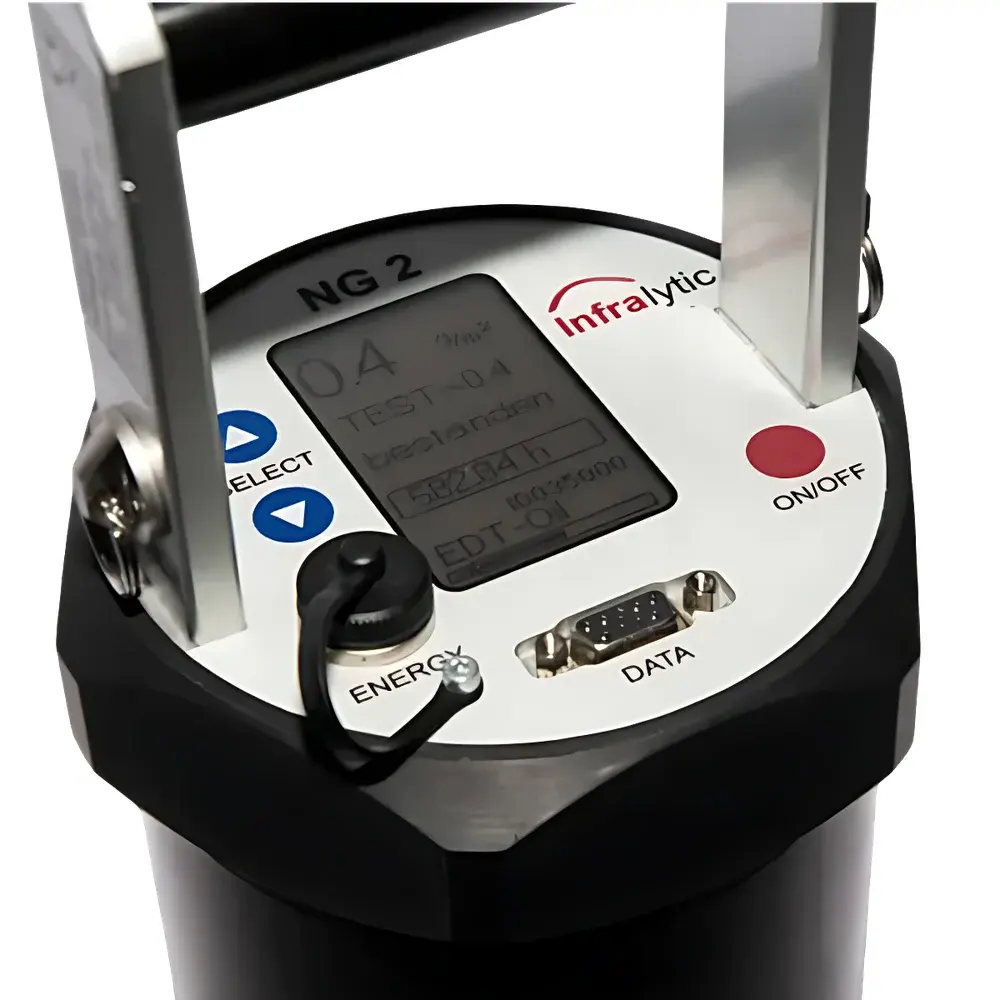
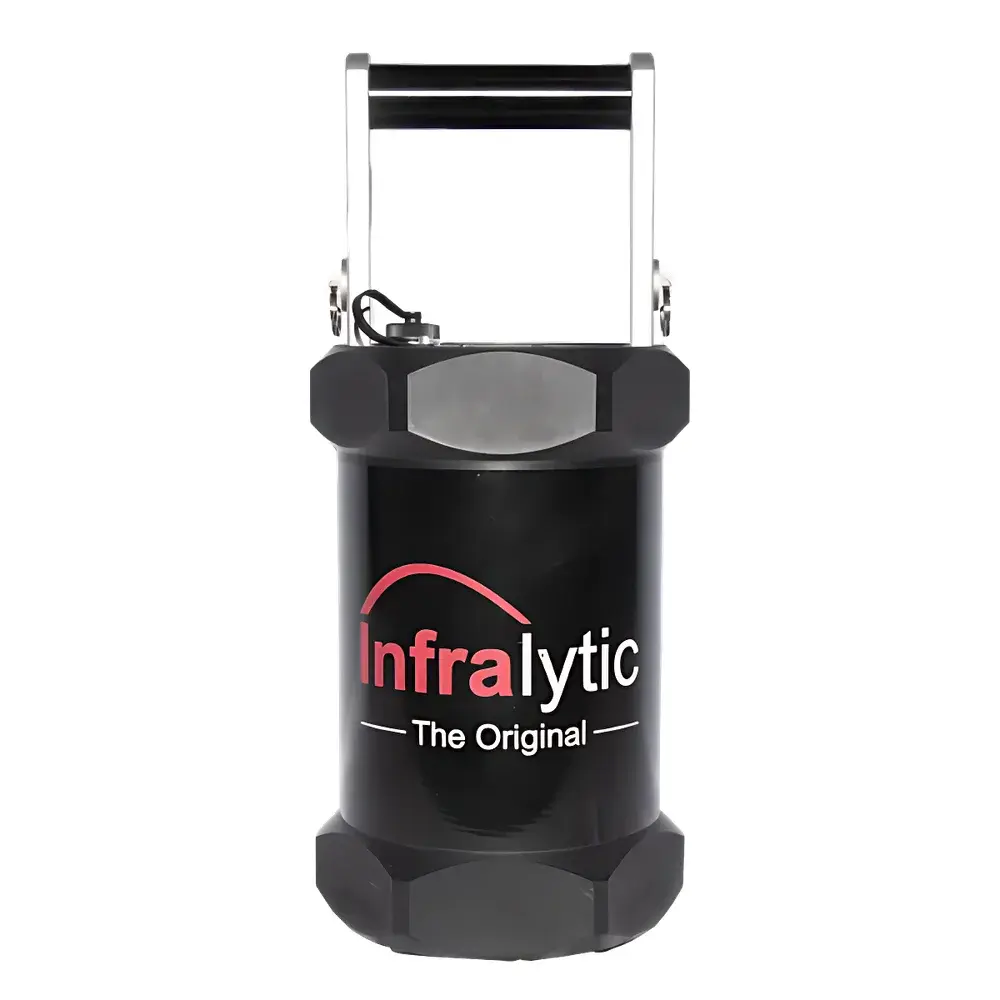
Infralytic NG02 Non-Contact Infrared Oil Film Thickness Gauge for Electrical Steel Insulation Coating
| Brand | Infralytic |
|---|---|
| Origin | Germany |
| Model | NG02 |
| Measurement Principle | Near-Infrared (NIR) Absorption Spectroscopy |
| Range | 0.05–6 g/m² |
| Accuracy | ±0.015 g/m² (0.02–0.3 g/m²), ±0.2 g/m² (0.3–2 g/m²), ±10% of reading (>2 g/m²) |
| Repeatability | <0.0010 g/m² |
| Resolution | 0.001 g/m² |
| Measurement Distance | 8 mm (+5/−2 mm) |
| IP Rating | IP65 |
| Operating Temperature | 0–45 °C |
| Power Supply | Internal rechargeable battery (≥12 h runtime) |
| Substrate Compatibility | Cold-rolled steel, hot-dip galvanized (HDG), electrogalvanized (EG), phosphated EG, annealed galvannealed, Al, ZnMg, aluzinc |
| Lubricant Compatibility | Mineral oils, thixotropic mineral oils, waxes, hot-melt adhesives, and other organics (with custom calibration) |
Overview
The Infralytic NG02 is a portable, non-contact infrared oil film thickness gauge engineered specifically for precise, real-time quantification of insulating organic coatings on electrical steel substrates—commonly referred to as silicon steel or grain-oriented/non-oriented (GO/NO) electrical steels. Unlike conventional eddy-current or beta-backscatter instruments, the NG02 employs near-infrared (NIR) absorption spectroscopy to measure coating mass per unit area (g/m²), directly correlating with insulation layer thickness in the range of ~0.05–6 µm for typical dielectric oils, waxes, and polymer-based lubricants. Its optical measurement principle eliminates mechanical contact, ensuring zero risk of surface damage, contamination, or wear during high-frequency inline or offline QC checks. Designed for demanding industrial environments—including continuous annealing lines, slitting facilities, and coil coating plants—the NG02 delivers traceable, repeatable measurements under variable ambient conditions, supporting stringent quality control protocols required by IEC 60404-7, ASTM A900, and JIS C 2550 standards for electrical steel performance.
Key Features
- Non-destructive, non-contact NIR measurement—no sample preparation or physical probe contact required
- Automatic substrate recognition via built-in spectral library (cold-rolled, HDG, EG, phosphated EG, GA, Al, ZnMg)
- Real-time auto-validation of calibration integrity before and during measurement sequences
- Integrated camera module for geotagged, timestamped photo documentation synced to measurement records
- IP65-rated ruggedized housing suitable for production floor, coil warehouse, and mobile lab use
- Onboard rechargeable battery providing ≥12 hours of continuous operation without external power
- Intuitive smartphone-assisted operation via Bluetooth-enabled companion app (iOS/Android)
- Roll direction detection algorithm enabling consistent orientation-aware measurement alignment
Sample Compatibility & Compliance
The NG02 is validated for use across the full spectrum of electrical steel surface treatments encountered in transformer, motor, and generator core manufacturing. It supports quantitative analysis on bare cold-rolled steel, hot-dip galvanized (Zn), electrogalvanized (Zn), phosphated electrogalvanized (for pre-paint passivation verification), galvannealed (GA), aluminum-coated, and ZnMg-alloyed substrates. Lubricant compatibility extends to mineral oils, thixotropic formulations, paraffin waxes, hot-melt adhesives, and specialty organics—provided user-specific calibrations are performed and archived. All measurement data comply with GLP/GMP documentation requirements, including full audit trails, electronic signatures, and timestamped calibration logs. The system supports 21 CFR Part 11-compliant data export when integrated with validated LIMS or MES platforms.
Software & Data Management
Measurements are managed through the Infralytic NG Connect software suite, which provides secure local storage, CSV/PDF report generation, trend charting, and statistical process control (SPC) visualization (X̄-R, Cp/Cpk). Raw spectra, reference calibrations, and environmental metadata (temperature, humidity, operator ID, location tag) are embedded in each record. Data synchronization occurs over encrypted Bluetooth or USB-C, with optional cloud backup configured per ISO/IEC 27001-aligned IT policies. Calibration files include traceability to NIST-traceable reference standards and are version-controlled with change history and approval workflows.
Applications
- Final QC inspection of insulation coating uniformity prior to core stacking or lamination
- In-process monitoring at exit sections of continuous annealing lines (CAL) and temper mills
- Verification of lubricant replenishment efficacy after cleaning or recoiling operations
- Root cause analysis of interlaminar shorting, core loss anomalies, or punchability issues
- Supplier qualification and incoming material inspection against OEM coating specifications (e.g., Hitachi, Nippon Steel, Voestalpine)
- Supporting ISO 9001:2015 clause 8.5.1 and IATF 16949 section 8.5.1.1 for process validation and control
FAQ
Can the NG02 measure insulation thickness on grain-oriented silicon steel with laser-scribed insulation patterns?
Yes—its 2-mm spot size and NIR spectral resolution enable localized quantification within scribed regions, provided surface roughness remains within Ra < 0.8 µm and no underlying oxide interference is present.
Is factory recalibration required annually?
No—NG02 features self-diagnostic optical path verification; however, annual traceable recalibration against certified reference standards is recommended for ISO/IEC 17025 compliance.
Does it support multi-point mapping across strip width?
Yes—via programmable XY stage integration or manual grid-based measurement mode with coordinate tagging.
Can it distinguish between oil and phosphate layers on electrogalvanized steel?
Yes—using spectral deconvolution algorithms trained on reference spectra of individual chemistries; requires initial method development with representative samples.
What is the minimum detectable coating mass for ultra-thin insulating films used in high-frequency applications?
The instrument achieves a lower limit of quantitation (LLOQ) of 0.02 g/m² with RSD < 3% under controlled lab conditions, corresponding to ~0.03 µm for standard mineral oil formulations.



