
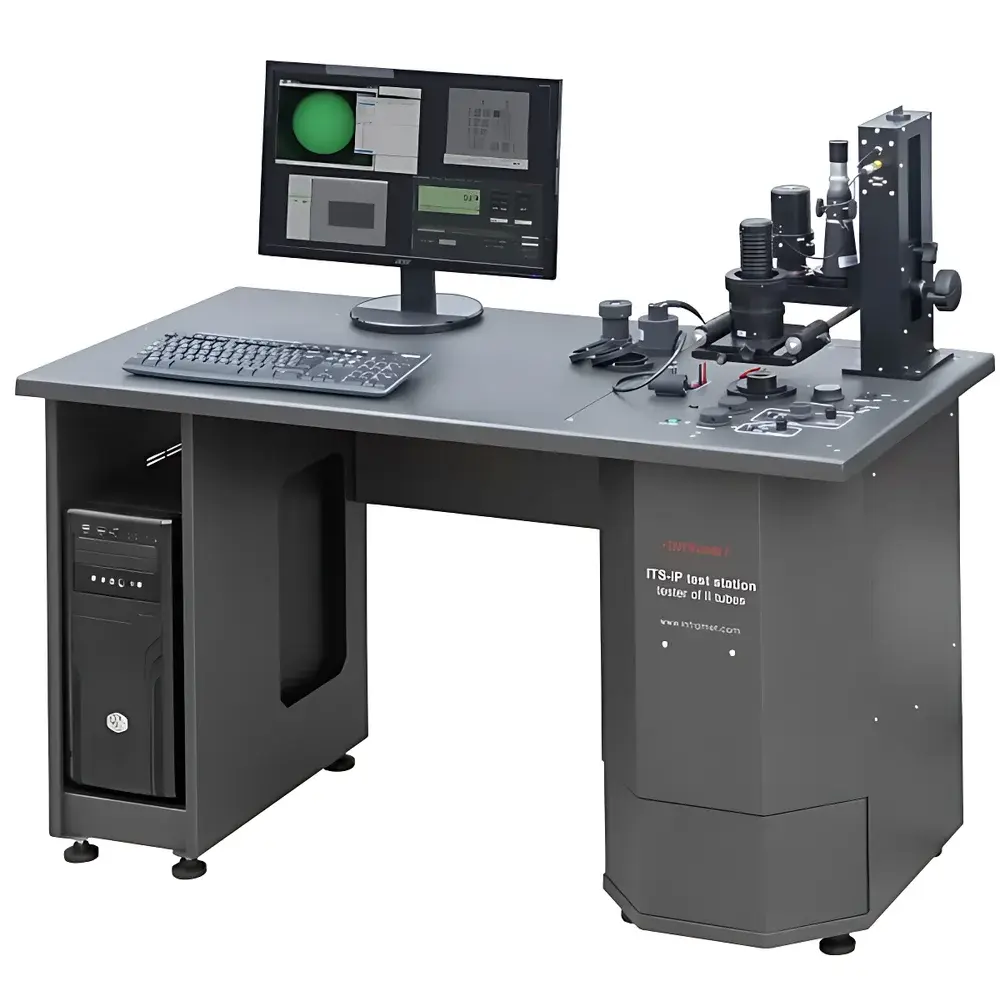
Inframet ITIP Series Image Intensifier Performance Test System
| Brand | Inframet |
|---|---|
| Origin | Poland |
| Model | ITIP |
| Type | Computerized Multi-Parameter Test System for Image Intensifiers (Gen II, III, IV) |
| Supported Formats | 16 mm, 18 mm, 25 mm |
| Measurement Domains | Image Quality, Photometric, Electrical, and Temporal Parameters |
| Compliance | Designed to support ASTM F2147–23 (Standard Test Methods for Image Intensifier Tube Performance), ISO 14134:2021 (Night Vision Equipment — Performance Testing), and MIL-STD-3009B Annex A (Image Intensifier Tube Testing Requirements) |
Overview
The Inframet ITIP Series is a precision-engineered, computer-controlled test platform specifically developed for comprehensive performance evaluation of image intensifier tubes (IITs). Operating on the principle of calibrated optical stimulation and quantitative digital image metrology, the system projects standardized test patterns—such as USAF 1951 resolution charts, sine-wave gratings, and uniform luminance fields—onto the photocathode surface under precisely controlled irradiance conditions. The intensified output is captured via high-resolution imaging sensors (CCD/CMOS), then analyzed using traceable photometric and spatial algorithms. This architecture enables simultaneous, repeatable quantification of critical parameters across four interdependent domains: image quality (spatial fidelity and noise structure), photometry (gain, saturation, EBI), electrical behavior (current draw, power consumption), and temporal response (rise time, decay kinetics, phosphor persistence). The ITIP system is not a generic optical bench but a purpose-built metrology instrument engineered for laboratory-grade reproducibility and production-line traceability in night vision device (NVD) manufacturing, military depot maintenance, and R&D validation environments.
Key Features
- Fully integrated, PC-based architecture with real-time data acquisition and automated report generation
- Modular design supporting scalable configuration—from basic resolution/SNR verification (ITIP/A) to full MIL-STD-3009B-compliant characterization (ITIP/E)
- Dual brightness probe capability (LP1 + LP2) for absolute luminance calibration and EBI measurement per ISO 14134 Annex C
- Multi-format mechanical adaptability: interchangeable fixtures for 16 mm, 18 mm, and 25 mm IITs, including bare-tube mounting options
- High-stability optical projection subsystem with motorized focus, adjustable intensity control (0.01–100 cd/m² range), and spectral filtering aligned to S-20/S-25 photocathode responsivity curves
- Comprehensive software suite featuring TAS-IP (Test Automation Software), ITS (Image Transfer Software), and MC (Measurement Control), all compliant with FDA 21 CFR Part 11 audit trail requirements
Sample Compatibility & Compliance
The ITIP system supports Gen II, Gen III, and Gen IV image intensifier tubes—including filmless, gated, and autogated variants—across standard diameters (16 mm, 18 mm, 25 mm) and common housing types (bare tube, OEM module, clip-in assembly). All configurations are validated against international standards governing night vision equipment qualification: ASTM F2147–23 (resolution, MTF, halo, distortion), ISO 14134:2021 (photometric gain, EBI, SNR), and MIL-STD-3009B Annex A (temporal response, alignment, uniformity). Optional CP current probes and high-voltage power supplies (up to 5 kV, ±0.1% stability) enable full electrical characterization per MIL-I-45199A. Mechanical interfaces comply with ANSI/ISO 10360-5 for dimensional repeatability; optical calibration traceability is maintained to NIST-traceable luminance standards.
Software & Data Management
TAS-IP serves as the core automation engine, orchestrating pattern projection, image capture, sensor synchronization, and parameter computation in accordance with pre-defined test sequences. Each measurement session generates a structured XML dataset containing raw images, metadata (exposure time, bias voltage, ambient temperature), and computed results with uncertainty estimates. ITS provides interactive visualization tools for MTF curve plotting, SNR heatmaps, and halo profile analysis. All software modules enforce role-based access control, electronic signatures, and immutable audit logs meeting GLP/GMP and FDA 21 CFR Part 11 requirements. Export formats include CSV (for statistical process control), PDF (certified test reports), and DICOM-compatible image stacks for archival in LIMS environments.
Applications
- Production line acceptance testing of IITs prior to integration into night vision goggles (NVGs), weapon sights, and driver’s viewers
- Depot-level recalibration and lifetime degradation assessment of fielded tubes (e.g., phosphor fatigue, photocathode aging)
- R&D validation of new photocathode materials (GaAs, GaAsP), microchannel plate (MCP) architectures, and phosphor screen formulations (P43, P45)
- Independent third-party certification for NATO STANAG 4522 compliance and export licensing documentation
- Failure analysis investigations involving fixed-pattern noise, ion barrier film defects, or MCP channel collapse
FAQ
Does the ITIP system support automated pass/fail decision logic based on user-defined thresholds?
Yes—TAS-IP allows configurable limit tables per parameter (e.g., MTF@10 lp/mm ≥ 0.35, EBI ≤ 1.5 × 10⁻⁴ cd/m²), with real-time flagging and exportable compliance summaries.
Can the system measure gated IITs with sub-microsecond timing resolution?
ITIP/D and ITIP/E configurations integrate DCI high-speed cameras (≥100 fps at full resolution) and synchronized HV pulse generators, enabling rise/decay time measurements down to 20 ns with jitter <1 ns.
Is remote operation and monitoring supported?
All ITIP versions include TCP/IP-based network interface and web-enabled status dashboard; secure remote desktop access is permitted under ITAR-compliant firewall policies.
What calibration services are available?
Inframet offers annual factory recalibration with NIST-traceable luminance, spatial, and temporal reference standards; on-site calibration verification kits (LP1/LP2 + reference targets) are also supplied.
How is software validation performed for regulated environments?
IQ/OQ/PQ protocols are provided; software version history, change logs, and regression test reports are included with each release to satisfy ISO 13485 and IEC 62304 requirements.



