
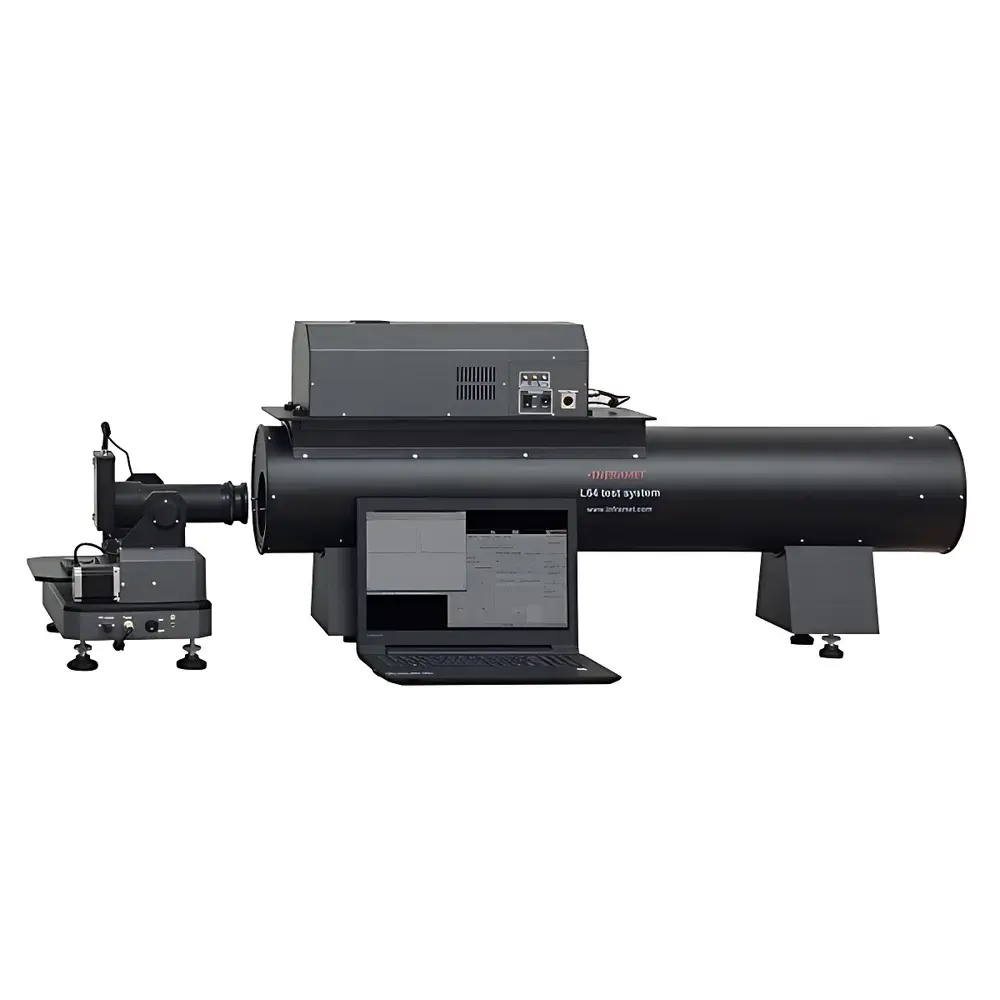
Inframet L64 Laser Receiver Test System
| Brand | Inframet |
|---|---|
| Origin | Poland |
| Manufacturer Type | Authorized Distributor |
| Origin Category | Imported |
| Model | L64 |
| Price Range | USD 105,000 – 132,000 (FOB Gdańsk) |
| Wavelength Range | 400–1700 nm (Visible to SWIR) |
| Operating Modes | Pulse Repetition Frequency (PRF) and Pulse Interval Modulation (PIM) |
| Adjustable Parameters | Peak Power (nW–W range), Pulse Width (1 ns–10 ms), Beam Divergence (0.1–10 mrad), Angular Spot Size (0.05°–5°), Temporal Modulation Depth (>95%) |
| Compliance | CE, RoHS, ISO/IEC 17025 traceable calibration support |
Overview
The Inframet L64 Laser Receiver Test System is a precision-engineered optical test platform designed for functional verification and performance characterization of laser receiver subsystems in electro-optical (EO) and infrared (IR) systems. It operates on the principle of controlled, spatially resolved laser pulse projection—emulating real-world emitter signatures—including those from laser designators, rangefinders, beam riders, and free-space optical communication terminals. Unlike passive alignment tools or generic light sources, the L64 generates calibrated, temporally structured laser radiation with programmable spectral, spatial, and temporal attributes. Its dual-band capability (400–1000 nm visible + 1000–1700 nm short-wave infrared) enables co-registration testing across heterogeneous sensor modalities—specifically synchronizing TV cameras, uncooled microbolometer arrays, and InGaAs-based detectors—thereby supporting rigorous axis alignment validation under representative operational conditions.
Key Features
- Programmable laser pulse generation across visible and SWIR spectra (400–1700 nm), with spectral output matched to common laser diode and DPSS emission lines (e.g., 532 nm, 808 nm, 850 nm, 1064 nm, 1550 nm)
- Independent adjustment of peak irradiance (nW/cm² to kW/cm²), pulse duration (1 ns to 10 ms), repetition rate (single-shot to 100 kHz), and modulation depth (≥95% contrast ratio)
- Motorized collimator and adjustable aperture assembly enabling precise control over angular spot size (0.05°–5°) and beam divergence (0.1–10 mrad), replicating near- and far-field emitter characteristics
- Dual operating modes: Pulse Repetition Frequency (PRF) mode for steady-state sensitivity evaluation; Pulse Interval Modulation (PIM) mode for dynamic response analysis, including jitter, latency, and pulse train fidelity
- Integrated reference photodetector channel with NIST-traceable responsivity calibration for real-time power monitoring and closed-loop intensity stabilization
- Robust mechanical architecture compliant with MIL-STD-810G shock/vibration profiles; EMI-shielded enclosure meeting EN 61326-1 for laboratory and field-deployable use
Sample Compatibility & Compliance
The L64 supports testing of diverse laser receiver architectures—including quadrant photodiodes, position-sensitive detectors (PSDs), focal-plane arrays (FPAs), and gated intensified sensors—without requiring hardware modification. It accommodates receivers with apertures from Ø2 mm to Ø50 mm and field-of-view angles up to ±30°. All optical paths are optimized for minimal wavefront distortion and diffraction-limited spot formation. The system conforms to ISO 11554 (laser beam parameter measurements), ISO 10110-7 (surface imperfection specifications for optics), and supports audit-ready documentation per GLP and ISO/IEC 17025 requirements. Optional factory calibration certificates include uncertainty budgets aligned with EURAMET cg-19 guidelines for radiometric measurements.
Software & Data Management
The L64 is operated via Inframet’s LRTS Control Suite—a Windows-based application offering deterministic timing control, waveform scripting (via Python API), and synchronized data acquisition from external DAQ systems. Software features include automated sweep sequences (power vs. sensitivity, pulse width vs. rise time), pass/fail threshold mapping against user-defined specification limits, and export of timestamped datasets in HDF5 and CSV formats. Audit trails record all parameter changes, operator logins, and calibration events—fully compliant with FDA 21 CFR Part 11 for regulated environments. Integration with MATLAB, LabVIEW, and NI TestStand is supported through standardized DLL and TCP/IP interfaces.
Applications
- Functional verification of laser warning receivers (LWRs) and directed energy countermeasure systems
- Dynamic linearity and saturation threshold assessment of analog and digital laser receivers
- Axis alignment validation between laser emitters and EO/IR seekers in guided munitions and UAV targeting pods
- Characterization of time-resolved response (rise/fall time, pulse delay, dead time) in high-speed laser detection circuits
- Environmental stress screening (ESS) of receiver modules under thermal cycling and vibration, using repeatable stimulus profiles
- Supporting development and verification of STANAG 4579-compliant laser designation interoperability
FAQ
Does the L64 support custom wavelength configurations beyond the standard 400–1700 nm range?
Yes—optional laser modules extend coverage to 2–5 µm (MWIR) upon request, subject to export licensing (EAR99/NLR).
Can the system be integrated into an automated test station (ATS) environment?
Fully supported via Ethernet (TCP/IP), USB 2.0, and TTL trigger I/O; SCPI command set included.
Is factory recalibration required annually?
Recommended every 12 months or after 2000 operational hours; calibration includes radiometric, spatial, and temporal verification against primary standards.
What safety certifications does the L64 carry?
CE marked per Directive 2014/35/EU (Low Voltage) and 2014/30/EU (EMC); Class 1M laser product per IEC 60825-1:2014.
Does the system include alignment aids for co-boresighting with thermal imagers?
Yes—integrated IR-visible overlay reticle projector and motorized XY stage enable sub-arcminute boresight alignment verification without disassembly.






