
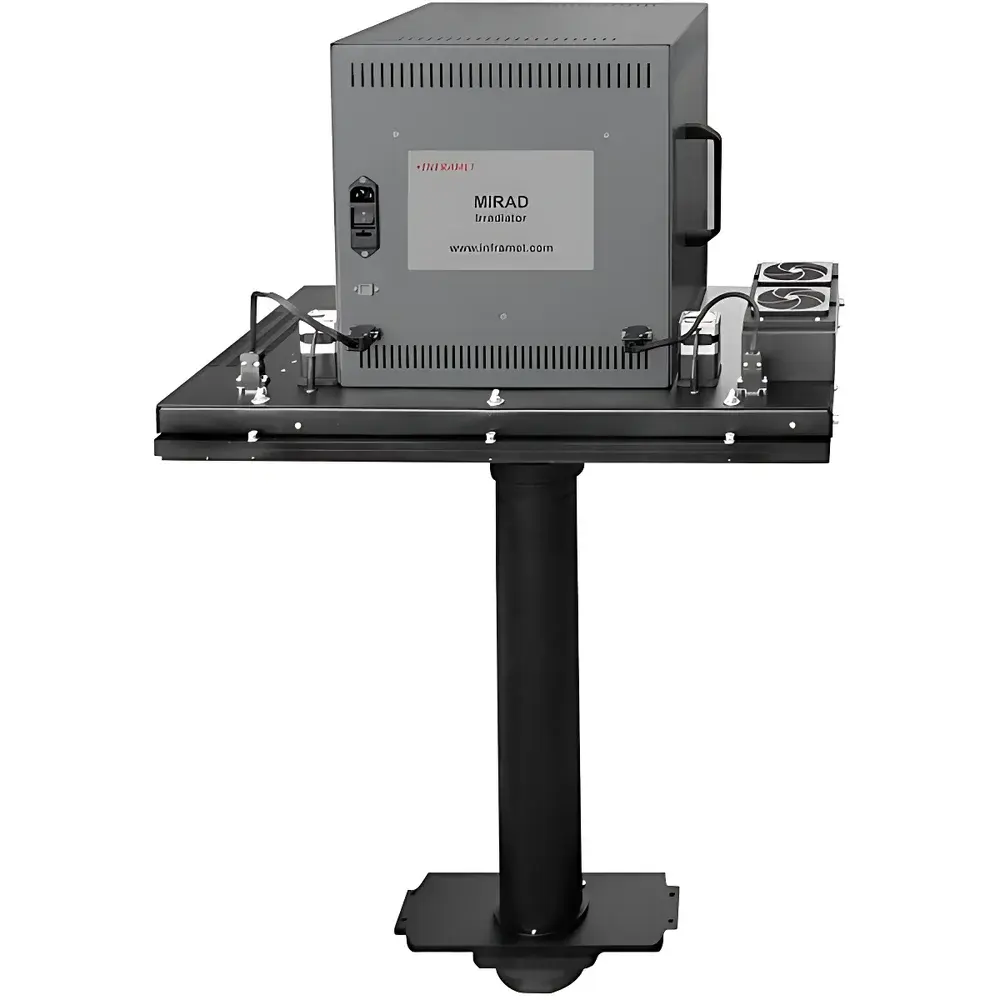
Inframet MIRAD Mid- and Long-Wave Infrared Radiator
| Brand | Inframet |
|---|---|
| Origin | Poland |
| Model | MIRAD |
| Radiation Range | 0.7 µm – 30 µm |
| Blackbody Temp. Range | 50 °C – 550 °C |
| Uniformity | < ±2% over Ø30 mm |
| Irradiance at Wafer Plane | ≥8 mW/cm² (broadband) |
| Working Distance (TP3 to Sensor) | 28 mm (customizable) |
| VAB Attenuation Range | 0–100% (0.1% resolution) |
| Control Interface | USB, PC-hosted software |
| Ambient Operating Conditions | +5 °C to +35 °C, ≤75% RH |
Overview
The Inframet MIRAD is a precision-engineered mid-wave infrared (MWIR) and long-wave infrared (LWIR) radiator designed specifically for front-end wafer-level testing of focal plane arrays (FPAs) in semiconductor manufacturing. It operates on the principle of calibrated blackbody radiation combined with spectral shaping and spatial homogenization to deliver stable, spectrally accurate, and spatially uniform irradiance across semiconductor wafers—critical for functional validation, non-uniformity correction (NUC), and responsivity mapping of unmounted IR detectors. Unlike conventional high-temperature blackbodies, the MIRAD integrates a Medium-Temperature Blackbody (MTB) module operating between 50 °C and 550 °C, engineered to minimize thermal emission from structural components while maintaining Planckian spectral fidelity. Its optical architecture avoids direct line-of-sight exposure of the wafer to the blackbody’s hot aperture, thereby eliminating particulate contamination risks associated with coating degradation—a key reliability requirement in Class 100 cleanroom environments.
Key Features
- Three-module integrated design: MTB blackbody source, Vacuum-Actuated Beam (VAB) attenuator, and TP-series transmission tubes (TP1/TP2/TP3) with internal baffles and collimating optics.
- Contamination-controlled beam path: All air entering the VAB module passes through a certified particulate filter; TP tubes incorporate protective optical elements that shield the wafer from debris originating at the MTB emitter surface.
- High spatial uniformity: Achieves < ±2% irradiance variation over Ø30 mm, < ±3% over Ø50 mm, and < ±5% over Ø60 mm measurement zones—validated per ISO 13697 and ASTM E1256-22 guidelines for radiometric uniformity assessment.
- Fine-resolution thermal and attenuation control: MTB temperature adjustable in 10 mK increments with ≤50 mK short-term stability; VAB provides continuous 0–100% transmittance control at ≥0.1% resolution.
- Full PC-based automation: Native USB interface supports deterministic timing, waveform sequencing (step, ramp, periodic), and real-time irradiance calculation within user-defined spectral bands (e.g., 3–5 µm or 8–12 µm).
Sample Compatibility & Compliance
The MIRAD is optimized for 150 mm (Ø6″) and 200 mm (Ø8″) silicon or ROIC-integrated wafers with active sensor diameters up to 60 mm. The recommended test zone is limited to Ø40 mm to ensure metrological confidence under production-grade repeatability requirements. Its mechanical footprint and TP3 tube length (standard 28 mm working distance) are co-designed with IP750 wafer probers and automated test handlers. The system complies with IEC 61000-6-2 (immunity) and IEC 61000-6-4 (emissions), and meets cleanroom compatibility standards per ISO 14644-1 Class 5 (formerly Class 100). All materials in contact with the optical path conform to outgassing limits defined in ECSS-Q-ST-70-02C for space-qualified instrumentation.
Software & Data Management
The MIRAD Control Suite is a Windows-native application supporting both manual operation and script-driven test sequences. It enables users to define time-varying blackbody temperatures and VAB transmittance profiles synchronized to external triggers (TTL input). For each configuration, the software computes broadband and band-limited irradiance values at the wafer plane using NIST-traceable Planck integrals and measured system throughput curves. Audit trails—including parameter sets, timestamps, operator IDs, and calibration certificate references—are logged in SQLite format compliant with FDA 21 CFR Part 11 requirements when deployed in GMP-regulated facilities. Export options include CSV, HDF5, and XML schemas aligned with SEMI E142 data exchange standards.
Applications
- Wafer-level electro-optical characterization of uncut MWIR/LWIR FPAs (InSb, HgCdTe, VOx microbolometers, quantum well IR photodetectors).
- Non-uniformity correction (NUC) coefficient derivation during wafer sort.
- Responsivity linearity verification across dynamic range (e.g., 10⁻⁴–10⁰ W/cm²).
- Thermal transient response analysis using programmable irradiance waveforms (e.g., square, sawtooth, pseudo-random binary sequences).
- Calibration transfer between reference radiometers and production test stations per ISO/IEC 17025-accredited protocols.
FAQ
What spectral bands does the MIRAD cover, and how is spectral output verified?
The MIRAD emits continuously from 0.7 µm to 30 µm. Spectral distribution follows Planck’s law for the selected blackbody temperature, validated via FTIR spectroradiometry traceable to NIST SRM 2241 and 2242.
Can the working distance be modified beyond the standard 28 mm?
Yes—TP3 tube length is customizable to accommodate alternative prober configurations or larger-diameter sensors; engineering consultation is required to maintain uniformity and irradiance specifications.
Is the system compatible with existing semiconductor ATE platforms?
It supports synchronization via TTL trigger input/output and exposes a COM-port-accessible command set (SCPI-like syntax) for integration into Teradyne, Advantest, or custom handler software stacks.
How often does the system require recalibration?
Annual recalibration is recommended; blackbody temperature accuracy is maintained via embedded Pt100 sensors calibrated against ITS-90, while VAB attenuation is verified using NIST-traceable pyroelectric detectors.
Does the MIRAD meet GLP/GMP documentation requirements?
Yes—the control software includes electronic signature support, change control logs, and IQ/OQ documentation templates aligned with ISO 13485 and ICH Q9 frameworks.




