
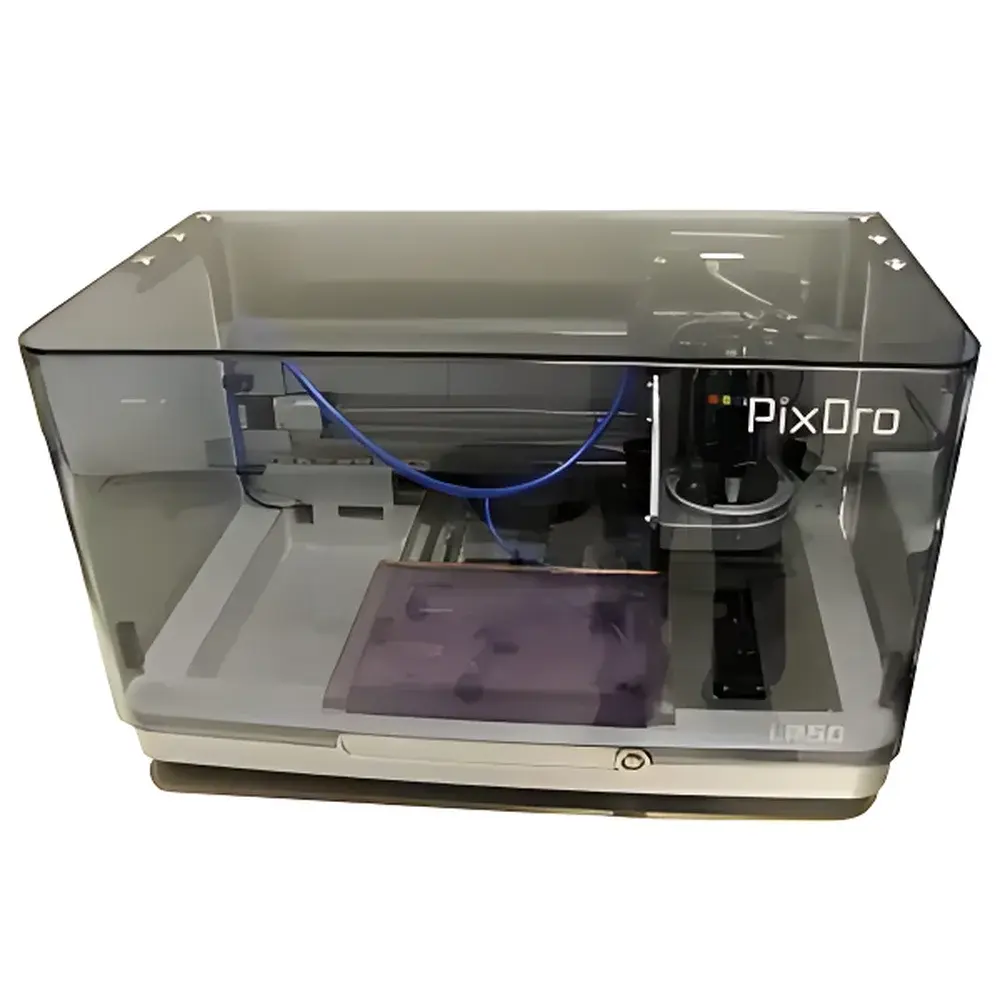
INNO+NR200+Plasma 3D Printer
| Origin | Netherlands |
|---|---|
| Manufacturer Type | Authorized Distributor |
| Origin Category | Imported |
| Model | NR200 |
| Price | USD 84,000 (FOB Rotterdam) |
Overview
The INNO NR200 Plasma 3D Printer is the world’s first commercially available atmospheric-pressure plasma-based additive manufacturing system engineered for functional nanomaterial patterning at near-ambient conditions. Unlike conventional thermal or laser-assisted deposition techniques, the NR200 employs non-thermal, low-energy plasma discharge to activate, functionalize, and deposit precursor materials—enabling direct-write fabrication of conductive, catalytic, and sensing nanostructures on heat-sensitive, non-planar, and porous substrates including paper, textile fibers, PET films, and flexible polyimide. Its core operating principle relies on controlled dielectric barrier discharge (DBD) generated across 24 individually addressable needle electrodes, producing spatially resolved plasma plumes with sub-200 µm feature resolution. The process operates at a maximum substrate temperature of 40 °C, eliminating thermal degradation risks and enabling integration into roll-to-roll and lab-scale R&D workflows without vacuum infrastructure.
Key Features
- 24-channel addressable plasma head with independent electrode control for multi-material, multi-step patterning sequences
- Sub-200 µm minimum feature size (plasma spot diameter), supporting high-resolution functional micro-patterning
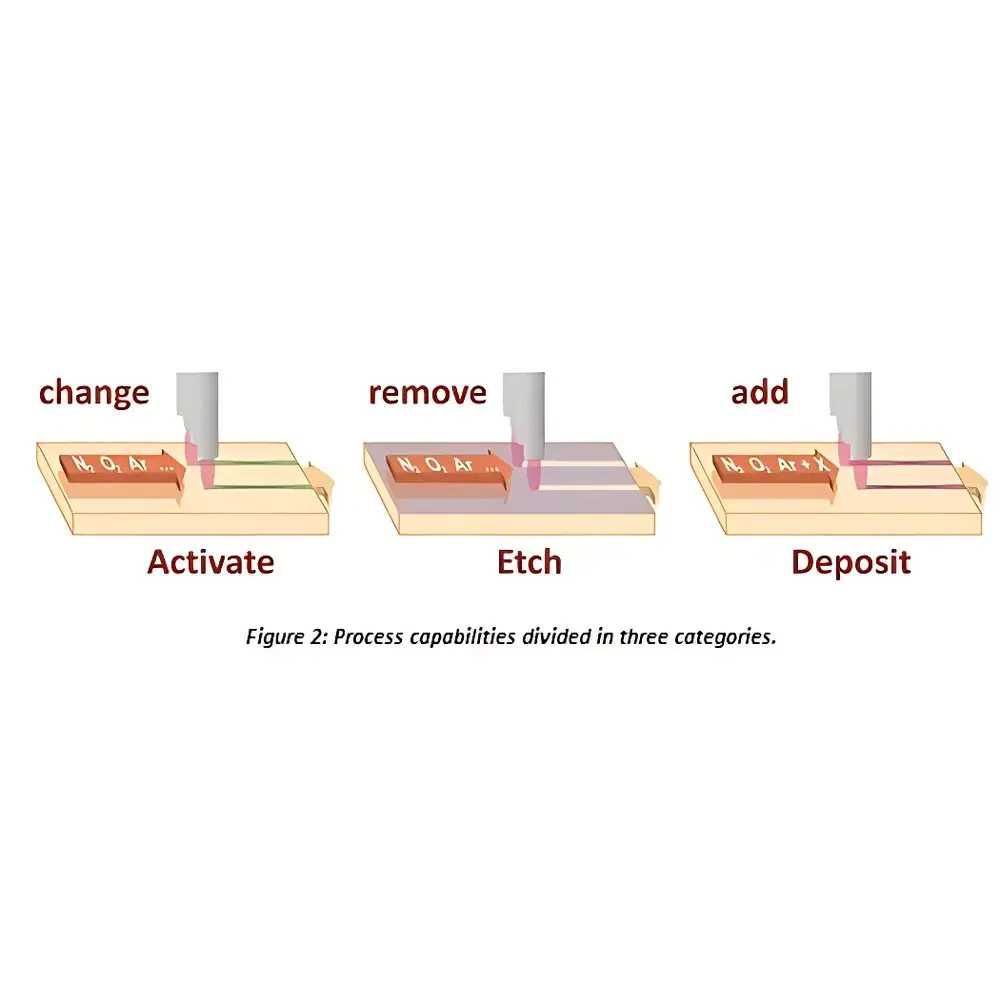
- Triple-mode plasma operation: surface activation, selective etching, and precursor-assisted deposition—configurable via gas manifold (Ar, He, N₂, O₂, NH₃, or custom mixtures)
- 400 Hz maximum printing frequency, enabling scalable throughput for prototyping and small-batch functional device fabrication
- Compact 19″ rack-mount (3U) architecture with integrated controller and RF power supply (10 kVpp, ~60 kHz)
- Low-power operation: 230 VAC, 50 Hz, 1 A; no external cooling or compressed air required
Sample Compatibility & Compliance
The NR200 is validated for use with a broad class of low-surface-energy and thermally fragile substrates—including cellulose-based papers, cotton and polyester textiles, PDMS elastomers, PET, PEN, and thin-film metal oxides. It supports direct integration of carbon nanotubes, graphene oxide dispersions, metal nanoparticle inks (Ag, Cu, Ni), and polymerizable monomers (e.g., allylamine, acrylic acid) as plasma-reactive precursors. The system complies with IEC 61000-6-3 (EMC emission limits) and IEC 61000-6-2 (immunity standards). All plasma process parameters—including voltage waveform, duty cycle, gas flow rates, and dwell time—are digitally logged with timestamping, supporting GLP-compliant documentation and audit-ready data traceability per FDA 21 CFR Part 11 requirements when used with validated software configurations.
Software & Data Management
The NR200 is operated via INNO’s PlasmaPrint Control Suite—a Windows-based application supporting G-code import, vector-based path planning, real-time plasma parameter modulation, and synchronized multi-axis motion control (X-Y-Z + rotation optional). All process logs—including electrode activation maps, gas composition history, voltage/current waveforms, and environmental sensor readings (ambient T/RH)—are stored in SQLite databases with SHA-256 hash integrity verification. Export formats include CSV, HDF5, and standardized ASTM E2912-22 metadata templates for cross-platform data exchange. Optional API access enables integration with LIMS platforms and automated QA/QC pipelines in regulated environments.
Applications
- Fabrication of wearable electrochemical biosensors (e.g., dopamine-selective electrodes via dopamine-imprinted polymer deposition)
- On-substrate patterning of ammonia-responsive chemiresistors using plasma-functionalized CNT networks
- Direct-write metallization of flexible PCBs and antenna elements on textile substrates
- Surface engineering of filtration membranes for enhanced antifouling or ion-selective transport
- Rapid prototyping of microfluidic channel functionalization (e.g., immobilized enzymes, antibodies, or aptamers)
- Pre-treatment and adhesion promotion prior to inkjet or aerosol jet printing of functional inks
FAQ
Does the NR200 require vacuum or inert-gas glovebox operation?
No. It operates exclusively at atmospheric pressure and is compatible with ambient air, nitrogen, or controlled gas environments—no vacuum pumps or sealed enclosures are needed.
Can the system deposit metallic layers without post-annealing?
Yes. Using plasma-enhanced reduction of metal salt precursors (e.g., AgNO₃ + H₂ plasma), conductive silver traces with sheet resistances < 0.5 Ω/sq can be achieved at ≤40 °C.
Is remote diagnostics and firmware update supported?
Yes. The embedded controller supports secure SSH/TLS remote access and over-the-air (OTA) firmware updates with cryptographic signature validation.
What substrate flatness tolerance does the plasma head accommodate?
The Z-axis auto-focus routine accommodates ±150 µm topographical variation across 100 × 100 mm areas, enabling reliable printing on woven fabrics and corrugated paperboards.
Are application-specific process recipes provided?
INNO delivers a validated recipe library covering 12 substrate–precursor combinations (including cotton–CNT, PET–AgNP, and filter paper–PEDOT:PSS), each with full metrology reports and reproducibility data (n ≥ 5 per batch).






