
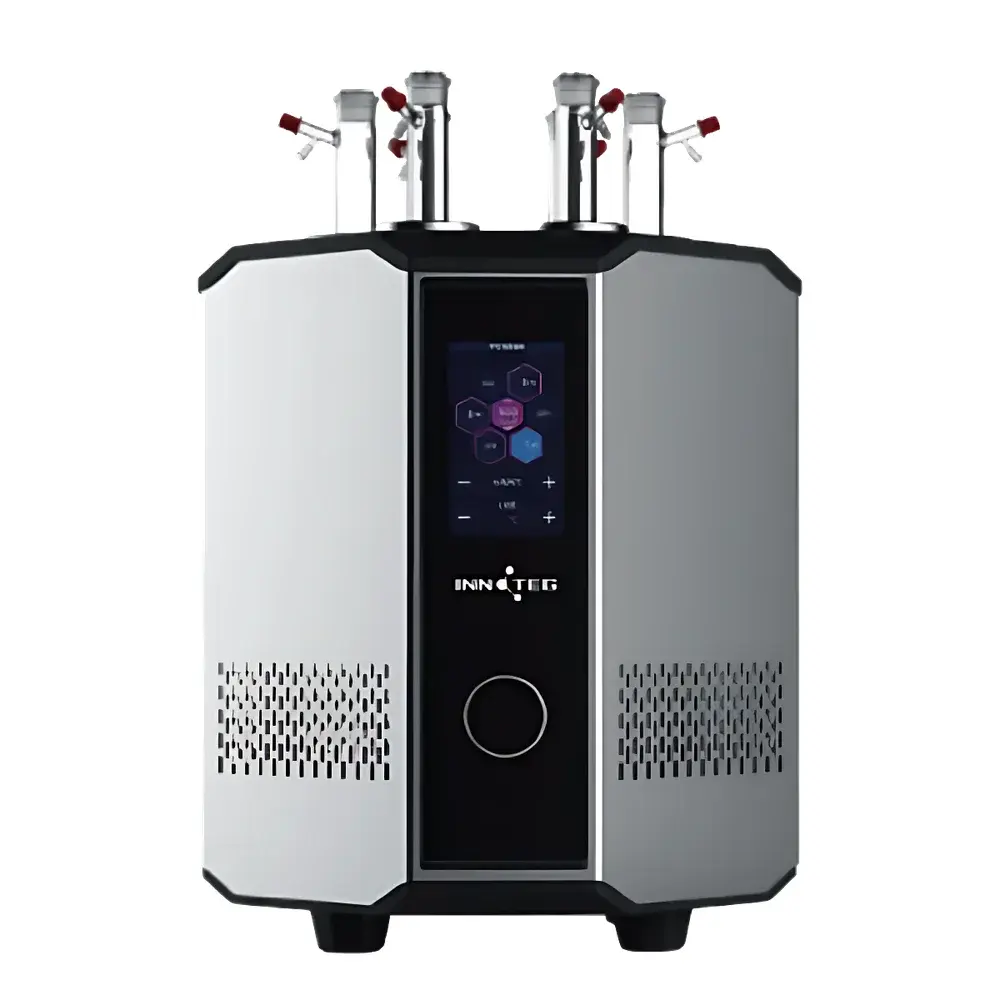
INNOTEG EasyPhoC-6 Parallel Photochemical Reactor
| Brand | INNOTEG |
|---|---|
| Origin | Guangdong, China |
| Model | EasyPhoC-6 |
| Temperature Range | 5–45 °C |
| Number of Reaction Stations | 6 |
| Light Source Wavelength Range | 365–950 nm (interchangeable plug-in modules) |
| Stirring Speed | 50–1500 rpm |
| Cooling | Integrated high-precision thermoelectric cooling module |
| Tube Compatibility | Single-hole tubes Φ22.5 mm or Φ27.5 mm |
Overview
The INNOTEG EasyPhoC-6 Parallel Photochemical Reactor is an engineered platform for high-throughput, temperature-controlled photochemical synthesis and catalytic screening under precisely defined irradiation conditions. Designed around the principles of uniform photon flux delivery and independent thermal management per reaction station, it employs collimated LED-based illumination coupled with a thermoelectric cooling architecture to maintain stable reaction environments across all six parallel channels. Unlike conventional batch photoreactors relying on external chillers or ambient air cooling, the EasyPhoC-6 integrates active solid-state cooling directly into its base assembly—enabling reproducible temperature control from 5 °C to 45 °C without auxiliary equipment. Its optical design utilizes precision collimating lenses to minimize beam divergence and maximize irradiance homogeneity at the sample plane, critical for quantitative structure–activity relationship (SAR) studies and kinetic modeling in photocatalytic transformations.
Key Features
- Six independently controllable reaction stations, each equipped with individual light intensity adjustment (0–100% PWM-driven output) and real-time temperature monitoring.
- Plug-and-play modular light source cartridges supporting standardized wavelength bands from 365 nm (UVA) to 950 nm (NIR); custom wavelengths available upon request for specialized photoactivation requirements.
- Collimated lens optics system optimized for >85% optical coupling efficiency between emitter and reaction vessel—reducing stray light and improving photon utilization per unit volume.
- Integrated Peltier-based cooling module with PID-regulated thermal feedback loop ensures ±0.3 °C temperature stability across the full operating range (5–45 °C), eliminating need for external recirculating chillers.
- Combined touchscreen interface and physical rotary encoder for intuitive parameter setting, real-time data visualization, and tactile confirmation during glove-box or fume hood operation.
- Built-in magnetic stirrers with speed range 50–1500 rpm and programmable ramp profiles support heterogeneous photocatalysis, suspension-based reactions, and viscous media handling.
Sample Compatibility & Compliance
The EasyPhoC-6 accommodates standard borosilicate glass photoreaction tubes in two configurations: single-bore formats (Φ22.5 mm and Φ27.5 mm inner diameter) and dual-bore variants (Φ16.5 mm × 2). All tube holders are chemically inert, autoclavable, and designed for secure vertical alignment to ensure consistent optical path length and minimal shadowing effects. The system complies with general laboratory safety standards for Class 3R optical radiation devices (IEC 60825-1:2014) and meets electromagnetic compatibility requirements per EN 61326-1:2013. While not certified for GMP manufacturing environments, its logging-capable software architecture supports GLP-aligned experimental traceability when paired with validated user protocols.
Software & Data Management
Control firmware supports local parameter logging at 1-second resolution—including setpoint temperature, actual chamber temperature, light intensity percentage, stirring speed, and elapsed time per station. Exportable CSV files include timestamped metadata and channel-specific identifiers, facilitating integration with LIMS or electronic lab notebook (ELN) platforms. Optional USB-host connectivity enables firmware updates and configuration backup. The system does not implement FDA 21 CFR Part 11-compliant audit trails or electronic signatures out-of-the-box; however, raw log files may be archived in accordance with institutional GLP documentation policies.
Applications
The EasyPhoC-6 serves as a primary tool in academic and industrial research laboratories conducting systematic investigation of photoinduced processes. Typical use cases include: optimization of visible-light-mediated C–N cross-coupling reactions in pharmaceutical lead diversification; screening of metal-free organic photocatalysts for CO2 reduction; surface functionalization of quantum dots and MOFs via UV-triggered grafting; photochemical peptide modification under mild aqueous conditions; and kinetic profiling of TiO2-based degradation pathways for emerging contaminants. Its multi-wavelength flexibility and thermal precision make it particularly suitable for mechanistic studies requiring controlled variation of both photon energy and activation barrier.
FAQ
Does the EasyPhoC-6 support external temperature probes for direct solution monitoring?
No—the system measures temperature at the aluminum heating/cooling block adjacent to each reaction well. Direct immersion probes are not integrated but may be used externally if compatible with the reactor’s physical footprint and sealing requirements.
Can multiple wavelength modules operate simultaneously across different stations?
Yes—each station accepts an independent light module; users may install 365 nm LEDs on stations 1–3 and 450 nm LEDs on stations 4–6, for example.
Is the stirring function synchronized across all stations?
No—stirring speed and ramp profiles are fully independent per station, allowing heterogeneous mixing conditions within a single run.
What maintenance is required for the thermoelectric cooling system?
No consumables or periodic servicing are needed; the Peltier modules are rated for >50,000 hours of continuous operation under nominal load.
Are quartz reaction tubes supported?
Standard configurations use borosilicate glass. Quartz tubes (e.g., Suprasil-grade) can be accommodated with custom holder inserts—contact technical support for mechanical specifications and UV transmission validation.
Related Products



