
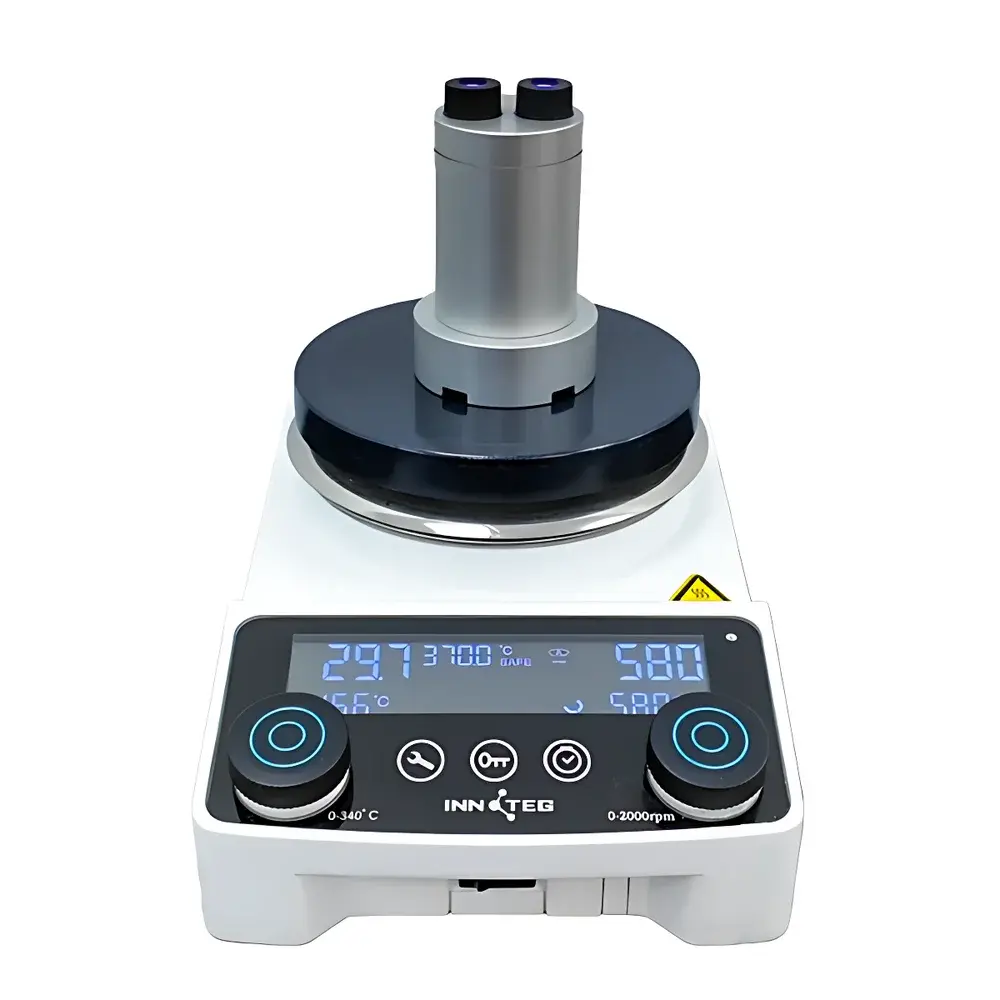
INNOTEG EasyPhoS Economical Single-Station Photochemical Reactor
| Brand | INNOTEG |
|---|---|
| Origin | Guangdong, China |
| Manufacturer Type | Authorized Distributor |
| Product Category | Domestic |
| Model | EasyPhoS |
| Configuration Options | Single-position / Dual-position |
| Wavelength Options | 390 nm / 450 nm |
| Light Source | High-efficiency transmissive LED array |
| Design | Compact benchtop unit compatible with standard magnetic stirrers |
| Compliance | Designed for laboratory-scale photochemical synthesis under ambient or controlled atmosphere |
Overview
The INNOTEG EasyPhoS Economical Single-Station Photochemical Reactor is a purpose-engineered benchtop instrument designed for reproducible, wavelength-selective photochemical activation in synthetic organic chemistry and catalysis research. Operating on the principle of controlled solid-state photon delivery via transmissive LED illumination, the EasyPhoS eliminates conventional reflector-based optical inefficiencies by directing light vertically through the reaction vessel—ensuring uniform irradiance distribution across the sample volume. This patented transmissive architecture minimizes lateral photon scattering, enhances photon flux density at the reaction interface, and improves quantum yield consistency compared to open-air LED arrays. The system supports discrete monochromatic excitation at 390 nm (UVA) and 450 nm (blue visible), enabling selective activation of photocatalysts such as Ru(bpy)₃²⁺, Ir(ppy)₃, eosin Y, and TiO₂-based systems without broadband spectral contamination. Its compact footprint and low thermal load allow direct integration with standard laboratory magnetic stirrers—eliminating the need for external cooling or mechanical agitation coupling.
Key Features
- Patented transmissive LED illumination geometry delivering >65% optical coupling efficiency into standard cylindrical reaction vials (e.g., 10–25 mL volume)
- Selectively tunable narrow-band emission at 390 nm (FWHM ≤ 15 nm) or 450 nm (FWHM ≤ 20 nm), certified per IEC 62471 photobiological safety standards
- Modular station design: available in single-position (T00SPP390/T00SPP450) and dual-position configurations for parallel screening
- Benchtop form factor (180 × 120 × 110 mm) with integrated heat-dissipating aluminum chassis; operating temperature rise <8 °C above ambient during continuous 4-h operation
- Universal vial compatibility: accommodates borosilicate glass tubes (Ø12–18 mm) and standard screw-cap reaction vessels with O-ring sealing options
- No external power supply required—operates via regulated 24 V DC input with overcurrent/overtemperature protection circuitry
Sample Compatibility & Compliance
The EasyPhoS is validated for use with common solvent systems including acetonitrile, DMF, THF, methanol, and aqueous buffers (pH 2–12). Reaction vessels are rated for pressures up to 1 bar(g) and temperatures from 0 °C to 60 °C. All optical and electrical components comply with CE marking requirements (EMC Directive 2014/30/EU, Low Voltage Directive 2014/35/EU) and RoHS 2011/65/EU material restrictions. While not certified for GMP manufacturing environments, the device supports GLP-aligned experimental documentation when used with traceable calibration records and logbook entries. It meets ASTM E2933-22 guidelines for photochemical reactor characterization and is suitable for method development under USP Analytical Instrument Qualification protocols.
Software & Data Management
The EasyPhoS operates in standalone mode without proprietary software dependency. Illumination duration is controlled via front-panel push-button timer (0–240 min, ±15 s accuracy), with LED status indicated by dual-color LED feedback (green = active, red = standby/fault). For traceable experimentation, users may integrate the unit into existing LIMS or ELN platforms using external digital timers with CSV export capability. Audit trails—including start time, duration, wavelength selection, and operator ID—can be manually recorded in accordance with FDA 21 CFR Part 11 Annex 11 principles when paired with electronic lab notebooks meeting ALCOA+ criteria.
Applications
- Photoredox catalysis: C–N, C–O, and C–C bond formations using iridium/ruthenium complexes or organic dyes
- Decarboxylative functionalization and radical cascade reactions under mild conditions
- Heterogeneous photocatalysis studies with TiO₂, g-C₃N₄, or MOF-based materials
- Photoinduced electron transfer (PET) kinetics profiling in mechanistic investigations
- Teaching laboratories: hands-on demonstration of Jablonski diagrams, quantum efficiency measurement, and wavelength-dependent reactivity
- Preparative-scale optimization prior to flow photoreactor scale-up
FAQ
Is the EasyPhoS compatible with inert atmosphere reactions?
Yes—reaction vials can be sealed with PTFE-lined caps and purged via septum injection prior to irradiation. Optional gas inlet adapters are available for continuous N₂/Ar sparging.
What is the typical photon flux density at the sample position?
Measured irradiance is 12–15 mW/cm² at 390 nm and 18–22 mW/cm² at 450 nm (using calibrated silicon photodiode, 1 cm² active area), referenced to ISO/CIE standard measurement geometry.
Can I use non-standard vial sizes or shapes?
The holder accommodates cylindrical vessels with outer diameters between 12 mm and 18 mm. Non-cylindrical or tapered vials may result in non-uniform illumination and are not recommended.
Does INNOTEG provide wavelength calibration certificates?
Each unit ships with a factory-verified spectral output report (±2 nm wavelength tolerance, ±5% irradiance repeatability over 100 h operational life). NIST-traceable recalibration services are available upon request.
Is the EasyPhoS suitable for kinetic studies requiring precise time resolution?
While the built-in timer offers minute-level control, sub-second initiation requires external triggering via TTL-compatible auxiliary port (optional accessory kit).



