
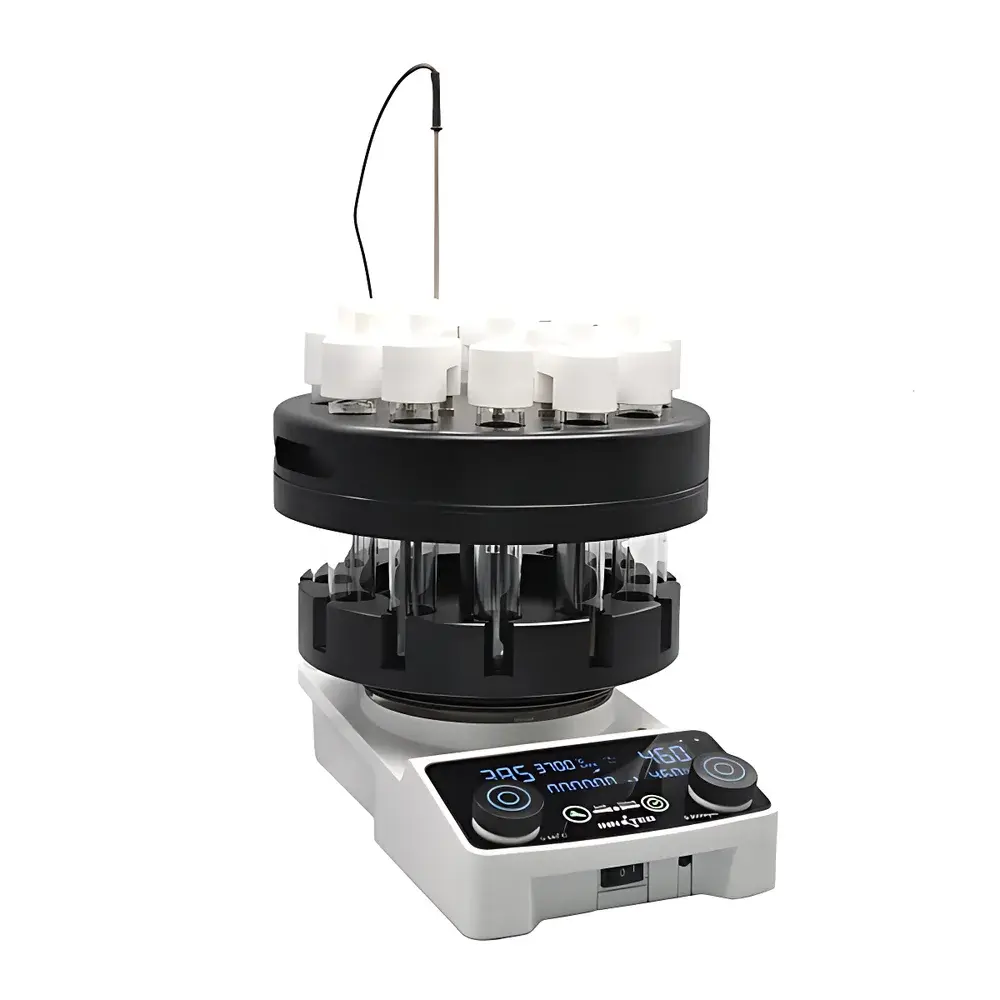
INNOTEG EasySyn-12 Parallel Synthesis Station
| Brand | INNOTEG |
|---|---|
| Origin | Guangdong, China |
| Manufacturer Type | Authorized Distributor |
| Country of Origin | China |
| Model | EasySyn-12 |
| Price | Upon Request |
| Temperature Range | RT–220 °C |
| Temperature Control Accuracy | ±1 °C |
| Reaction Positions | 12 |
| Reaction Volume per Vessel | 20 mL |
| Stirring Speed | 50–2000 rpm |
| Heating Method | Conductive Aluminum Block with Pt1000 Sensor |
| Temperature Sensing Modes | Block Temperature or Solution Temperature |
| Gas Management | Central Inlet/Outlet Valve with Individual On/Off Valves per Position |
| Condensation | Removable Water-Cooled Reflux Ports |
| Sampling | Mid-reaction and Rapid Sampling Ports |
| Sealing | PTFE-Capped Glass Tubes with 1/4″ Quick-Twist Thread |
| Surface Coating | Chemically Resistant Fluoropolymer |
| Safety Features | Post-Shutdown Surface Temperature Display & Intelligent Anti-Scald Logic |
Overview
The INNOTEG EasySyn-12 Parallel Synthesis Station is an engineered platform for high-throughput solution-phase and solid-supported organic synthesis under controlled thermal, atmospheric, and mechanical conditions. Designed around the principles of conductive block heating and precise magnetic stirring, it enables reproducible parallel reactions across 12 independent reaction vessels—each accommodating up to 20 mL volume. Its core architecture integrates a thermally uniform aluminum heating block, a Pt1000 resistance temperature detector (RTD) capable of dual-mode sensing (block or direct solution temperature), and a robust magnetic drive system delivering stable agitation from 50 to 2000 rpm. The system supports inert atmosphere operation via centralized vacuum/inert gas manifold with position-specific shutoff valves, making it suitable for air-sensitive transformations including cross-coupling, hydrogenation, and organometallic catalysis. Operating from ambient temperature to 220 °C—with sustained stability at 180 °C and short-term capability at 220 °C—the EasySyn-12 meets the thermal demands of modern synthetic methodology development while maintaining ±1 °C control accuracy across all positions.
Key Features
- 12-position parallel reaction capability with individually addressable thermal and gas control per vessel
- Conductive aluminum heating block with integrated Pt1000 sensor for real-time, high-fidelity temperature feedback
- Dual temperature control mode: selectable between block surface temperature or direct solution temperature via optional probe insertion through PTFE cap
- Chemically inert fluoropolymer-coated housing and PTFE reaction caps with 1/4″ quick-twist thread interface—ensuring rapid, leak-tight sealing to standard borosilicate glass tubes
- Removable water-cooled reflux condenser ports compatible with standard laboratory condensers for solvent reflux applications
- Centralized quick-release valve manifold for simultaneous vacuum evacuation or inert gas purging, plus individual on/off valves per reaction position for selective atmosphere control
- Mid-reaction injection and rapid sampling ports enabling kinetic profiling without system interruption
- Intelligent thermal safety logic: post-power-off surface temperature display and anti-scald warning prevents accidental contact with residual heat
- Ergonomic design with transparent observation window for real-time visual monitoring of reaction progress, phase separation, or precipitate formation
Sample Compatibility & Compliance
The EasySyn-12 accommodates standard 10–20 mL round-bottom or screw-cap glass reaction tubes (e.g., 18 × 150 mm or 24 × 150 mm formats). All wetted surfaces—including caps, seals, and inlet/outlet fittings—are constructed from PTFE or fluorinated elastomers, ensuring compatibility with strong acids (e.g., HCl, H₂SO₄), bases (e.g., NaOH, KOtBu), halogenated solvents (CH₂Cl₂, CHCl₃), and reactive reagents (n-BuLi, DIBAL-H). The system supports GLP-compliant workflows when paired with external data logging; its temperature setpoints, ramp rates, and hold times are fully recordable via external USB or RS-232 interface (optional). While not pre-certified to ISO/IEC 17025 or ASTM E2917, its thermal performance aligns with common validation protocols for synthetic equipment used in pharmaceutical process research (per ICH Q5A and Q7 guidance).
Software & Data Management
The EasySyn-12 operates as a standalone instrument with front-panel digital interface for manual parameter entry. For traceable, auditable operation, it supports integration with third-party laboratory information management systems (LIMS) and electronic lab notebooks (ELN) via ASCII-based serial communication (RS-232 or USB-to-serial adapter). Temperature profiles—including ramp rate, dwell time, and final hold duration—can be exported as CSV files. Optional firmware upgrade enables timestamped event logging (start/stop, temperature deviation alerts, valve actuation) compliant with FDA 21 CFR Part 11 requirements when deployed with validated user access controls and audit trail configuration.
Applications
- High-throughput screening of catalysts, ligands, and reagent combinations in C–C and C–heteroatom bond-forming reactions
- Optimization of reaction parameters (temperature, stoichiometry, residence time) for API intermediate synthesis
- Solid-phase peptide synthesis (SPPS) using resin-bound substrates in sealed tube format
- Thermal stability assessment of novel compounds under controlled inert atmosphere
- Kinetic studies requiring sequential sampling under reproducible thermal conditions
- Scale-down reaction modeling for continuous flow process development
FAQ
What temperature sensing modes does the EasySyn-12 support?
It supports two modes: block temperature (default) and direct solution temperature—enabled by inserting the supplied Pt1000 probe through the PTFE cap into the reaction mixture.
Can the system maintain inert atmosphere during prolonged heating?
Yes—via the central gas manifold with position-specific isolation valves, enabling continuous N₂ or Ar sparging or static blanketing for >24 h at 180 °C.
Is the heating block interchangeable for different tube formats?
No—the block is fixed for 12 × 20 mL tube geometry; however, custom inserts for 10 mL or 5 mL tubes are available upon request and qualification.
Does the system comply with electrical safety standards for international use?
It meets IEC 61010-1:2010 for laboratory electrical equipment and carries CE marking; voltage/frequency variants (110 V/60 Hz and 230 V/50 Hz) are factory-configured per regional requirement.
How is calibration verified?
Users may perform field verification using a NIST-traceable calibrated thermometer inserted into a representative reaction vessel; full metrological calibration services are offered by INNOTEG-authorized service centers.



