
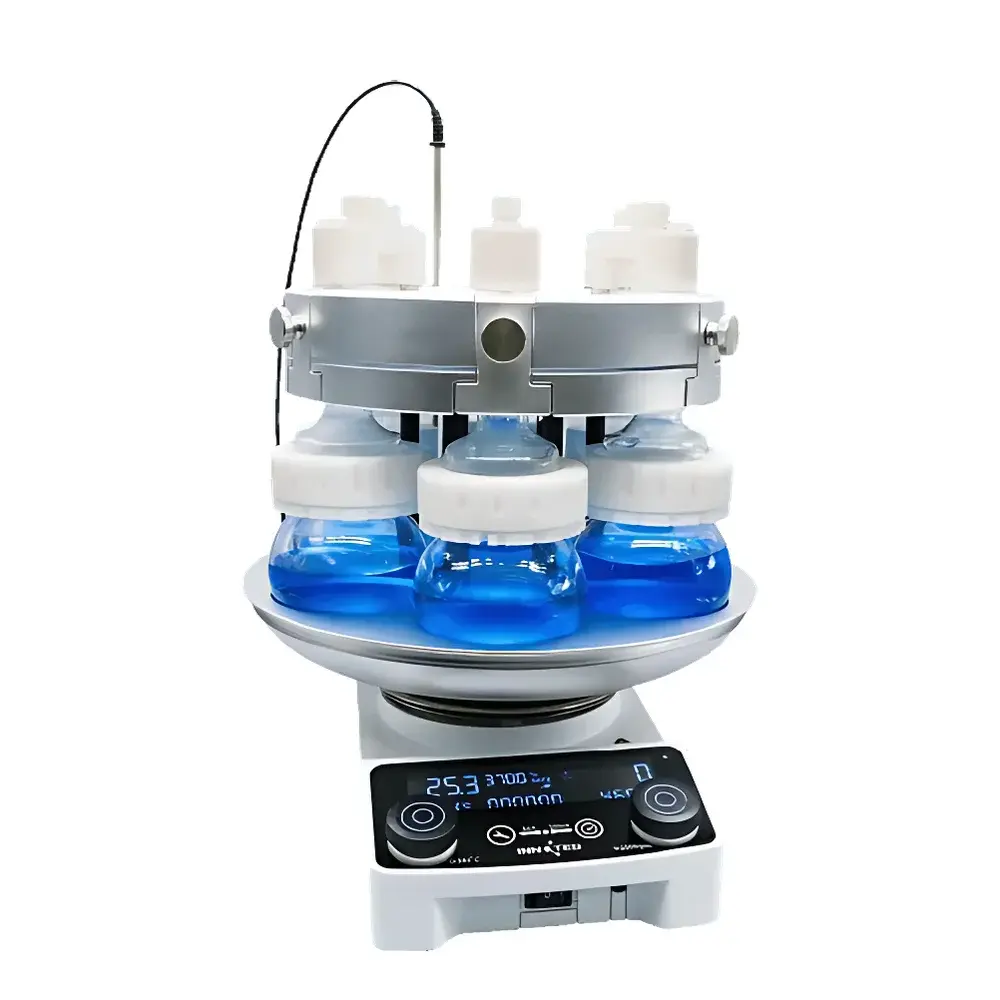
INNOTEG EasySyn-6 Parallel Synthesis Station
| Brand | INNOTEG |
|---|---|
| Model | EasySyn-6 |
| Reaction Positions | 6 |
| Temperature Range | Ambient to 180 °C |
| Temperature Accuracy | ±1 °C |
| Temperature Sensing | Pt1000 sensor (block or solution immersion) |
| Heating Platform | Compatible with INNOTEG WM-1 magnetic stirrer |
| Condensation Method | Integrated aluminum heat-sink plate with external cooling water connection |
| Atmosphere Control | PTFE reaction caps with radial gas dispersion system |
| Layout | Circular, compact benchtop design |
Overview
The INNOTEG EasySyn-6 Parallel Synthesis Station is an engineered platform for reproducible, temperature-controlled parallel synthesis in solution-phase and solid-supported chemistry. Designed as a modular add-on to the INNOTEG WM-1 magnetic stirring base, it enables simultaneous execution of six independent reactions under precisely regulated thermal and atmospheric conditions. Its operation relies on conductive heating via an aluminum heating block, coupled with real-time feedback from a calibrated Pt1000 resistance temperature detector—capable of measuring either block surface temperature or direct solution temperature when immersed through the reaction cap. This dual-sensing capability supports method development where thermal lag or heterogeneous heat transfer must be accounted for. The system operates within a defined ambient-to-180 °C range, making it suitable for standard organic transformations (e.g., amide couplings, Suzuki cross-couplings, esterifications), as well as more demanding protocols requiring sustained elevated temperatures without solvent loss.
Key Features
- Six-position parallel architecture: Enables concurrent execution of discrete reaction conditions—ideal for reaction optimization, catalyst screening, or reagent matrix testing.
- Pt1000-based temperature control: Delivers ±1 °C accuracy across the full operating range; user-selectable measurement mode (block vs. solution temperature) improves thermal fidelity in viscous or low-volume systems.
- Integrated condensation management: Replaces conventional glass condensers with a thermally conductive aluminum top plate connected to external cooling water; rapid valve-switching allows seamless transition between reflux, inert purge, or vacuum modes.
- Controlled atmosphere compatibility: Equipped with chemically resistant PTFE reaction caps and a radial gas inlet manifold that ensures uniform inert gas distribution across all six vessels—critical for air-sensitive organometallic or lithiation reactions.
- Ergonomic circular layout: Provides unobstructed visual access to all reaction vessels; facilitates intuitive reagent addition, sampling, and cap handling without cross-contamination risk.
- Benchtop footprint optimization: Compact mechanical integration with the WM-1 base minimizes spatial demand while maintaining structural rigidity and thermal isolation from surrounding lab environment.
Sample Compatibility & Compliance
The EasySyn-6 accommodates standard 10–25 mL round-bottom reaction vials (with optional adapter kits for alternative vessel geometries). All wetted components—including caps, gas manifolds, and thermal interface surfaces—are constructed from PTFE, anodized aluminum, or borosilicate-compatible materials, ensuring broad chemical resistance across acidic, basic, and halogenated media. While not certified to specific ISO/IEC 17025 or GLP validation frameworks out-of-the-box, the system’s traceable temperature control, repeatable mechanical actuation, and documented thermal profiles support internal method qualification per ASTM E29–23 (Standard Practice for Using Significant Digits in Test Data) and USP Analytical Instrument Qualification guidelines. Users performing GxP-regulated work may implement supplementary calibration logs, audit trails, and preventive maintenance records consistent with FDA 21 CFR Part 11 requirements.
Software & Data Management
The EasySyn-6 operates as a hardware-integrated platform without embedded microprocessor control or proprietary software. Temperature setpoints and monitoring are performed externally via the WM-1 controller interface, which supports analog output (0–10 V or 4–20 mA) for connection to laboratory data acquisition systems (e.g., LabVIEW, DeltaV, or custom SCADA environments). All thermal data—including ramp rates, dwell times, and real-time Pt1000 readings—can be logged at user-defined intervals for post-run analysis. No cloud connectivity, firmware updates, or vendor-specific drivers are required, reducing cybersecurity exposure and long-term obsolescence risk.
Applications
- Organic synthesis: Optimization of coupling reactions, heterocycle formation, and protecting group strategies under controlled reflux or inert conditions.
- Pharmaceutical process R&D: Accelerated DoE (Design of Experiments) workflows for identifying optimal temperature, stoichiometry, and residence time parameters prior to kilolab scale-up.
- Materials chemistry: Synthesis of MOFs, covalent organic frameworks (COFs), and polymer precursors requiring precise thermal ramping and gas-phase exclusion.
- Academic teaching labs: Demonstrates fundamental principles of parallel experimentation, heat transfer kinetics, and atmosphere-sensitive reaction handling—without requiring advanced instrumentation training.
FAQ
Is the EasySyn-6 compatible with non-INNOTEG magnetic stirrers?
Yes—provided the external stirrer features a flat, thermally stable top plate (≥120 mm diameter) and supports external temperature sensor input (Pt1000 compatible). Mechanical alignment and thermal coupling efficiency should be verified empirically.
Can I monitor individual vessel temperatures independently?
No—the system uses a single Pt1000 sensor; simultaneous multi-point measurement requires external probe deployment and third-party DAQ hardware.
What vacuum level can be achieved using the integrated gas/vacuum manifold?
The PTFE sealing system supports rough vacuum down to ~10 mbar (absolute) when paired with a diaphragm pump; deeper vacuum requires supplemental cold traps and validated gasketing.
Are replacement caps and adapters available for specialized reaction vessels?
Yes—INNOTEG offers optional accessory kits for 5 mL microwave vials, screw-thread PCR tubes, and Schlenk-style side-arm flasks, all maintaining the same thermal and gas-integrity specifications.
Does the system meet CE or UL safety certification standards?
The EasySyn-6 itself carries no standalone regulatory marking; compliance is achieved only when used in conjunction with a CE-marked WM-1 base unit operating within its rated electrical and thermal limits.



