
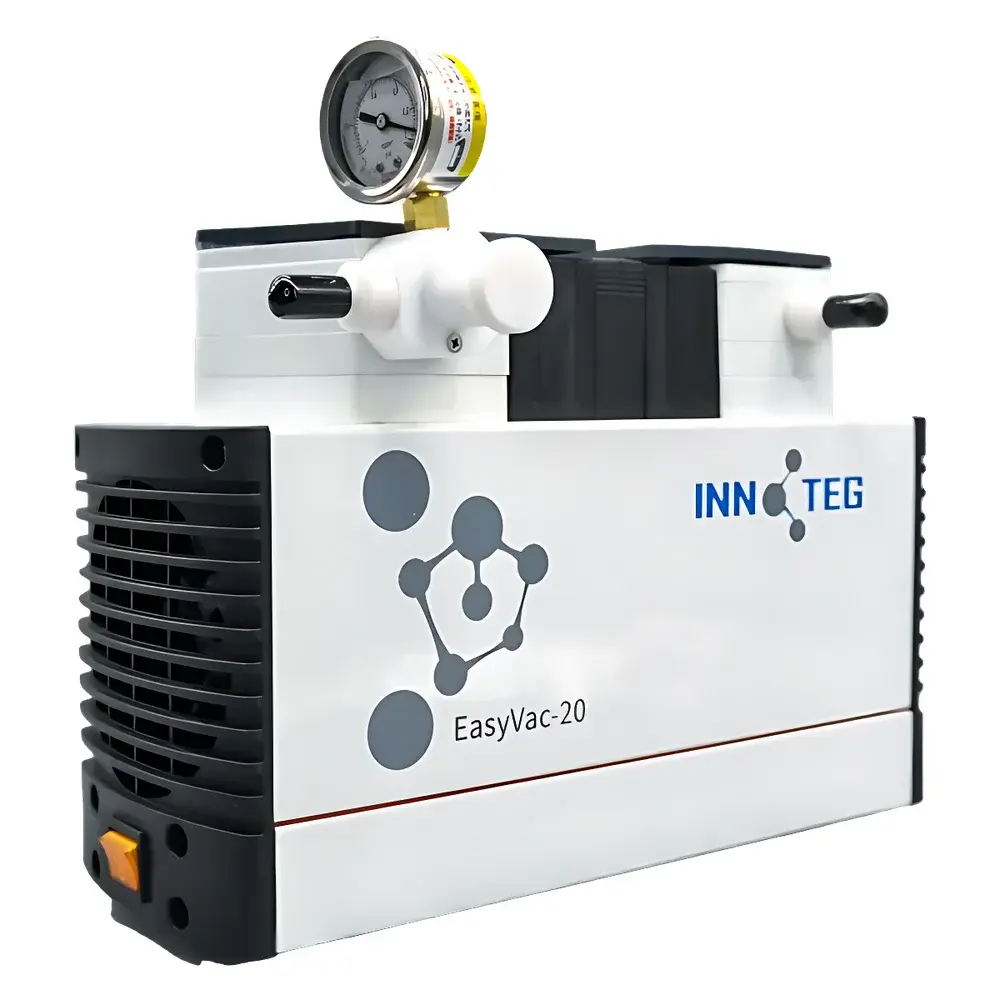
INNOTEG EasyVac Corrosion-Resistant Diaphragm Vacuum Pump
| Brand | INNOTEG |
|---|---|
| Model | EasyVac-20 / EasyVac-40 |
| Pump Type | Dual-Stage Diaphragm Vacuum Pump |
| Motor Power | 120 W / 240 W |
| External Dimensions | 315 × 165 × 210 mm / 330 × 170 × 210 mm |
| Weight | 9.4 kg / 10.4 kg |
| Gas Contact Materials | Fully PTFE-Lined (including diaphragm, pump head, valves, and tubing) |
| Noise Level | <70 dB(A) |
| Thermal Protection | Integrated bimetallic temperature switch with auto-reset function |
| Compliance | Designed for GLP-compliant laboratories |
Overview
The INNOTEG EasyVac Corrosion-Resistant Diaphragm Vacuum Pump is an engineered solution for laboratories requiring reliable, contamination-free vacuum generation in chemically aggressive environments. Operating on a dual-stage positive displacement principle, the pump utilizes elastomeric diaphragms actuated by eccentric crankshafts to alternately expand and compress gas volumes—enabling continuous evacuation without oil or water lubrication. Unlike rotary vane or water aspirator systems, the EasyVac eliminates condensate formation, solvent carryover, and cross-contamination risks. Its fully PTFE-wetted path—including diaphragm surfaces coated with sintered polytetrafluoroethylene, chemically inert valve assemblies, and fluoropolymer-sealed port fittings—ensures long-term stability when handling halogenated solvents (e.g., chloroform, DCM), acidic vapors (HCl, HF), alkaline fumes (NH₃), and oxidizing agents (HNO₃, H₂O₂). This architecture supports vacuum levels down to 2 mbar (absolute) and ultimate pressures of ≤1.5 mbar, making it suitable for applications demanding consistent suction performance across variable load conditions.
Key Features
- Chemical Resistance Engineering: All gas-path components—including diaphragm, inlet/outlet valves, pump head cavity, and internal tubing—are constructed from or lined with virgin PTFE (ASTM D4894 compliant), providing resistance to >95% of common laboratory corrosive gases and vapors.
- Dry, Oil-Free Operation: No lubricants, seals, or cooling fluids contact the process stream; eliminates risk of hydrocarbon contamination and enables full solvent recovery in rotary evaporation and vacuum concentration workflows.
- Thermal Safety Architecture: Integrated bimetallic thermal cutoff interrupts power at 95 °C ±5 °C; automatic reset occurs upon passive cooling to ≤70 °C, ensuring uninterrupted operation during extended duty cycles.
- Acoustic Optimization: Direct-coupled motor design eliminates gearboxes or belt drives; low-stroke diaphragm motion (<3.2 mm peak-to-peak displacement) and vibration-damped chassis reduce operational noise to <70 dB(A) at 1 m distance (per ISO 3744).
- Modular Service Design: Front-accessible diaphragm cartridge allows field replacement in <15 minutes without specialized tools; PTFE valve sets are pre-assembled and calibrated for rapid swap-out.
Sample Compatibility & Compliance
The EasyVac series is validated for use with volatile organic compounds (VOCs), inorganic acid/alkali vapors, and reactive halogen species commonly encountered in analytical sample preparation. It meets mechanical safety requirements per IEC 61000-6-2 (EMC immunity) and IEC 61000-6-4 (EMC emissions). While not certified for explosive atmospheres (ATEX/IECEx), its non-sparking motor and static-dissipative housing (surface resistivity <10⁹ Ω/sq) support safe operation in Class I, Division 2 environments per NEC Article 500. The pump is routinely deployed in facilities adhering to USP Analytical Instrument Qualification protocols and supports audit-ready documentation for FDA 21 CFR Part 11–governed data integrity frameworks when paired with compliant vacuum controllers.
Software & Data Management
The EasyVac operates as a standalone hardware platform without embedded firmware or digital interfaces. However, its analog-compatible pressure output (0–10 V DC proportional to vacuum level) enables integration with third-party LabVIEW, MATLAB, or SCADA systems via standard DAQ modules. Optional external vacuum controllers (e.g., Vacuubrand RC 6) provide programmable setpoint regulation, real-time pressure logging, and event-triggered shutdown—all traceable through electronic audit trails meeting ALCOA+ principles. Raw operational logs (runtime hours, thermal events, start-stop cycles) are stored locally on replaceable SD cards for GLP-compliant record retention.
Applications
- Vacuum-assisted filtration of aggressive reagents in solid-phase extraction (SPE) cartridges
- Pressure-controlled distillation of acid-sensitive compounds under reduced boiling points
- Rotary evaporation of fluorinated solvents (e.g., Freon substitutes) without PTFE degradation
- Lyophilization pre-freeze stage vacuum conditioning for pharmaceutical APIs
- In-line vacuum drying of catalysts exposed to sulfur-containing feedstocks
- Gas scavenging in Schlenk line manifolds handling moisture-sensitive organometallics
FAQ
What vacuum level can the EasyVac-40 achieve with corrosive gases?
Under continuous operation with HCl-saturated air at 25 °C, the EasyVac-40 maintains ≤2.1 mbar absolute pressure, verified per ISO 21809-2 Annex B gravimetric leak testing.
Is PTFE compatibility validated against ASTM F2217 for elastomer swelling?
Yes—diaphragm material lot certificates include ASTM F2217 immersion data showing <3.2% volume swell after 72 h exposure to 37% hydrochloric acid at 40 °C.
Can the pump be used in GMP manufacturing cleanrooms?
While not ISO 14644-1 Class-certified, its particle emission profile (<10 particles ≥0.5 µm/m³ at idle) meets ISO 14644-1 Class 8 baseline requirements for supporting equipment in ancillary lab zones.
Does the thermal protection system comply with IEC 60335-1 Clause 11?
Yes—the bimetallic switch is UL-recognized (E492147) and tested to withstand 10,000 thermal cycles without drift beyond ±3 °C tolerance.
What maintenance intervals are recommended for GLP audits?
Diaphragm replacement every 6,000 operating hours or biannually (whichever occurs first); valve assembly inspection quarterly; full calibration verification annually using NIST-traceable Pirani gauge reference standards.



