
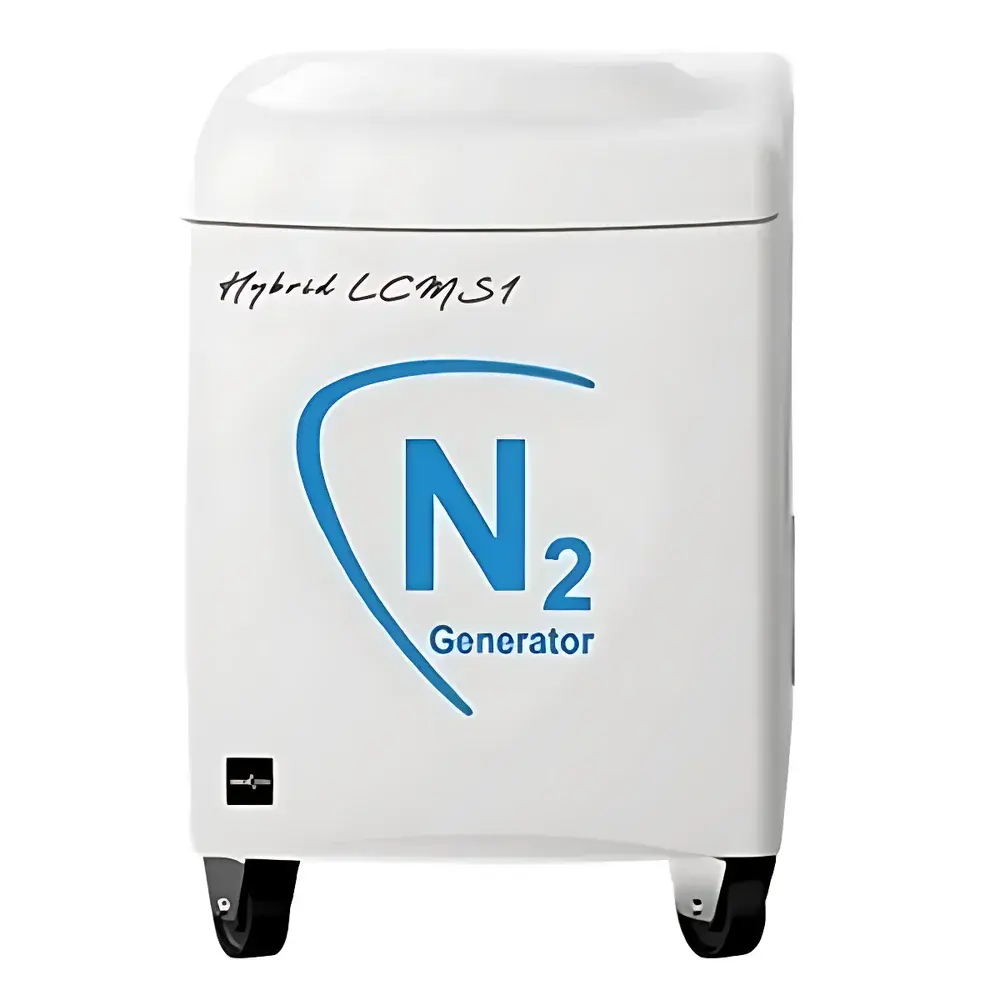
INNOTEG Hybrid LCMS1 Nitrogen Generator
| Brand | INNOTEG |
|---|---|
| Origin | Italy |
| Model | Hybrid LCMS1 |
| Nitrogen Generation Principle | Pressure Swing Adsorption (PSA) |
| Output Flow Rate | 12 L/min |
| Output Pressure | 5 bar |
| Nitrogen Purity | >98% |
| Dew Point | −40 °C |
| Certifications | CE, FCC, MET (UL/CSA) |
| Compressor Type | Integrated Oil-Free Air Compressor |
| Operating Duty Cycle | Continuous 24/7 Operation |
| Mobility | Casters for Easy Relocation |
| Safety Features | Multi-Stage Pressure Monitoring, Real-Time System Diagnostics |
Overview
The INNOTEG Hybrid LCMS1 Nitrogen Generator is an engineered solution designed specifically to support high-demand liquid chromatography–mass spectrometry (LC-MS) platforms—including AB Sciex instrumentation—by delivering a continuous, on-site supply of laboratory-grade nitrogen gas. It operates on the well-established principle of Pressure Swing Adsorption (PSA), utilizing carbon molecular sieve (CMS) beds to selectively separate nitrogen from compressed ambient air. During adsorption under elevated pressure, oxygen, moisture, CO₂, and trace hydrocarbons are retained by the CMS, while nitrogen passes through with high selectivity. The CMS beds undergo automatic cyclic regeneration during depressurization, ensuring long-term stability and eliminating the need for consumable replacement or manual intervention. This architecture enables consistent output at 12 L/min and 5 bar, with purity exceeding 98% (v/v) and a certified dew point of −40 °C—meeting stringent requirements for electrospray ionization (ESI) and atmospheric pressure chemical ionization (APCI) sources where moisture and volatile organic contaminants can compromise signal stability and detector longevity.
Key Features
- Integrated oil-free scroll air compressor ensures zero hydrocarbon contamination and silent operation (<62 dB(A) at 1 m)
- Real-time monitoring via high-resolution LCD display showing instantaneous flow rate, outlet pressure, dew point, CMS bed status, and system fault codes
- Multi-stage pressure safety architecture including inlet pressure sensors, inter-stage regulators, and over-pressure relief valves compliant with EN ISO 13850
- No liquid phase accumulation; fully dry gas path eliminates risk of condensate ingress into sensitive LC-MS interfaces
- Phthalate-free construction throughout all wetted components—validated per USP and EU Directive 2002/72/EC for compatibility with regulated bioanalytical workflows
- Designed for unattended 24/7 operation with thermal overload protection, CMS bed temperature monitoring, and predictive maintenance alerts
- CE, FCC, and MET (UL 61010-1 / CSA C22.2 No. 61010-1) certified for global deployment in Class I, Division 2 hazardous locations where applicable
Sample Compatibility & Compliance
The Hybrid LCMS1 is validated for use with all major LC-MS configurations requiring auxiliary nitrogen for nebulization, desolvation, and collision-induced dissociation (CID). Its output meets ASTM D8272-22 specifications for instrument-grade nitrogen used in analytical applications. The absence of phthalates and residual lubricants aligns with ICH Q5C guidelines for biopharmaceutical process gases and supports GLP/GMP-compliant laboratories subject to FDA 21 CFR Part 11 audit requirements. All internal materials—including stainless-steel 316L manifolds, fluoropolymer-sealed solenoid valves, and CMS cartridges—are documented in full material declarations (MDRs) and comply with RoHS 2011/65/EU and REACH SVHC screening thresholds.
Software & Data Management
While the Hybrid LCMS1 operates as a standalone hardware unit without proprietary software dependencies, it provides analog 0–10 V and digital RS-485 Modbus RTU outputs for integration into centralized laboratory infrastructure management systems (LIMS) or building automation platforms. Event logs—including runtime hours, CMS cycle count, pressure excursions, and alarm history—are stored onboard for ≥30 days and exportable via USB-C interface in CSV format. Audit trails conform to ALCOA+ principles and support electronic record retention per 21 CFR Part 11 when interfaced with validated data acquisition software.
Applications
- LC-MS-based quantitative bioanalysis in clinical pharmacokinetic studies
- Residual solvent testing and impurity profiling in small-molecule pharmaceutical development
- Environmental analysis of persistent organic pollutants (POPs) using triple-quadrupole MS/MS
- Proteomics and metabolomics workflows requiring high ion transmission efficiency
- Quality control laboratories performing compendial methods per USP , EP 2.2.46, and JP 2.07
FAQ
Is the Hybrid LCMS1 compatible with non-AB Sciex LC-MS systems?
Yes—it delivers standardized nitrogen specifications suitable for Thermo Fisher, Waters, Agilent, and Shimadzu LC-MS platforms requiring ≤12 L/min at ≥4 bar and ≤−40 °C dew point.
What maintenance intervals are recommended?
CMS cartridge replacement is specified at 20,000 operating hours or every 36 months, whichever occurs first; air filter elements require quarterly inspection and semiannual replacement under typical lab conditions.
Does the unit require external cooling or ventilation?
No active cooling is needed; however, minimum clearance of 15 cm on all sides and ambient temperature control between 15–30 °C are required to maintain dew point stability and compressor efficiency.
Can output pressure be adjusted externally?
Yes—the integrated pressure regulator is field-configurable from 3 to 6 bar via front-panel menu navigation, with lockable setpoint memory to prevent accidental changes.
How is system integrity verified during qualification?
Factory-installed calibration certificates include traceable verification of flow accuracy (±1.5% FS), pressure transducer linearity (±0.5% FS), and dew point sensor performance (±2 °C) per ISO/IEC 17025-accredited procedures.



